The clouds are clearing over Island Bay - again

A new year and familiar patterns - another southerly front is clearing beyond Taputeranga and out to sea beyond Baring Head.  Summer so far has delivered a lot of unsettled weather and vivid contrasts - warm northerlies, cold southerlies, bright sunny days and bleak grey ones.

Never boring, but some consistent warmth would be a treat!

Summer mist over Island Bay

We are getting plenty of summer rain due to repeated collisions of warm moist air from the north with the cool southerlies.  Swirling mists also form, around the hills and along the coast.  In the late afternoon there was a pattern of pale blues - clouds softening the sky and mist shrouding the view across Island Bay beyond Taputeranga to Baring Head, giving an air of mystery - what lies beyond?  is the route safe?  (Whenever I see mist swirling around the jagged rocks of Taputeranga I think of how this island was a refuge for people of Ngati Ira, sheltering there from danger that did in the end overtake them.)

All of this seems to me an apt reminder.  The year is almost over.  What we all do is important for the future of this good earth and the life it supports.  Our view of the future is misty, but we can have some awareness about our impact right now.  Are we prepared to focus on this, to take notice and really see?  How conscious are we of the route we are taking?  Are we clear about the choices we are making? 

We can hope for safety, that we can find a way to care properly for our precious planet.  But there are hazards - we can become befuddled and not see what is around us, in the way that the mist obscures the sharpness of the rocks.  For me the mist is a dramatic reminder to have clarity of intention - caring for life and the earth that supports it - and to have this intention act as a compass to guide me.

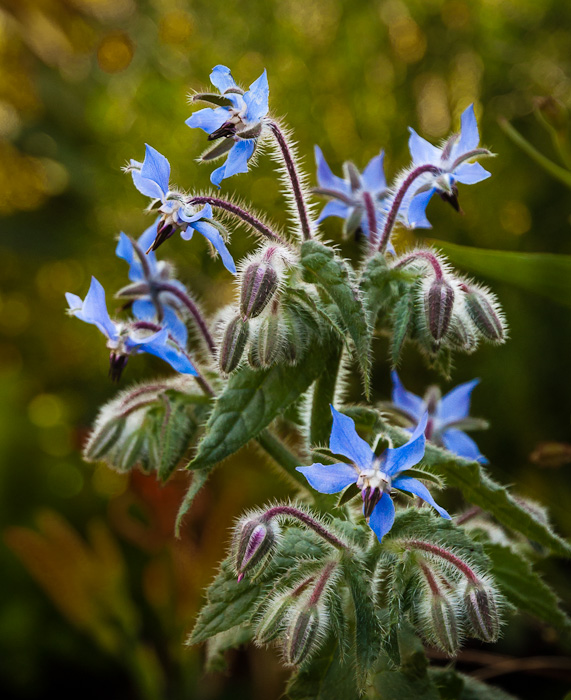
Bristly but calming - blue borage

It is oddly stressful at the end of the year with preparations for Christmas and other festivals plus summer holidays for students and a lot of workers.  It all suggests that we will be having a great time.  And many people are.  But there are lots of pressures too and it can be hard to just quietly enjoy the season.  Time for some calming I think, and the blue flowers of borage do it well for me.

Borage (Borago officinalis) flowers have a delicacy that contrasts with the bristly appearance of the plant - the white hairs are very prominent on the stems and buds.  The leaves are edible and taste quite like cucumber but they are a bit too hairy and textured for me to use in that way.  The flowers are also edible, and quite charming in a salad or floating in a drink.  My childhood recall is that they turned from blue to a bit pink in lemonade, like litmus, but that could just be a fanciful reconstruction.  I think I might make some lemonade and see what happens.

Christmas crimson - bougainvillea this time

I just made a brief visit to Auckland where the warmer, more humid, and less windy climate fosters lush and vibrant plant growth.  Ah, the trees!  And more Christmas crimson (or carmine perhaps?)...

Bougainvillea in flower - this close-up shows the tiny true flowers in clusters of three, surrounded by brilliantly coloured bracts.  A splash of colour for our summer Christmas.

Crimson pohutukawa - unfurling for Christmas

The pohutukawa seem to have sprung into action very suddenly - there are beautiful displays of the bright red flowers everywhere.  Although they were actually only native to the north of the North Island, they have thrived here in Wellington and have been planted extensively in the city.  Close-up the flowers are quite intriguing.  Clusters of hairy (tomentose) buds are grouped together, the white of the dense hairs contrasting with the green sepals and red petals at the tips of the buds.

The petals are modest compared to the crimson thickets that emerge - a central stigma and then the wonderful wiry red stamens in great profusion around it.  When fully open the stamens make an orderly array.  But these are crumpled and still in a bit of a tangle - as if they are just waking up and beginning to stretch in the light.

Feeling itchy and scratchy

Privet!  I am not ill disposed to many plants but this is one I would like never to see.  The name privet covers a number of different Ligustrum species.  They tend to be a pest wherever they are introduced because they are so very successful.  They produce squillions of little flowers that result in similar numbers of little purple fruit.  Birds at least appreciate them but then go on to scatter the seeds in their droppings, and the resulting privet seedlings then out-compete the native plants and anything else, and take over.  Privet is also poisonous to browsing animals, particularly horses.  And the sweet cloying scent of the little flowers is thought to be the cause of the nasty allergic reactions experienced by lots of people - myself included.

At least the bumblebees enjoy the flowers.  This one zoomed in as I took the photo, wings beating (and blurred) it paused for a quick feed then busily flew to another spray.  Here the flowers are just opening so they are not at their most allergy-causing - I quickly shot some photos and made my escape, sneezes on their way.

Like gorse, another pest, privet was introduced to New Zealand as a hedging plant.  The qualities that make them good hedges - robust, easy to grow, tolerant of a wide range of conditions and so on, are the very reason they were risky introductions - useful plants which turned into thugs.

There are a number of native plants in the genus Aciphylla that can be planted to defend territory because of a different thuggish defining characteristic - they draw blood.  No kidding - some have spikes that can puncture tramping boots. 

Don't mess with me say the formidable spines - here on top of a flowering spike, protecting the forming seeds, but the whole plant is defended by spines and sharpness. 

Maybe the spines evolved to stop moa from eating the plants - there weren't any other browsing animals around before humans arrived.   Apparently the roots and shoots of some Aciphylla are edible, but generally it is wise to give them a wide berth - falling into an Aciphylla is not recommended.

Yellow pohutukawa - a variant of the crimson "Christmas tree"

One of the recurring images used to represent summer or Christmas in New Zealand is that of the crimson pohutukawa in flower.  (The flowering season spans November to January, but most are in bloom in mid to late December.)  The yellow pohutukawa (Metrosideros excelsa 'Aurea') is seen much less often.  It was found in 1940 on Motiti Island in the Bay of Plenty, and was brought into nursery production seven years later.

This one, by Shorland Park near the beach at Island Bay, is flowering beautifully.  The flowers are spiky clusters of yellow stamens, and they are very attractive to birds and bees - tonight it was bumble bees and sparrows having a feast, and often it is tui enjoying them.      

It is much more subtle than the rich red forms with their range of hues from crimson to scarlet to almost vermilion.  I think of the yellow one as like a starter, stimulating our taste buds for the rich main course that is coming soon.

A walk on the shore - lots to see and lots to learn

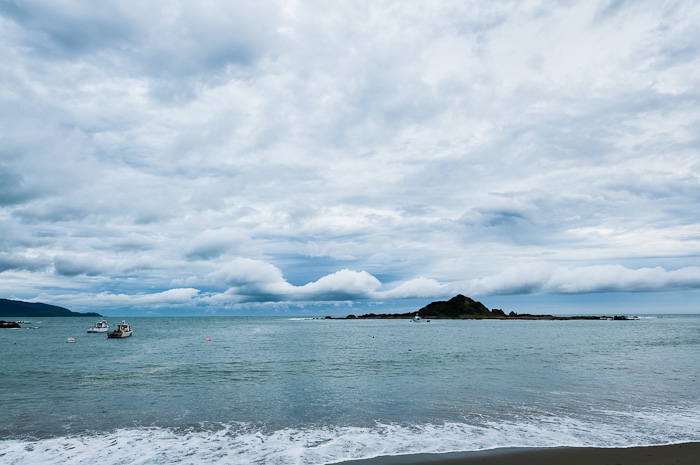
A few evenings ago I was on my way home, but stopped to admire an interesting cloud formation over Island Bay.  Looking from the beach a line of lumpy clouds echo the lumpy shape of Taputeranga.

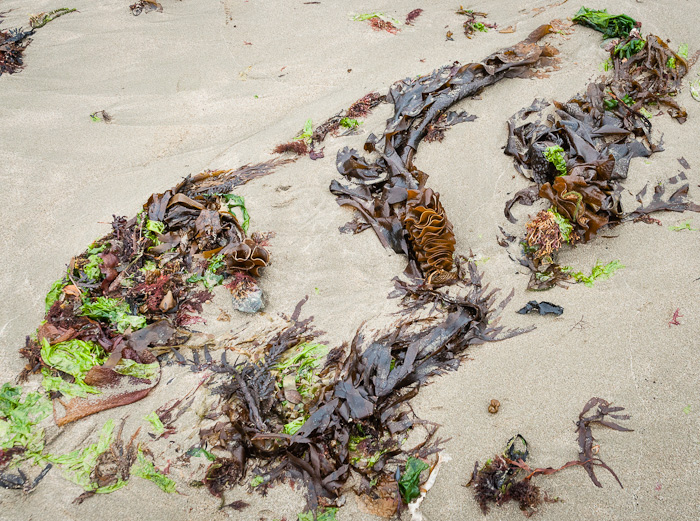
There were many seaweeds - red, green and brown, washed up on the beach and decorating the sand.  I thought the shape of this group looked like the outline of a large fish. 

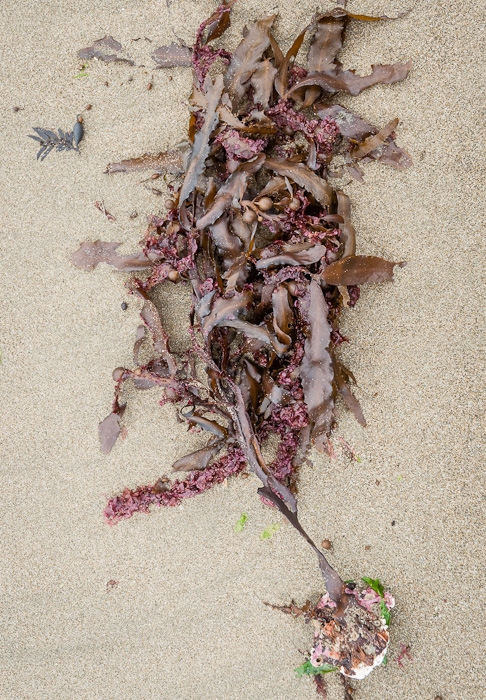
Although they had mostly dried up and had been partly covered by sand, I enjoyed taking a closer look.  This seaweed looks brown but I know enough to know that doesn't necessarily mean it is a brown alga.  It had a red coloured fringing on some of the blades.  So I wondered - are they part of the seaweed or another one which has jumped on for the ride?

The force of the waves that dump the seaweeds on the beach is reflected in the number of holdfast anchoring structures that were evident.  This one had a multicoloured decoration of other seaweeds - very pretty.

There were more curiosities to come.

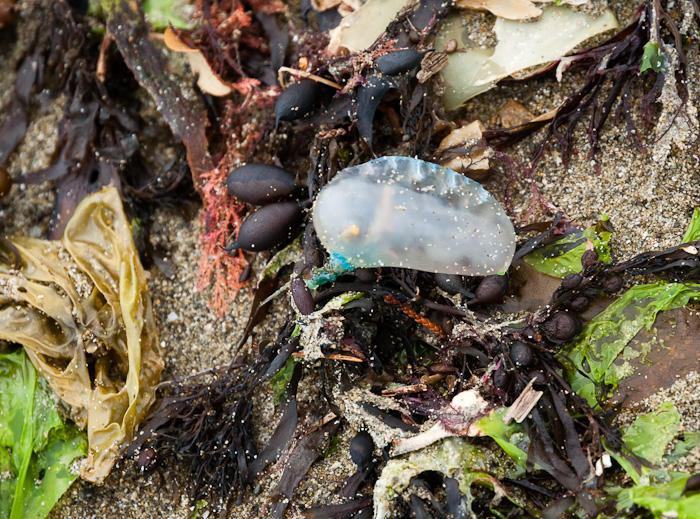
A little bladder-like structure amidst the seaweed debris.  One of many. 

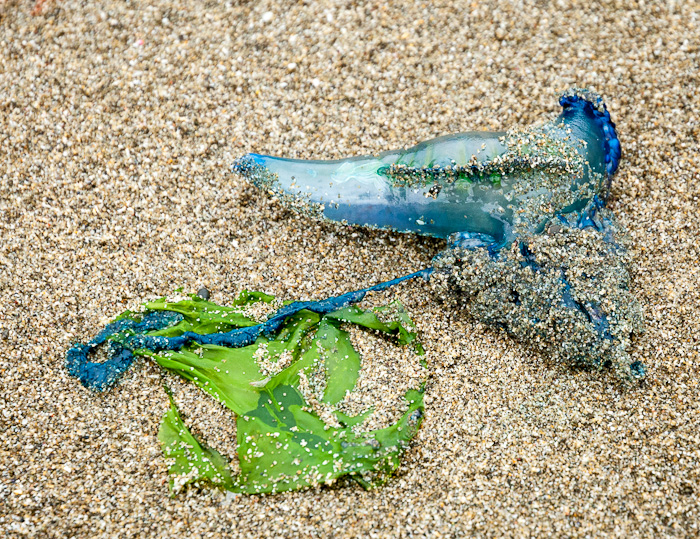
Here it is more obvious - the remains of a bluebottle (a jellyfish, the long blue thing a stinger) and a sea lettuce (a green alga).  I think.

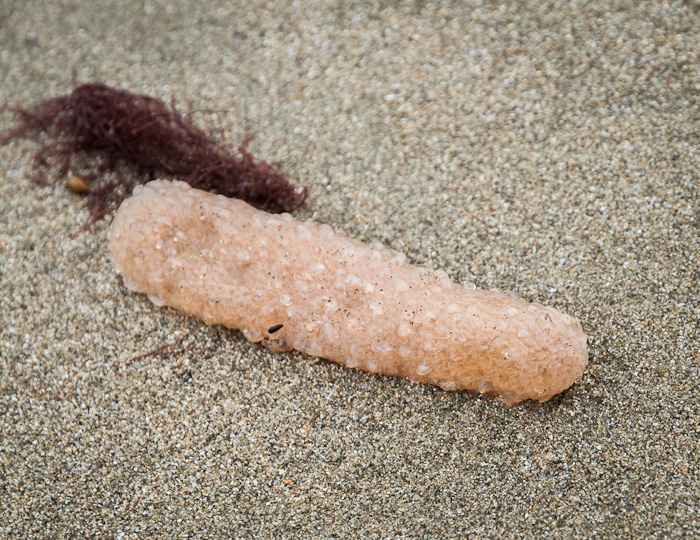
And what on earth?  The only thing I can think of is a sea cucumber, but this doesn't look like the few pictures I have seen of the local one. 

There's always lots to learn!

From the pyramids to Island Bay - Rosa sancta

We are surrounded by fascinating stories if only we knew or could hear them.  Imbued in the landscape are memories of events, often dramatic, from the past.  But plants carry stories and history too.  I grow a rose called Rosa sancta or Rosa richardii.  The flowers are single, blush pink, with a thick cluster of long golden stamens - very pretty but still quite subdued compared to the bigger brighter roses nearby.

But to me this rose is very special because it links us back to pyramids in Egypt, specifically to Hawara.  There in the late 1800's an English Egyptologist named William Flinders Petrie made exciting finds including the Fayum mummy portraits and many papyri - one, a great papyrus roll, contained parts of books 1 and 2 of the Iliad (the "Hawara Homer").  What you learn when you start reading about roses! 

But his rose-related find that links us with the Roman era in Egypt?  In tombs dating about 170 AD, he found floral funerary wreaths well preserved in the dry conditions.  And some of these wreaths included roses identified as Rosa sancta. 

Rosa sancta was introduced to cultivation in Europe around 1895, sourced from the collections of an Italian botanist in Abyssinia/Ethiopia where it was grown beside churches and monasteries.  It is robust but not a thug, and is happy as a low growing prostrate rose.  It is once-flowering and unfortunately the flowering this year has coincided with some brutal weather.  So the petals have been blown and battered, and are short-lived.  But the stamens make a lovely golden display, as befits a little treasure.

Morning balm

Early morning calm - muted light and soft colours before sunrise, over the still waters of Island Bay.

The sun is about to rise, and is colouring the wispy high clouds and low clouds over the horizon.  A lone fishing boat is moored by the island Taputeranga, both in dark silhouette.  The silvery patterns on the water reflect the subtle movement of the apparently calm water.  Before everything warms up and gets going there is quiet and stillness - balm to the soul.