In the pink

Just after sunset, soft pink light bathes Lyall Bay.  This is a city beach - not a particularly picturesque place,  but nevertheless a source of pleasure for us city folk, providing an opportunity for us to play and to connect with nature - sand, sea, peace, and the size and scope of it all.

Children play on a very large sandcastle, six surfers catch a wave - in the pink vastness of the sea and sky.

Bug Feature

The bright green heart-shaped leaves of the kawakawa (Macropiper excelsum.)

This is a NZ native shrub or small tree that flourishes in the shade despite the usually occurring lacy holes made by a looper caterpillar (Cleora scriptaria) which munches away at night, out of sight.

A bug feature in software is an unintended feature that may or may not be a problem. 

Strictly, the kawakawa looper moth is not a bug, but who cares - to me this is one of nature's bug features!  It doesn't cause the plant to suffer, and it is definitely a feature.  I think it is attractive - maybe not so appealing to the tidy-minded, but the richness of the natural world doesn't seem to do tidy very often. 

The bright winter light played on the leaves, and where they were backlit, shadows of lacy leaves were cast on other leaves, creating patterns on patterns.

Gorgeous!

Rain, rain, go away

It has rained - a lot.  The wiry coppery red stems of Muehlenbeckia astonii gather the drops like little jewels.

With a limited depth of field, the appearance of the out of focus elements ("bokeh") of the image creates a soft misty ethereal appearance - rather more beautiful than what it feels like.... but the rain does ease in the end...

... and the skies start clearing over Baring Head in dramatic contrast to the rain clouds.

Lyall Bay update

A chalk sign on the wall, and little plants dotted on the damaged dunes - people have been at work.

Written on the wall - "find us on (f)acebook - Lyall Bay Coast Care" ....

"Dune Planting - Please Keep Off The Plants." 

A number of community groups work to protect the coastal environment, taking action such as clearing rubbish and caring for wanted plants.  Lyall Bay Coast Care got into action with replanting really quickly - the pole for the rope barrier is still fallen, but there are little flax and rush plants dotted on the recently bared sand.  Maybe they will hold the sand more firmly than the lovely golden pingao, which looks somewhat battered, with roots exposed. 

Midwinter glow

A sunny midwinter's day, with errands to do in the city, I took my camera just in case I had time... 

And I did!  I enjoy the way that NZ native plants are used for amenity planting, such as on large inner city traffic islands like this one.  I've been admiring it for a while. 

The plants are presumably chosen for their ability to cope with the adverse conditions and because they don't need a lot of fussing and attention once established. 

NZ native plants don't tend to have colourful flowers, and they are mostly evergreen.  So there aren't the dramatic spring or autumn displays that are associated with a lot of introduced plants.  But there is a great range of textures and forms so that plantings of NZ natives can be dramatic, quirky, and even quite colourful.

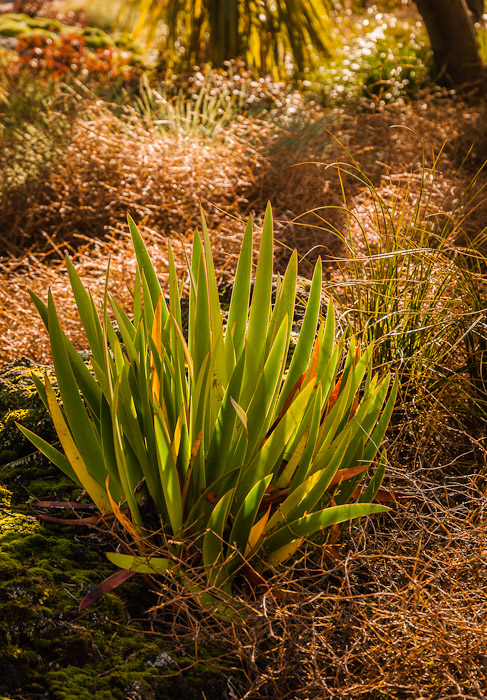
I especially like the glow and intensification of colour that occurs when the plants are backlit.  The daylight was bright and harsh, but under the partial shade of a cordyline and a kowhai which you can't see, the plants show their rich greens, reds, orange and brown.  If and when the Xeronema gets around to flowering - this is still a small plant, and they can be shy about flowering even when conditions seem perfect - it will add a glorious spike of red. 

 Xeronema callistemon (Poor Knights lily) beside a mossy stone, surrounded by twisted wiry stems of Coprosma acerosa - possibly the form called Red Rocks, and grassy Carex testacea.

Golden

A warming sight.  Looking across Island Bay and behind Taputeranga, the golden evening glow of sunset lights up the cloudy sky and the lower hills of the Orongorongos - the southern end of the Rimutaka Range. 

The hills face towards the setting sun.  The colour on the hills intensifies as the sun goes down but the island Taputeranga, in the shade of a headland, misses out on the gilding.  

Yes, it is alive

Animal, vegetable or mineral?  

Actually it is a plant - Muehlenbeckia astonii - apparently also known as shrubby tororaro, though I haven't ever heard it called that.  It is unusual for a New Zealand native plant in being deciduous.   It's another tough coastal plant, and is a great little windbreak in my garden.  

In winter it looks like a tangle of coppery reddish wires, with the widely spaced branchlets firing off in all directions together making a curious mound that doesn't look much like a living thing.

However, in spring and summer it does have tiny bright green leaves and little white flowers and fruits.   It doesn't look much less odd, but it does look alive.  There is a fantastical quality to quite a few of our native plants, a happy reminder of the great diversity in the forms and adaptations of living things.

Study in blue

Dense storm clouds over Island Bay create deep blue shadows, the island Taputeranga in the foreground, the light breaking through over the lighthouse on distant Baring Head.

Dune damage at Lyall Bay

Lyall Bay is a long sandy beach hemmed in by human constructions - at one end the airport, along its length a concrete wall which contains the sand dunes and separates them from the footpath and busy road, and at the far end some houses built almost on the rocky shore.  Of course, the concrete wall doesn't contain the sand, which is blown in flurries up the roads when the southerly wind is in force. 

Attempts to anchor and protect the dunes have been made - they are roped off and little signs tell us to use designated walkways to get on to the beach, in an attempt to protect the dunes and the grasses - especially the pingao, a golden-coloured native sand sedge which has been fostered along the coast in more recent years. These roped-in areas are usually well clear of high tide, but the southerly swell has been washing right up to the dunes, no respecter of the barrier.

When I took this photograph the wind was still strong - you get some idea of it from the flattening of the grasses and the way they point away from the prevailing wind.  It was already evident that the contours of the beach were changing - as they often do with the dynamic weather the beach is exposed to - with a hollowing out near the usual water line and a heaping of sand up around the posts and ropes.

But after the winds lessened and the sea subsided somewhat, the damage was much more evident:

"Save our dunes" indeed - sand and seaweed washed up around the post, scouring and erosion within the protected area.

The long roots of the pingao, which help to secure the dunes, now exposed and vulnerable.

The harsh bright sunlight reveals the extent of the erosion, not only care of the storm but also because intrepid people out walking on the beach, despite the storm, dodged the waves by clambering over the already battered dunes.  We, too, are forces of nature! 

Backlit Taupata leaves

Backlighting by the winter sun (just as it sounds, illumination of something from behind) outlines the rich greens and the veining of Taupata leaves.  Taupata (Coprosma repens) is a tough New Zealand native shrub/small tree found in coastal areas.  Its leaves are so glossy that it is also called the mirror plant.   

While the backlighting doesn't show the glistening leaf surface, it does show the liveliness of a plant that seems happy in really difficult situations - a bit of a tonic on a grey winter's day.