Karo - crass?

Botanical names convey a lot of information to those in the know - but even if we aren't taxonomists we can still get an idea of what they are referring to.  Karo, one of our tough native coastal plants pictured on the edge of Houghton Bay (see previous post) has the name Pittosporum crassifolium.  Pittosporum (the genus name) is the group it belongs to of plants with similar characteristics, and refers to their sticky seeds.  These shrubs and trees are thought to have originated from the ancient continent of Gondwana.  Wow.  I enjoy these reminders of connections, life's patterns and changes. 

And down by the coast at Island Bay there are some karo braving the conditions, and sure enough, the seeds from last year's flowering are pretty sticky:

A tangle of old seed pods of Pittosporum crassifolium, or karo.  To me they have a certain beauty - the leathery texture of the rusty coloured pods contrasts with the sticky shiny black seeds.  The tangle of twisted stems reflects the way the flowers grow in dangling umbels.  

This close-up of the end of a branch shows the new year's growth developing alongside the seedpods from last year - the new buds are tomentose (hairy) as are the stems and the undersides of the leaves.  These buds will develop and flower in spring.

The leaves are tough and weather resistant - thick and leathery with a dense coat of pale hairs protecting the undersides - altogether making them weather resistant, able to withstand wind damage and drying.  But they don't always look that pretty - the yellowing and dimpling of some of the leaves is damage caused by a wee pest, the Pittosporum psyllid. 

So back to the naming - Pittosporum covers the sticky seeds, but what about crassifolium?

Folium is the Latin for leaf - no surprise that leaves are featured in naming a plant that can hold on to them despite all kinds of weather - but crass??

Definitions of crass include insensitive, dull, boring, ill-mannered...but this time it means thick or tough.  And the leaves really are.  Some people might think this plant is also ill-mannered - the sticky seeds stick to the feathers and feet of birds and spread the plant around - it can be a weed in some places, and as a survivor it can displace other plants in an insensitive manner.  It might be seen as dull, because from a distance it can seem a dull green and you don't see the seeds, flowers or new growth very clearly...but look close, and there is much to admire. 

The three stages:   in bud, flower, and fruit.   

And a close-up of those pretty flowers and baby leaves:                  

While the close-ups are of dense-growing relatively sheltered plants in low light, karo plants can also look quite sparse and delicate - here's one right by the water's edge on Island Bay beach:

Windscaping

A rainy grey day - very misty and not very inspiring - but the light is bright.  Even though this means that there are no strong shadows, I hope that my pictures convey the quite striking wind-sculpturing of the shrubs along the south coast.  Houghton Bay is a small enclosed bay subject to strong southerly winds which funnel in and batter the plants which fringe it.  This view is looking south, and the hedge-like formation of the shrubs at the edge of the road almost obscures the cars driving along. The shrubs, pittosporums and brighter green Coprosma repens, are moulded and shaped in ridges by the southerly wind.  Looking in the other direction, the sculptured ridges are even more evident:

It is interesting to contrast these weather-made hedges with some human-made ones which are a very determined wind shelter strategy - staggered blocks of shrubs clipped in straight lines disrupt the blast of the wind and create a sheltered space for a garden and chicken coop, and a cyclindrical hedge encloses what I think is a studio. 

These hedges, human and wind-made, are tough and functional. 

To my eye they are also living sculptures - less decorative than topiary and not needing artistic validation through deeper meaning, but being a dramatic illustration of the impact of the energy that is manifest in the wind and the weather.


A tiny treasure

Manuka or tea tree, Leptospermum scoparium, is a New Zealand plant which has pretty and conspicuous flowers  - most of our plants have rather subtle and inconspicuous flowers.  I have seen hillsides of white-flowered manuka plants flowering so profusely it looked like snow had fallen, and this was in the subtropical north where snow is never seen!  Manuka honey is another happy result - it tastes great and has considerable medicinal value, helping healing of skin and gastric ulcers.  Pretty and practical - could it get better?  Well, yes - gardeners are always looking for "improved" plants, and many Leptospermum cultivars have been developed with differences in flower and plant forms which satisfy this plant-acquisition itch.  Alas, some cultivars are not readily available.  As I understand it, Warwick Harris crossed a small prostrate form of the Tasmanian subalpine species Leptospermum rupestre with 'Huia' a dwarf cultivar of the NZ species L. scoparium.  One result was this dwarf prostrate form Leptospermum 'Lilliput', but it was not taken up for commercial release.

Leptospermum 'Lilliput' - a tiny treasure, perfect for a rockery or pot culture.  My plant is barely 10cm tall, generous in production of pretty pink flowers.  I was lucky to get it from Hokonui Alpines, another treasure - Peter Salmond's specialist nursery that helps to maintain the diversity of plants available for gardeners and plant-lovers to tend and enjoy. 

Purplish haze

Sunny still days again, and the phenomenon of misty mornings - it is still cold, but the air is warmer.  I wasn't up early with my camera yesterday but a year ago I was up at sunrise.  And this is what I saw:

The colour in the dawn sky gave the water a purple tint, while the rolling mist shrouded the contours of the lower hills of the Orongorongos.  This view is looking over the waters of Island Bay.  There is a lone fishing boat, one of the fleet that moor in the shelter of the island Taputeranga.   The times like this when the sea seems an improbable colour make sense for me of Homer's description of the "wine dark sea." 

Coastal colours

A grey cloudy day and at sunset there was almost no colour in the sky, although the sea had a slight pinkness.

Along the rocky shore between Te Raekaihau Point and Princess Bay the access area has been planted with New Zealand native coastal plants which are resilient and adapted for harsh conditions. 

In the subdued light the plants seem to glow - I love the blue-grey green of the Euphorbia glauca, a plant which is described as in "serious decline" but can be quite a thug if given half a chance - spreading by underground rhizomes.  But it is much reduced in distribution by the usual suspects - introduced animals browsing and trampling it, competition from introduced weeds, erosion, and coastal "development" such as the widening of roads.

It contrasts well with the other plants.  Dark green shapes in the background close to the water (and self-sown) are Coprosma repens, the "mirror plant", which has glossy leaves able to cope with salt spray.  In the foreground there are two other coprosmas, a prostrate reddish one, possibly Coprosma acerosa, and a small shrubby one whose name I don't know.  The rather delicate native ice plant, Horokaka or Disphyma australe, is spreading amongst them.

Using endangered plants in gardens and amenity plantings means that their survival is assisted.  It's not pretending to mimic how things would look naturally - the plants tend to look much more plump and well-fed (nature is tougher on plants than gardeners) - and their arrangement is much more about human aesthetics than if they were sighted in their remaining habitats.  But the process of planting them means we are thinking about caring for the coast as well as the future of the plants.  I think they really reward this effort, that their colour, textures and shapes enliven the beauty of the coast.

A bit of a buzz

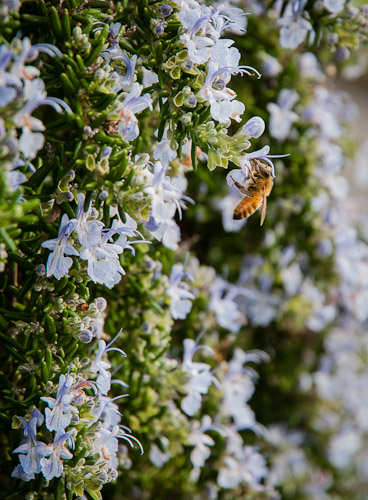
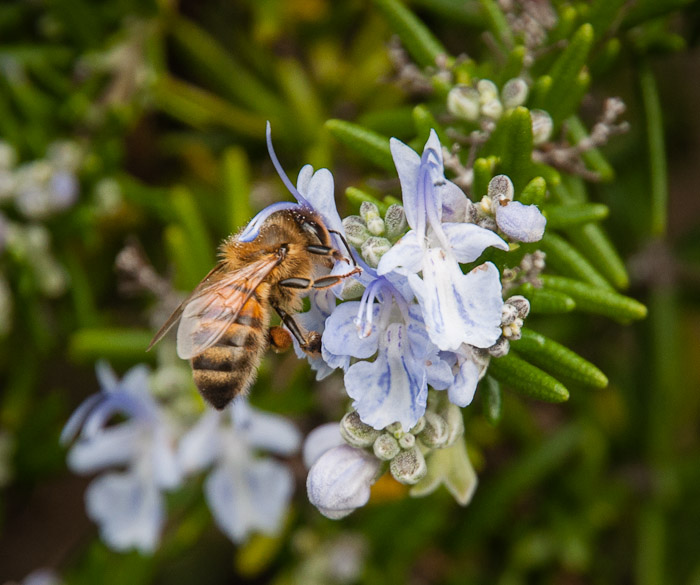
A honeybee - seen on a grey winters day foraging for nectar and pollen from the flowers of a trailing rosemary. 

I was delighted to see her, but sad that she was on her own.  Only a few years ago, this plant would be abuzz with bees - but that is not the case any longer.  These little insects are very precious indeed - even more so now because their numbers are much reduced worldwide.  Disease, parasites, loss of diversity of plants and thus their food sources, pollution, pesticides, maybe even electromagnetic disturbance - there are lots of factors that could cause their death by damaging the functioning of their bodies and their hives - they live complex lives, with great navigation abilities and social organisation, and these can be disrupted in unintended ways.  But we rely on these little hard-working creatures for so much.  It is not just about their honey which we enjoy as a food and use for its medicinal qualities, but it is also because they are so crucial to the pollination and therefore production of food to be eaten and seed to be used to grow further crops.   

When I was young, walking barefoot on the lawn included the risk of disturbing a bee and being stung.  How quickly things can change!  Instead of regarding a bee as a source of possible danger, I now see the bee as being beseiged and needing our help.  So it's a great pleasure to provide them with fodder - plant lots of flowering plants for the bees!

The visiting honeybee (Apis mellifera), perched on the pale blue flowers of trailing rosemary (Rosemarinus officinalis 'Prostratus').  Small grains of pollen are scattered on her head and thorax, her head deep in the flower and capped by overhanging stamens - illustrating the transfer of pollen from the stamens onto the bee's body.  By this means the pollen will be carried to another flower, assisting pollination.

Evening calm

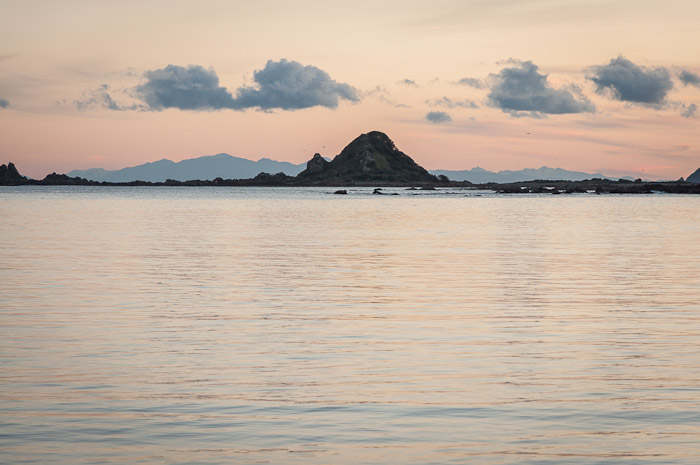
The sunset has left a salmon-pink glow in the sky.  A period of calm, following a southerly front and leading no doubt into another, has meant the day has been bright and sunny, the sky has been clear and the sea quiet.

Taputeranga, the island of Island Bay, seen from Princess Bay on Wellington's south coast.  The sea has a soft, pearly colour, with faint reflections of the island and the puffy clouds above it.  The South Island is seen in the distance, a soft silhouette.  A time for slowing down, and appreciation, a gentle end to the day.

Food for the eyes, now food for the stomach

Since my last post, the weather has improved.  No cloud cover so it's cold at night, and the days are crisp and clear, with bright sunshine making colours sing.  I finally get to the vegetable patch...

Amidst the lush green weeds (otherwise known as successful but unwanted plants) shine the brilliant colours of silverbeet Bright Lights, also known as Rainbow chard. 

The glossy green leaves contrast with the almost psychedelic intensity of the coloured ribs - intense pink, orange, red, and golden yellow.  Alas, when they are cooked the ribs just look mostly red and they lose some of their zing.

These plants survive a rather bleak site, with not much sun at all in winter, strong winds, and general neglect.  But they are planted in soil which has been built up by the use of lots of compost, made from all the weeds which we grow so well, kitchen scraps, shredded paper, and prunings of woody plants.  This is not a carefully made compost, although I try to balance the nitrogen and carbon input, so it is used to increase the amount of soil (which was minimal to start off with) and improve soil structure rather than for feeding the plants.  But these plants do pretty well, I reckon.

And the photographic models have now been eaten.

Yum. 

Edible bedding

That sounds odd, doesn't it?  I'm not talking about eating our blankets or duvets, but about using edible plants as "bedding" plants.  In this case the plants used are a herb - parsley, and a leafy vegetable - silverbeet or Swiss Chard, here the colourful form Rainbow chard.  Maybe it is because they are so easily grown, and readily available, or maybe because we saw too much of them as children (along with those dreaded words "eat your greens, they are good for you")...but it seems to be only recently that they have been used for their aesthetic qualities.  

To me the patterns made by the rich green of curly leafed parsley, at the front in this picture, are like densely textured, almost velvety, cloudscapes.  The reddish green Rainbow chard glows, especially on the overcast rainy day when I saw this bedding scheme at the entrance to the Wellington Botanical Gardens.  I am not sure of the identity of the white-flowered plant. 

Bedding plants are grown to be used en masse to provide colour or texture as part of a planting design, usually a formal pattern which is a decorative feature in a garden or park.  These were very popular with the Victorians in England, tending to be colourful and exotic displays.  Bedding schemes continue to be a feature of municipal planting, and nowadays they are often quite adventurous in the choice of plants.  

The simple blocks of colour of parsley, anonymous white flowered plant and Rainbow chard are bright and effective in the muted light of a rainy winters day, and lead the eye into the garden, towards a fountain in the distance framed by two large trees. 


If you are hungry...they are full of vitamins and goodness!


But here they are food for the eyes, and a tonic for winter blahs.

A little garden designed by nature

A wet day and a brief visit to the Wellington Botanical Gardens to recharge my batteries.  Though the sky is grey and things in the city seem a bit forlorn, amongst the trees there is freshness and colour and life.


The rain is filtered by the canopy of the trees, and the air smells damp and sweet. 


At the base of a tree there is a rich community of plants - mosses and lichens on the rocks;  and ferns, small trees - I can see a pseudopanax and a mahoe, small shrubs and grasses, all growing up from the leaf litter collected around the big tree's roots... a gentle collection of greens and rusts and goldish-brown and silver... a delightful little garden designed by nature.  They are to be found everywhere!