Dynamic weather

Living in Wellington means learning more about the weather, and caring more about it, than in any other place I have lived.  Wind is the issue.  The Roaring Forties are strong westerly winds which occur in the Southern Hemisphere, where there are few land masses to act as windbreaks to slow these winds down.  Wellington sits by the Cook Strait, which lies between the North and South Islands.  It is quite narrow - about 24 kilometres at its narrowest point, and it acts as a funnel, deflecting these very strong westerly winds.  In addition, from the south we get cold fronts that seem to come straight from Antarctica - brrrr - instant winter.  And from the north, there are moist and warmer fronts, with a hint of the tropical - actually that is fanciful, they are usually drying and unpleasant.  This weekend we had a short sharp shock from the southwest - a lovely sunny morning, but clouds were on their way...

From the rocky shore by Island Bay, looking southwest towards the South Island, a front approaches.  The rainclouds are beginning to let loose over Taputeranga, even though the sun is still lighting up the rocks, the coprosmas in the foreground, and the sandy shore of the beach in the distance.

A froth of flowers

Happy Valley Road travels inland from Owhiro Bay along a valley, as the name suggests.  Beside the road there are quite steep hillsides covered by shrubs and a few trees - a fresh green now, although at times of low light quite sombre. 

This spring I have been delighted and surprised by a NZ native shrub, one of the tree daisies, Rangiora (Brachyglottis rependa).  In flower it is revealing itself to be much more widespread than I had realised.. there seems to be a froth of the creamy white flowers everywhere I look.  The individual flowers are actually tiny - about 5mm across, and the opposite of the image of large daises that is conjured up by the description "tree daisy".  

It is the plant that can get big, not the flowers.  Rangiora can grow to be small trees, although they are generally more shrubby and spreading. 

The leaves are large and leathery with soft felted white hairs on their undersides, and they have had rather different uses.  Their antiseptic properties and strength meant they were were used as bandages by Maori, and they have also been called "bushmen's toilet paper"!  There is a purple leafed form, and the contrast of the pale stems and the dark leaves is very attractive - this form is the one most often seen in gardens.  But it is one of those plants that seems to be taken for granted, and not deliberately planted very often.

Well, it might be something to do with the milder wetter winter, but the Rangiora seem to be making more of a statement than usual.  And what a lovely one!

The profusion of tiny flowers, quite fragrant, contrasting with the large leathery leaves.

Swirling birds

Daylight saving has arrived.  A happy benefit is the fact that it is still light when I get home from work.  When I was coming along the coast I saw cloud formations of the kind that colour up at sunset.  Knowing how much I would benefit from a good dose of nature's beauty, I returned to inhale the fresh air and watch the evening light intensify.  At first it was bright and golden, glowing on the lower hills of the Orongorongos which face the direction of the sunset.  Taputeranga was lit up, then quickly fell into the shade of a headland, and around it there were crowds of seagulls swirling together - probably riding the thermals, the warm air rising from the mass of the island...

This is, I think, the evening roosting flight, before they settle in the relative safety of the island's shore.  I could get into flights of fancy too, about the social function of this swirling swooping get together, as I haven't found much information about it.  They seem to be playing and I enjoy believing that! 

A closer view:

And from the other direction, the reason the light was such a golden colour - a pretty fiery sunset, and a great energiser for my rather tired self...

Sunset over the South Island - seen in silhouette, from the rocky coast road between Island Bay and Owhiro Bay

Atmospherics

Yesterday the light northerly wind brought moisture and warmth and we had a sunny day with mists that flowed over the hills then dissipated, only to return and completely obscure the view, then finally to dissolve away later in the day to reveal blue skies and sunshine...

Today the wind was less kind - northerly gales rocking the house and making it unpleasant to be outside.  But as if to compensate, there were the everchanging cloud patterns in the sky.  Looking across Island Bay towards Baring Head past Taputeranga...

The water is stirred up, dotted with white caps, and the clouds make a dynamic display. 

And looking across to the south coast hills in the other direction...

The sun is low in the sky and lights up a rapidly changing churning spectacle of cloud forms which I cannot yet identify.  Time to study my cloud-spotters guide!

A little all black bird

The light is fading in the evening and the water at Island Bay beach is quite still.  Around the water's edge near the rocks where the old bait house perches, an oystercatcher forages in the mounds of seaweed.  Apparently oystercatchers are found all around the world, but this little all black bird is a so-called variable oystercatcher or toreapango (Haematopus unicolor), a species found only in New Zealand.  (They can be pied rather than all black - hence the "variable" in the name.)  This particular species doesn't migrate and the birds tend to stay put, in pairs, around the coast where they nest.  They are distinctive characters, bobbing around actively looking for food - digging for little shelled critters, not only oysters despite their name - and they are adept at using their strong orange beaks to open the shells up.  They can be very bold and brave in defending their space and their peep peep peep calls announce their presence or flight overhead.  They are a very engaging sight, and it is as if we know them, because they seem to be permanent occupants of certain parts of the beach. 

A familiar and engaging sight, an oystercatcher foraging near the old bait shed at Island Bay beach.

Spring surprise

At the Wellington Botanic Garden, the flowering of thousands of brightly coloured tulips is a feature of the Spring Festival.  This year they have arrived rather earlier than anticipated, courtesy of a milder and wetter winter.  I was surprised and delighted when I saw what had been hiding underneath the edible bedding plants that I described in winter...the brilliantly red tulip "Parade" has emerged and taken centre stage.  I had no idea what was in store when I was admiring the combination of silverbeet "Bright Lights", white bedding chrysanthemum and parsley.  But hiding under their cover were the tulip bulbs - like marvellous little plant-packages sheltering through the winter in the safety of the soil, waiting to spring up into leaf and flower once conditions are right.  In this image the tulips are backlit by the bright noonday sun - not usually a good time for photography - but it does convey the almost uncomfortably intense contrast of red and green.

Looking beyond this bed, there is a glimpse of more tulips...colours almost eye-wateringly bright...

A busy, busy scene around the Joy Fountain - tulips, spring blossom and new spring growth, people admiring, sitting, strolling, and gardeners gardening in the background.  It is certainly not winter now!

Mega-beautiful

A honeybee visits a Chatham Island forget-me-not (Myosotidium hortensia).  No, it is not a miniature bee - the flowers that have opened are indeed much larger than the little forget-me-not after which it is named (but to which it is not related).  One of the oddities of New Zealand plants is a tendency to have giant forms of what are much smaller plants in the northern hemisphere - we have tree-sized daisy, lily and fuchsia plants, for example.  "Megaherbs" is the term used to describe large-leaved flowering plants which are found on the subantarctic islands and although not from a subantarctic island this forget-me-not is also described as a megaherb.  It is an endangered coastal herbaceous perennial plant endemic to the Chatham Islands, which lie east of the South Island of New Zealand.  

The glossy leaves are rich green and deeply ribbed and make a very large clump.  They look so lush and beautiful it is hard to believe that they come from islands which are very exposed to harsh weather.  But the subantarctic islands, further south and even more inhospitable as their location suggests, are home to even more extraordinary flowering plants, which I have (as yet!) only seen in pictures.   Those megaherbs are pretty much impossible to grow in the kind conditions found in gardens, but the Chatham Island forget-me-not can be a lovely addition to a garden, albeit somewhat tricky to please.

Chatham Island forget-me-not, the glossy leaves and soft blue flowers with their darker blue centres.

The spider's spectacle

Silhouetted in the early evening light, a spider was perching by its web, woven between leaves of the golden sand sedge pingao (Ficinia spiralis), one of the dune grasses at Island Bay beach.  The sky was clearing after the rain, the clouds parting, and the sea a soft blue.   And looking across Island Bay towards Baring Head, there was a sight that is always magical to me - a rainbow...  

I recall as a child memorising the sequence of colours, drawing the arc of a rainbow, being intrigued by the idea of a pot of gold at the end... then later, getting a sense of the complexity of light in the way that the colours are revealed by refraction - how I loved prisms!  And later again, being fascinated by and struggling with the idea that light is a form of energy that moves in packets and waves (how can this be?).  I also love the transience of the bright colours decorating the landscape, and the surprise of seeing a rainbow, even though it is associated with such a common event - rain! 

Dwarfed by the spectacle two kayakers paddle towards the tip of Taputeranga, while (the ubiquitous) seagulls do their evening fly-past. 

The island itself is lit by the rather golden evening light, the rainbow fades, and to the south more clouds seem to be amassing.

Tenacity

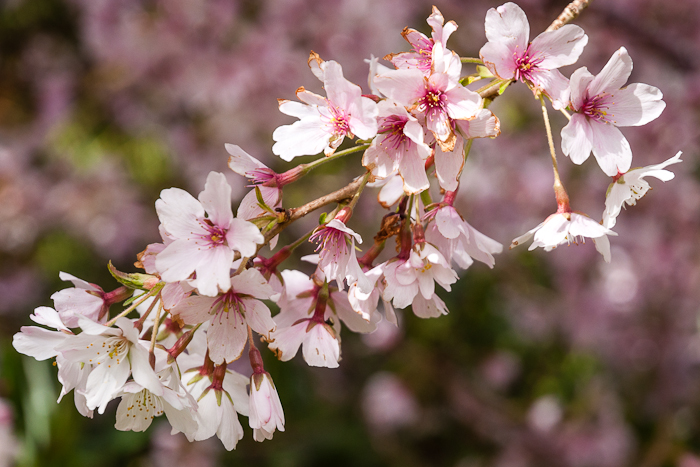
Well, so much for my pessimism.  Despite northerly and southerly gales, these cherry blossoms held on tight.  I underestimated their tenacity!  When the sun was bright and I made a brief visit to the Wellington Botanic Garden rose garden - lo and behold - there it was, the graceful form of Prunus "Awanui", not denuded by the winds as I had imagined.  Perhaps this was a more sheltered spot than I thought?

But no - en masse a pretty froth of pink but on individual blooms the impact of the wind is indicated by the bruised and ragged petals.  So - being soft pink and delicate in appearance does not mean weak or insipid.  And my assumptions again turn out to be mistaken.  Fittingly, the sculpture beside the blossom trees is titled "Dance of Life".

Wild and woolly waves

After the northerly gales subsided the southerly gales arrived from Antarctica bringing the cold - sometimes they drop a frosting of snow on the Orongorongos, but there was not much this time.  There can be glorious quite still periods in between with blue skies and sunshine, before another weather front arrives.  Here on the south coast the arrival of the front can often be clearly seen - a dramatic bank of clouds, a change of colour in the sky, a stirring up of the ocean waves.  And following the southerly winds there is a southerly swell.  I learned the description "wild and woolly" when I was young.  I think it describes very well the foaming southerly swell as it crashes onto the rocky shore by Houghton Bay beach on Wellington's south coast.