Acceptance

Wellington is known for its dynamic weather, and sure enough, the spring gales that have been battering Wellington have been "severe" - wind gusts up to 170km/hr on a hillside road near the coast north of here, and around where I live they have been up to 140km/hr - planes unable to land at the airport, loss of roofing, trampolines airborn, that sort of thing.  When I first lived in Wellington I was really upset by the way these spring winds battered the tender new spring growth.  I used to think that acceptance risked being too passive, resigned, defeated.  But the weather just is, the winds will happen no matter what I think or how I feel, and the plants manage on the whole and I do too.  Acceptance is living with rather than struggling against.  A much better energy somehow. 

A few days ago, before the winds hit hard, I had a few minutes late in the day and made a quick visit to the Botanic Garden.  The area around the rose garden is a lovely peaceful spot for quiet contemplation.  I was very surprised to see a cherry blossom out - Prunus "Awanui", a graceful and floriferous cultivar discovered in a New Zealand garden, covered in a gorgeous froth of white and pale pink.  I like to practise with my camera, and snapped away briefly as the light faded.  I expected I would be back in a few days to get pictures in a better light.  So much for expectations - so often a cause for suffering!  I imagine that the tree now has a lovely carpet of shattered blossoms under it...

The ephemeral beauty of spring - cherry blossom.  Its brief presence a delight, but not lasting long enough for a hanami (Japanese cherry blossom viewing party).

In bud, in leaf, and in between

Every year I am intrigued by three mature oak trees at the top of Willis Street in Wellington city on the fringe of the business district.  This area, Te Aro, was settled early on and has some impressive old houses.  The trees stand in front of one of these, on a busy road - a rather unprepossessing spot.

The thing that catches my eye is the distinct sequence of spring growth that occurs every year, with the tree on the left starting first.  In the photo it is in leaf, the middle tree has baby leaves with that soft golden colour of fresh new growth, and the tree on the right is in bud, with only a few signs of bud burst.  Why?  Is it because the first tree to show spring growth faces north and therefore gets the sun most?  Is it then like a chain reaction? - I have read recently about how much trees and other plants communicate and sense changes in their environment.  Whatever determines this pattern, it happens reliably.  I took this photo in less than perfect conditions because a gale was predicted.  It eventuated - another regular spring feature of Wellington - damaging gales that the plants, and we, are somehow not daunted by.

A closer view of the tangle of branches and branchlets and wires, with the leaves, leaflets and buds in their green, gold and reddish hues.

Looking up to the branches - in leaf and in between

.....and in bud

The most advanced leaves and flowers in more detail - they were the only ones I could get close to!

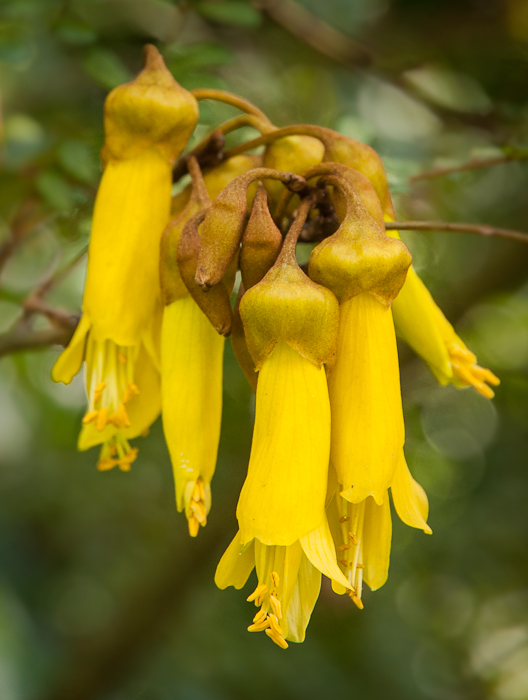
Kowhai gold

There is warmth in the sunshine and the days are getting longer and suddenly it's as if everything is bursting with energy (including the wind!)  It's a bit like cooking popcorn - there doesn't seem to be much happening in the pot, then there are a few ping ping ping noises as some corn pops and hits the lid, then suddenly there is a burst of popping and pinging, and the pot is full of the froth of popcorn.  Well, all around is the froth of spring - bright pinks and yellows and blues of spring flowers, and the rather acid green of new leaves on some of the deciduous trees. 

New Zealand native plants tend to have less showy flowers than introduced plants, but the kowhai is gloriously golden. 

There are a number of species of kowhai and many cultivars, and I am unsure about identifying them.  Some are small trees and others are more shrubby, some are semi-deciduous and flower when there are few leaves in evidence.  The most dramatic time is in spring, when trees are laden with clusters of golden flowers - and because the spring winds are ferocious, this means there are soon golden carpets under the trees, and dangling from the branches are the developing seedpods that remind us this is a leguminous tree - they look a bit like pea pods.  And keeping the colour theme, they even have golden seeds!

Divarication?

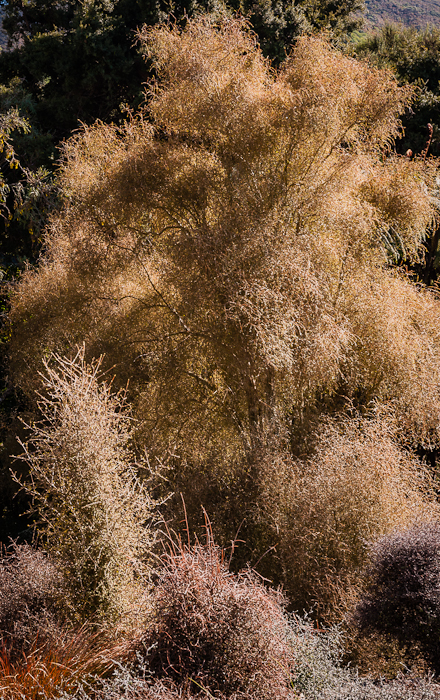
The native plants of New Zealand are a pretty interesting bunch.  Quite a few show divarication, a growth habit where the stems branch frequently and at wide angles.  This makes a kind of spreading zig-zag pattern with the stems multiplying and spreading into a big intertwined tangle - like the Muehlenbeckia astonii which I have already pictured and described.  The plants with this structure typically also have very small leaves which tend to grow within the tangle, so that the twiggy branches have a protective effect.  Divarication is quite a common feature, found not just in shrubs but also in juvenile forms of trees which start off as shrubby divaricating forms that then mature into a recognisable tree form. 

Above - a golden Coprosma virescens side-lit by the morning sun, showing the foaming tangle of twiggy stems and surrounded by smaller divaricating shrubs in shades of reddish brown - in a section of Otari Wilton's Bush.

A rather appealing theory as to why this form developed was that it protected foliage from browsing by the now-extinct moa - a very large flightless bird even bigger than an emu or ostrich.  However, a more prosaic explanation for the development of this pattern of growth in a number of different species is that this structure protected the plant, and leaves especially, from adverse weather conditions - wind, desiccation, and so on. 

Being a Wellingtonian, I tend to imagine that the weather is more dreadful to plants than a big bird would be!  But that is because Wellington is renowned for its wind, and we are beginning to get the spring gales...

Whatever the reasons for divarication to have become a feature, I think there is beauty in the oddness of this form.  A closer view shows in more detail the golden branches and the tiny green leaves in a lacy tangle.

A plant of Coprosma virescens, side-lit, showing the lacy intertwining tangle of divarication.

Light, colour, texture

At Otari Wilton's Bush on a sunny late winter's morning, the side lighting emphasised the textures and shapes of the grasses, divaricating shrubs, a cordyline and a treefern with the bush (the use of "bush" to describe NZ mixed forest is probably a bit confusing for non-NZers) in the background.

This is a Botanic Garden in Wellington dedicated to New Zealand native plants, with areas of really interesting plant collections and extensive reserves of bush for people to explore, learn and have fun.  The path here leads to a nature trail and other walks.  I love the colours, the gold and reddish browns and all the different greens, and the foaming textures of the shrubs contrasting with the strap-like leaves of grasses and cordyline. 

Colour schemers

Sighted while photographing a Needle-leaved totara, Podocarpus acutifolius, which is a shrubby native plant with a lovely range of colours and, as named, very sharp leaves, was a stick insect.  It was sitting very quietly - part of its protection plan.  They move around and eat at night, when the birds can't see them.  Then there is the cover of the colour - the green doesn't blend with the browns and golds so well, but there is green in the plant too. 

And it does look like a stick, a wee branch of the shrub, when it holds itself in position.

Can it see me?

It stays so very still, its front legs held in front to make it even longer and more stick-like.

This led to another discovery.  I had been wondering what had been eating my plant of Ugni molinae, previously known as Myrtus ugni, sold here as NZ cranberry - only it isn't from NZ and it isn't a cranberry.  It's a small tough bush with tasty little pinkish red fruit, and is from South America.  A more accurate name is Chilean guava. 

Something was enjoying not just the fruit but the leaves...

Stick insect alert!  They may look skinny, but they sure can get through the food.

Close-up of a culprit.  It was really hard to find - a very good colour and shape match. 

Precocious signs of spring

Winter is hanging on - grey skies, rain, wind - and we don't seem to be getting as many of the clear bright still days that usually occur between wind changes.  But spring will soon be here.  One of the earliest signs that winter is coming to an end is the glorious display of pinkness that is the flowering of a grand Magnolia campbellii in the Wellington Botanic Garden.  This majestic tree is over seventy years old and impressively tall, but surrounded - this photo shows how it is framed by evergreen trees and treeferns which sit on hills around it.

Such a welcome sight, but difficult to convey.  This challenges me - I crane my neck and perch my camera against my face...looking up against the bright grey sky, trying to avoid having the flowers in dark silhouette.

Upper branches of the magnolia, bare except for the gorgeous pink blooms (and a sprinkling of lichen).  Oh to see them better...

A closer view of the pink flowers, the large buds and the tangle of branches of Magnolia campbellii.

Dancing branches

I love the patterns made by the bare branches of a line of magnolias in the Wellington Botanic Garden - their only clothing a frosting of pale grey-green lichen.  Soon there will be large buds covered with soft hairs, and shapely globular flowers, then the green foliage obscuring the curious shapes of the branches.  But, exposed by winter, they twist and writhe together busily, as if dancing an exotic dance.

The bare branches of a line of deciduous magnolias (probably Magnolia soulangeana).

Weather as predicted

"Red in the morning shepherd's warning, red at night shepherd's delight" is the simple weather forecasting system that I learned from my grandparents.  I understand that the colour results from the scattering of light by water vapour and dust particles in the atmosphere, and the prediction works best when the weather comes from the west.  I'm not sure if this old saying applies to the northern hemisphere only, but it does seem to have some predictive power here in the southern hemisphere.     So - looking across to the Orongorongos from Island Bay this is what I saw this morning:

(Actually to me it looks more orange-y than red - reddish I guess is what I'd call it.) 

But it was right...rain today.  What a colourful harbinger of grey skies!

Smelling of roses

The sweet scent of old-fashioned roses is one of my favourites.  In winter, when rose bushes are bare, I could feel deprived.  But at my front door I have growing a little shrub with bright green leaves that always look healthy, and pretty but small pink flowers.  The stems, and to a lesser extent the leaves, are covered by soft hairs - very discreet, but they pack a punch.  Apparently glands within the hairs are the source of a richly beautiful rose perfume.  The flowers, even though they look somehow as if they should be the scent-bearers, actually lack perfume.  So even if there are no flowers I can pick a leaf and be transported by the rose scent.  Even more wonderful - this is an incredibly easy plant to care for.  It is easy to grow from cuttings, and despite moves and neglect this plant is the offspring of one I first got decades ago - tolerant of my haphazard care, a treasured old friend.   

The small pink flowers and soft green leaves of my rose-scented pelargonium, called 'Attar of Roses', probably a form of Pelargonium capitatum.