Swords into ploughshares

I chanced upon this sculpture in Russell, a historic settlement in the Bay of Islands across the bay from Paihia.  The plaque beside it read:
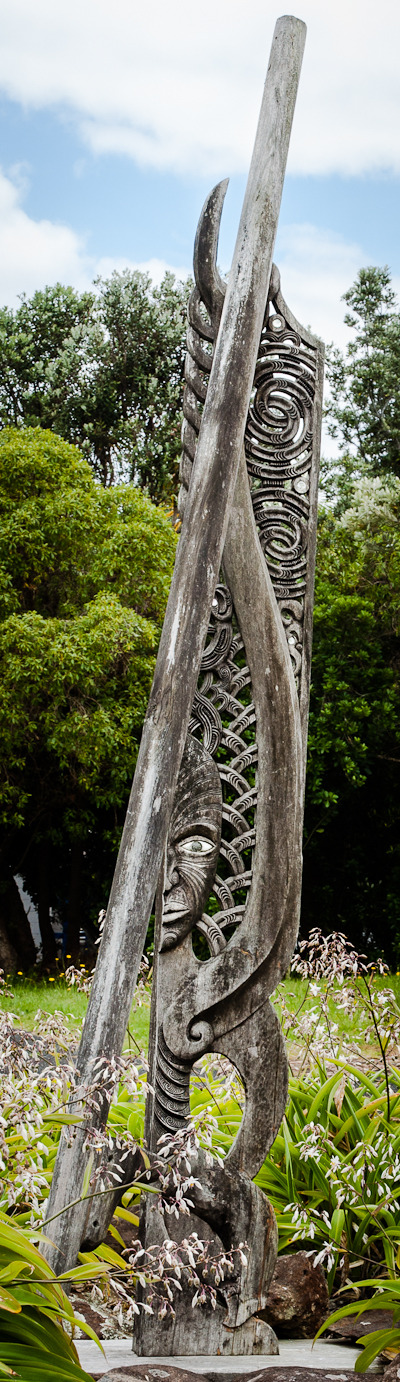
"SWORDS INTO PLOUGHSHARES

The Pou-ihi is a cultural recognition of conservation and its value in Maori society.  The Tangata whenua (Maori people) with the assistance of the Maori and South Pacific Arts Council 1988 gifted this carving to the Bay of Islands Maritime and Historic Park. 

The pillar or Pou-ihi shows only half a person, Rongo who represents the portion of people who recognise and uphold the values of conservation.  Rongo's upraised left arm holds a ko (digging stick) which symbolises the concepts and instruments that will bring about the healing of Papatuanuku (Mother Earth). 

The carving faces west so that symbolically like the sun it rises to shine the light of conservation knowledge upon those in darkness."

Russell, originally Kororareka, is a small and picturesque settlement which was a site of early contact between Maori and tauiwi (nonMaori) from the early 1800's. With a mixed bunch of arrivals - whalers, sailors, missionaries, escaped convicts from Australia, settlers - it had a reputation as a lawless and disreputable port ("the Hellhole of the Pacific"), but it was also a place where prayerbooks in Maori were printed and bound.  Nearby, just across the water, was the setting for the signing on February 6 1840 of the Treaty of Waitangi between the British crown and Maori people, recognising Maori ownership of their lands and other properties and guaranteeing them the rights of British subjects.  Russell was too unsavory in reputation so the first  capital was established (briefly) nearby but then moved to Auckland.  There was subsequent conflict that led to the sacking of Russell in 1845, but the church and mission were spared and still survive, and there are also a number of colonial buildings along the waterfront. 

Nowadays it is a little port for tourists, big game fisherfolk, holidaymakers, and passengers who ferry in from very large cruise ships.  It is a pretty place to visit, and a suitable place to think about conservation and how we live together and care for our environment. 

This sculpture sat quietly in a little park, a rather subtle reminder of big issues that we all face.

A taste of summer - tui and pohutukawa

The North Island is, according to Maori legend, Te Ika a Maui - a fish hooked and landed by Maui which transformed into this land.  Wellington is at the southern end, the head of Maui's fish - Te Upoko o Te Ika a Maui.  It was a very large fish indeed - te ika nui a Maui! - and it is long - about 830km (515 miles).  So when I headed up north for a visit to Paihia, I was travelling a decent distance and to a warmer and more subtropical climate - how I love balmy evenings!

The pohutukawa (Metrosideros excelsa) is also known as the New Zealand Christmas tree because it flowers around Christmas time with a glorious display of crimson flowers.  It is a coastal plant, and grows well even when located precariously holding on to rocky cliffs - and because Christmas here is in our summer, the colourful display is associated with sunny days and blue skies and holidays at the beach.  Some pohutukawa were already out at Paihia beach, and tui song was also in evidence.  When I went closer I could see a lot of movement within the tree, but what was going on?

Can you see it?  A tui - and it was one of many!  Not exactly hiding, just busy feeding - tui belong to the "honeyeaters" group of birds, and there surely was a lot of nectar to be consumed - I could see a lot of honeybees there too.  A bold bird and a bold floral display - and a foretaste of the delights of December.

Purple poppy pollinator

A sumptuous double purple poppy (Papaver species) dwarfs a honeybee (Apis mellifera) busily and successfully foraging, as evidenced by its well-filled pollen basket - the pale bulge visible on a leg.  It had been burrowing in the folds of the crinkly petals to access some parts of the large central boss of stamens, and has emerged before another foray into the depths of the flower.

The vibrant colour of the flower and the depth and complexity of the petal forms and the wealth of stamens all add to a sense of bounty and richness. 

Really ruggedly rocky

Sometimes, in the odd light of winds and storm fronts, the south coast can look like strange and alien territory...

And even in the brighter light of calmer skies, the rock formations can appear stark and forbidding. 

Beached seaweeds litter the gravelly beach - this kelp makes a graceful wave pattern, much gentler than the waves which washed it up...

But in death, this kelp and other seaweeds soften the harsh environment and provide sustenance for plants that live only a short distance further from the tide...

The pretty pink flowers and bright green leaves of Calystegia soldanella - known by many names, as it is found in the temperate regions of both Northern and Southern hemispheres, it is a scrambling perennial vine which lives on shorelines.  The Maori name is pohue, a descriptive English name is the sand bindweed - but this is even less hospitable than sand...somehow this plant manages to find enough sustenance for survival, even thriving.

The seaweed, displaced from its marine home, has helped to create a new home for a very different plant on this apparently unwelcoming gravel shore.

Perky pollinator

A tui, sighted perched on a flower stalk (korari) of the flax commonly found along the south coast - wharariki or Phormium cookianum.  I don't know who was more surprised, the agile bird feeding on nectar from the handily beak-shaped flowers, or me.  A few seconds later this bird had flown - but not before I had done my paparazzi act.  The bird's pose looks staged, but it was just in brief freeze mode before it flew - my attention apparently unwelcome for this perky performer.

There are noticeably more tui (Prosthemadera novaeseelandiae) around Wellington since a predator-free sanctuary was created.  They are engaging birds, very vocal and good at mimicry (cellphone ringtones, for example!).  From a distance they look a glossy black with a little tuft of white feathers at their throats and a light dusting of white feathers on the neck like a lacy collar.  Closer up you can see that there are soft brown patches of feathers on the back and above the legs, and that the dark feathers have a greenish-blue iridescent sheen.  The orange patch above its beak is pollen from the flowers it has been feeding on -

Wharariki flowers, showing the prominently positioned sticky bright orange pollen - as seen in the patch above the tui's beak.  The pollen is placed so that it will brush on the visiting bird's head and thus be conveyed to another flower - cross pollination is required, and the flowers are shaped so that the feeding bird drinks deep into the flower.  Very neat!

Holding on

I do wonder what the coast would have looked like before it was so disturbed by our activity and our mostly accidental plant introductions which are at times plant invasions. You might wonder, why worry about introduced weeds if they are colourful and pretty, or even just if they are successful in difficult terrain?  On one hand, they can be enjoyed and appreciated.  But on the other hand, a successful newcomer can do harm to a whole environment - to the survival not just of the original plants, but also of animals that are adapted to those environments.  Replanting and conservation efforts give us a glimpse of what we could lose if we don't care for the native plants that belong here.  The native ice plant Horokaka, or Disphyma australe, copes with tough coastal conditions - salty winds, dry shingle or sand.  The pale pink flowers open and close with sunlight, and the creeping succulent branches and leaves lie close to the ground.  Although introduced forms of ice plant which are larger in form and flower can threaten the horokaka, it has been replanted and is doing very well along the coast here.

Like many native plants it is rather shy and small-flowered, but its delicate beauty belies its toughness and capacity for survival - provided we give it a chance. 

Pretty hairy

Introduced plants that find their footing along the south coast are by necessity equipped with features that make them survivors against the salty air, the desiccating wind, and so on.  Hairs on leaves are such a feature - creating an effective protective coating.

The pictured leaves are covered with fine hairs which give them a velvety appearance and enhance their soft green which looks particularly lovely in the morning light.  They belong to a mallow plant growing on the south coast.  But what is its name?

My research leaves me a bit unsure - it looks very like the mallow which is a weed along Australia's coast, and was called Malva dendromorpha, but this name was preceded by Malva arborea and Lavatera arborea, and it could be Malva maritima.  I guess all I can say is that it has the characteristic pretty flowers and upright growth and soft palmately lobed leaves of... shall I call it a tree mallow?

Whichever it is, this plant belongs to a family of plants with medicinal and culinary uses, and some forms are used in gardens.  With its capacity for survival it has the qualities to be a notified weed, although it seems not to be listed as such for New Zealand - yet. 

A backlit flower stem in bright sunlight shows the pretty pinkish purple mallow flower, purple buds and the hairy stem and leaves.  This plant is growing beside Princess Bay, battered by the salty wind and looking quite undeterred.

Turbulence

I have learned to accept, mostly, the marked turbulence of spring - tender new growth appears on plants, the days lengthen, there is more sunlight, even warmth - it feels expansive, the sap rises literally and metaphorically.  But the wind shifts, the temperature plummets, we hunker down again, seeking warmth, covering up and sheltering, a time for retreat and protection.  I used to rue the damage wrought by those winds - snapping the stems of tomato seedlings, bruising new leaves.  I rationalise, and it is mostly true, that those plants that survive are more likely to be resilient.  And I am more realistic about what I plant, when I plant, providing protection, and so on.  These weather patterns of turbulence and calm are quite like the patterns in our lives - periods of equilibrium and periods of disruption - and how we learn to respond and care for our plants are lessons we might apply to how we care for ourselves and all that is around us.  On the south coast there is a beauty in the impact of the storms...and a relief when, as today, the warmth and calm begin to return.

A couple contemplate the southerly swell from the rocky shore of Houghton Bay, on Wellingon's south coast, looking towards Taputeranga.  Life and the weather - times of turbulence and times of calm.  And beauty in all of it.

Pretty and prolific

A colourful spring display which appears each year, on a hillside by Wellington's south coast - pretty plants which are potential problems:  Centranthus ruber or false valerian, a garden escapee of Mediterranean origin in white, pink, and crimson - it grows in all kinds of inauspicious places, such as stone walls or highly alkaline soils, and produces a great profusion of tiny seed;  Lupinus arboreus, tree lupin from California, with its yellow spires - often planted to stabilise sand dunes, its seed pods pop explosively scattering seed widely;  Senecio glastifolius, holly leaved senecio or pink ragwort with its pink and purplish daisies, from South Africa - toxic to stock, a great coloniser of disturbed soil, it highlights any such areas with its massed flowers.  All great survivors.  All with the potential to overwhelm vulnerable native plants.  This great display is not just for our pleasure!  But in this case they have not taken over, in fact the area they fill is dwindling, so I enjoy them while they last.

Golden

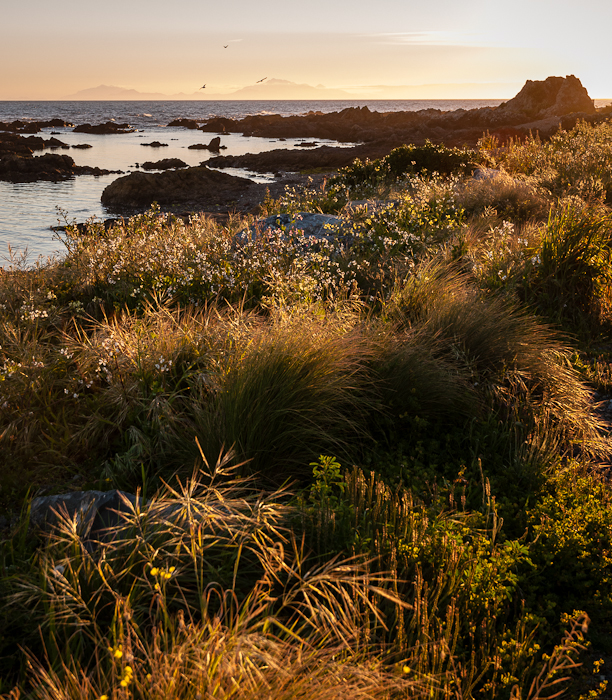
At sunset, when the sun is just about to disappear behind a headland, the golden light seems to be particularly intense - perhaps the contrast with the deepening shadows makes it seem so very bright, able to burnish and beautify almost anything.  Along the south coast between Island Bay and Owhiro Bay the road is right beside the rocky shore.  At the road's edge is a footpath and a strip of impoverished soil supporting native grasses, flaxes, and coprosmas, but also introduced grasses and wildflowers.  Plants are called weeds when they are growing too successfully in places we don't want them to.  These wildflowers are a symptom of a disrupted environment - but I very much doubt that they are the reason the native vegetation is so limited, and I don't just think of them as weeds.  It seems that we humans try to impose our ideas on the natural environment in all kinds of ways, usually when we become aware of our unthinking impact.  Even within New Zealand some of our native plants are being regarded as weeds after flourishing too well when planted in places beyond their normal habitat.  Introduced plants have certainly caused problems but they are also part of the production, beauty and diversity of life here.  As for these little golden plants, however you regard them, the lacy froth of the flowers and the textures of the grasses are very pleasing to my eye.

Grasses and wildflowers, backlit by the golden evening light, along Wellington's south coast, with a distant view of the South Island.