Full moon fly-past

The full moon is rising in the early evening, up into a soft pink sky over the hills along the south coast from Island Bay to Houghton Bay.  The island, Taputeranga, is out of the picture to the right and shelters the waters that we are looking across - but the weather is more settled anyway, and the skies have cleared.  It is a peaceful time, a transition, muted sounds of distant traffic, the ebb and flow of the water, and the sharp scent that conveys the salty dampness of the seashore.  A noisy formation of seagulls flies past, saluting the end of the day.

Light effects

The morning light broke through some rather dramatic clouds and made a brief display of "god beams" which act like searchlights, focusing on the landscape and bringing into contrast the soft shapes of the Orongorongo foothills, viewed from Island Bay.  The only evidence of human activity are the little white dots which are the two Pencarrow lighthouses, sitting by the eastern entrance to Wellington Harbour.  The upper one was New Zealand's first permanent lighthouse, first "lit" on 1 January 1859.  Mary Bennett and her husband had tended a makeshift beacon, but after he drowned (the "New Zealand death" for early settlers) she became the first and only female lighthouse keeper in New Zealand.  Low fog was a problem for the lighthouse on the hill - it is in a much more exposed position than it seems from this angle - and the second was built down by the shore in 1906.  The lights burned together until 1935 when the Baring Head lighthouse, further along, took over.

The little white structures remind me of all kinds of things - the might of the sea, the courage of the keepers and people who take to the sea, the drama and changeability of the elements, and how a simple thing like a beam of light can mean so much and be so important. 

More shy flowers bold leaves

Another grey day, but Coprosma repens - taupata or "mirror plant" has a fresh and sparkly look because of the very glossy leaves which also make it such a successful coastal plant, and this cultivar has the added zing of multicoloured leaves in green, gold, yellow, orange and red.  The flowers, on the other hand, are shy and tiny - clustered together on the stem behind the leaves.  These are male flowers (you can tell by the dangling stamens).  Although Coprosma repens is apparently dioecious - separate male and female plants - I am sure that I have seen male flowers on a plant which also produces the lovely orange drupes (berries) which the birds love to eat.  Must check again...

The shy flowers and bold leaves of Coprosma 'Painter's Palette'.

A breath of fresh green

At Otari (Otari Native Botanic Garden - to give it the full name which I never hear used) the diversity of New Zealand native plants can be so readily accessed and enjoyed it is easy to escape the sense of being in a city.  There are areas of more natural bush in Wilton's Bush, but for a brief visit and sense of renewal Otari meets my needs beautifully.  I read some time ago about the Japanese term "shinrin yoku" which was translated as "forest bathing" - the idea of becoming immersed in a forest environment for health purposes.  (This is apparently a relatively recent concept from 1982, originating in the Akazawa Natural Recreation Forest in Agematsu.)  Research has looked at the elements which might be helpful (such as chemicals released by the plants, textures, scents, sounds, temperature and light patterns) and the impact that walking in the forest has on people's stress levels, immune response, and so on.  The benefits seem to be substantial.  I don't need a health reason, I just like to breathe it all in...

The path wanders through the fresh greens of the mixed NZ native plants, glistening after a rainshower - climbers decorating the trunks of the trees which tower over the treeferns, shrubs, rengarenaga lilies and other perennials.  Ahhh.

Our flax

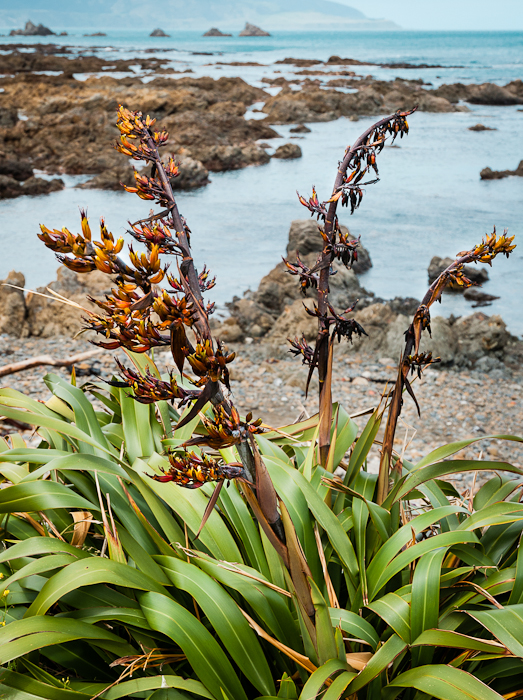
A plant used as a symbol of New Zealand, almost as often as the silver fern, is the NZ flax or Phormium.  It has long sword-shaped leaves and upright flowering spikes and when not battered by the elements can have an imposing "architectural" presence.  Many garden cultivars have been bred with different leaf colouration and currently it is in fashion in Northern Hemisphere horticulture, particularly in England it seems.  There are swathes of flax plants along the steep hillsides bordering Wellington's south coast, and it also grows right down on the rocky shore. 

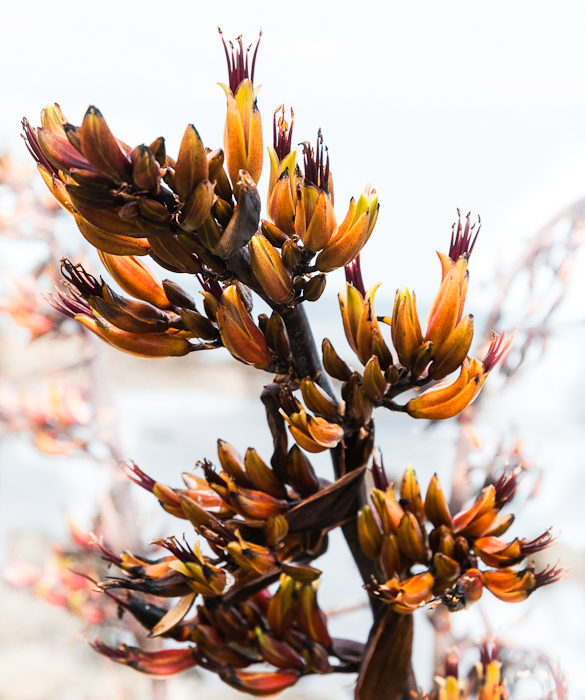
Around the Cook Strait the plants are generally Phormium colensoi, or wharariki.  It is tough and resilient, and now in flower.  It is not related to the flax of the Northern Hemisphere, although it is also a source of fibre.  In fact it is a member of the lily family.  What the flowers lack in size, they make up for in number - flowers cluster along branchlets up tall flowering spikes.  They provide nectar, particularly enjoyed by the tui.  Alas, the one I saw feeding on the flax today was not interested in having its portrait taken, so I made a flower portrait instead...a rather more cooperative subject.

Shy flowers bold leaves

Pingao, the NZ golden sand sedge (Ficinia spiralis) is a coastal plant which grows on active sand dunes and has the effect of stabilising them.  It is lovely and tough - able to grow closer to the water's edge than any other such sand binding plant.  It was apparently widespread, but became endangered following the arrival of European colonists.  In the last decade or so, conservation efforts and replanting mean that it is increasingly in evidence, adorning the dunes along Wellington's south coast.  The tough leaves hold their bright golden colour well and are used in traditional Maori weaving to great effect. 

This is a very simple kete  - a Maori woven kit, made of pingao and showing the unfading natural colour of the leaves despite it being over thirty years old:

The flowers, on the other hand, are inconspicuous and rather odd (to me) in appearance. 

A close-up reveals the densely packed small flowers which spiral around the upright flowering spike, or culm.  They are followed by shiny dark brown seeds in early summer. 

I have to admit that it is only in the last few years that I have even noticed the flowers - my eyes focused instead on the golden colour of the leaves. 

The plants on the dunes of the south coast - in this case, Lyall Bay, are blasted by the wind, and the leaves form a dense tangle about the flower spikes. The young leaves are a fresh green with just a touch of gold.  As they mature they tend to become the rich gold that is so special for beach-goers and weavers alike.                                     

I am so grateful that such conservation work is being done!

After the storm

(Or more accurately, in between the storm fronts.).  A lovely sunny day, clear sky, just a light wind (now northerly) and, as expected, the southerly swell with attached surfers.  To be a Wellington surfer I think you need to be patient, optimistic, and cold-hardy.  Having moved from a place which had much more reliable surf beaches, I was bemused at first to see the wet-suited surfers of Lyall Bay waiting, waiting...

Looking southwards where the waves will come from - near the seawall at Lyall Bay.

Not a great wave, but two surfers catch it while the others will wait some more...

Riding a wave - it looks so smooth when the skill is there!

As the waves get closer to the beach the wind catches them, creating "horses' manes" of spray.

The foaming waves meet the beach in a dramatic veil of spray - the northerly is picking up, I think!

Wheeeee

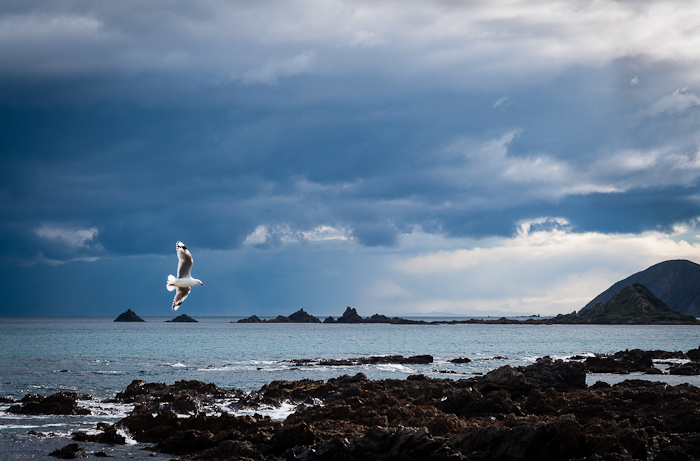
It's been really stormy around the country, and here in Wellington we have had northerly then southerly gales.  Looking southwest from the rocky shore by Princess Bay on Wellington's south coast, with the South Island barely visible in the distance, we can see storm clouds approaching...

The seagull seems to be surfing the wind - just as keen and hardy surfers will be enjoying the waves of the southerly swell in the days that follow the storm.

Luminous leaves

The young leaflets of the honey locust (Gleditsia triacanthos 'Sunburst') are a gorgeous golden yellow, contrasting with the blue sky of a sunny spring day.

The backlit trees on a hillside show the contrasting greens and textures of their spring growth - in the front is a golden elm (Ulmus procera 'Louis van Houtte"), behind it an array of deciduous and evergreen trees in bright contrast.  

The finely cut bright red young leaves of a Japanese maple (Acer palmatum) are ruffled by spring winds.

A striking spring display

The idea of flowers in spring tends to conjure up images of rather softly pretty and colourful displays.  But there are other plants in bloom celebrating the arrival of more sunshine and warmth with drama and style...

In the foreground an Aciphylla, or speargrass, a New Zealand native plant whose name says it all - spiny leaves in a grass-like clump.  It has golden flowers which make a colourful display as a group.  In the background is a Xeronema callistemon, with its red brush-like flowers beginning to open.  Around them are the golds, reds and greens of groundcovers including coprosmas and fluffy grasses.  Seen here in a municipal planting in Wellington city - I find it a pleasing sight.

There is a curiously attractive don't-mess-with-me quality in the Aciphylla and I have even seen suggestions that they be planted strategically in the home garden to deter burglars! 

The Aciphyllas are on the whole alpine plants, living in tough conditions.  They vary in size and ferocity and some of them are very tall and very spiny and very intimidating.  Fashions come and go even in plant choices for gardens.  I have rarely seen them in garden settings, but Aciphyllas would fulfil the vogue for so-called architectural plants very well indeed. 

This spring display certainly contrasts greatly with the rather soft and dewy new growth on non-native deciduous trees which have been in blossom and leaf recently.  I enjoy them all!