Celebration

It is six months since I started blogging, and I am thoroughly enjoying spending this time putting my attention into not only noticing but also trying to convey some of the wonder, pleasure and privilege of life here on this part of the planet.  My first post was at the time of the winter solstice.  I thought it would be fun to celebrate the six month anniversary - the summer solstice.  We have travelled from the shortest to the longest day here.  I have a bit of trouble picturing it, but the earth is at a tilt in relation to the plane of our solar system and our star - the sun - and so there are differing amounts of sunlight reaching different regions of the earth through the annual orbit around the sun.  An image that captures the figure of eight path of the sun relative to a location on earth over an entire year is called an analemma, and the National Geographic website shows some of these rare images:  http://news.nationalgeographic.com/news/2010/12/photogalleries/101228-sun-end-year-analemmas-solstice-eclipse-pictures/#/year-in-picture-analemma-sun-path-first_30693_600x450.jpg  

Well, I couldn't think of how I would convey the idea of summer solstice much better than with the lovely blue skies of a clear sunny day and the rich crimson blooms of pohutukawa (Metrosideros excelsa), which have been out in abundance.  There was even a waxing half moon - the moon in its first quarter.

While images of pohutukawa in bloom are a bit of a cliche here when used to represent summer or Christmas, they are always a welcome sight, as if the rather elegantly understated pohutukawa trees are bursting in a joyous celebration.

An underwater garden

The tide was out about halfway on the coast by Lyall Bay and there was a colourful display of exposed seaweeds - particularly the green of "sea lettuce" which, as the name suggests, has a very fresh and vibrant colour. 

There was a lot to see - the lumpy rocks, the beach in the distance with the buildings of the two surf lifesaving clubs that are based at Lyall Bay, and lo and behold - an oystercatcher. 

First I saw an all black variable oystercatcher (Haematopus unicolor) foraging amidst the seaweeds...  and then I saw another variable oystercatcher of the "mottled variant" type - it has white speckling as well as glossy black feathers (despite the "unicolor" in its proper name.)  Oystercatchers are very engaging to me with their busy purposeful manner and their rather spectacular long orange beaks and orange rimmed beady eyes.  

But when I got closer my attention was taken by this dense grouping of brown seaweeds - so many different shades and patterns, together a busy rich tapestry just under the shallow water, hinting at the wonderful sights to be seen in this underwater garden that is the ocean.

Take a nice deep breath...

...and relax

aaah...the exquisite rose "Jude the Obscure", bred by David Austin - a stem with its cluster of beautiful flowers, in stages from bud to petal fall, brought inside to enjoy away from the damaging wind.  Although in this image I have used dramatic backlighting, it shows the subtle buff and yellow colouring and the soft cup-shape of the blooms.  Even more exquisite is the perfume - the scent of old roses with a soft fruity note, powerful, sumptuous, calming - and alas, unable to be shared with you. 

The end of the year can be a curiously stressful time in New Zealand - the end of the year for schools and universities, time for summer holidays, Christmas, New Year - all times for celebration and festivity, but we humans evolved to experience any change as stress and we have cultural habits that can make things more demanding and more stressful and less enjoyable than we anticipate.  Fortunately for rose-lover me, the end of the year also brings a magnificence of roses.  Now, roses have a bad rap - lots of people think of them as delicate, needing all kinds of artificial life support, especially feeding and spraying.  Roses bred for their gorgeous flowers at the expense of the robustness of the plant may need lots of coddling.  But rose species can be very tough indeed, and roses which are closer to that essential nature, grown in environments which meet their needs, survive and thrive without special treatment.  In the inhospitable zone called my garden many do very well.  These are never sprayed, never fertilised, and watered judiciously.  They may not have exhibition-type blooms, but I love them.

The pretty pink "Mrs Doreen Pike," also a David Austin rose - perfumed, tough, with characteristics from the coastal rose species Rosa rugosa.  These flowers have been through gale force winds in the last few days, and I have photographed them in what is regarded as the least flattering light - very bright daylight. 

As I did with this image too, appropriately for its name, the rose "Sunlit"...

This is a more modern style rose bred in the 1930's by the Australian rose breeder Alister Clark.  It is not a large bush, unlike many of his roses, but is very robust and seems to be in flower almost all year.  Again, the light is too bright really, and unflattering, but I wanted to share it because it is such a delightful old friend and gives me great pleasure despite the very windy sunny days we are having.

Smoke on the water?

From a distance, I wondered what I was seeing - was that a waterspout forming?  The wind was a very strong northerly and the ocean surface was all churned up and foaming, but quite flat at the same time.  Closer to shore, the water was white with the reflected bright afternoon light, in stark contrast to the shadowed coastal hills by Owhiro Bay.  And against the backdrop of the hills, this was what I saw...

The strong wind funnelling down the valley to Owhiro Bay must have been hitting the water in such a way to cause these tall plumes of sea spray to billow up in the air - you can see houses in the lower right hand corner of the image, so this gives you some idea of the height of the spray.  The way it swelled up then drifted was so reminiscent of smoke, I wondered for a moment whether there was a fire - but no, it was the force of wind on the ocean creating another dramatic spectacle.

Caught in a sunbeam

Amidst some scrubby bush by the river there was a small clearing, lit by a narrow beam of sunlight.  I was captivated by the spotlight effect.  It brought into stark contrast the fresh greens of a small whau (sounds like "foe") tree against a background of dark shade.  The leaves of whau are large and soft, the seedheads a dramatic spiky cluster - brown when mature.  The tree has an almost tropical lushness.

Whau (Entelia arborescens) is a New Zealand small tree which we don't see much in Wellington because it is unhappy in even moderate wind, and it prefers warmth and enough moisture - with our strong winds none of those preferences are reliably met!  The seeds are long-lived and profuse, ready to pop up in places where there is a new clearing, but it tends to be a transient with other plants eventually shading it and taking over.  The wood is very light - like balsa wood.  The whau tree can be very pretty with its clusters of creamy flowers and fresh lively green leaves, then a bit daunting with its clusters of spiky seedheads.

Rainbow falls, Kerikeri

More from my recent trip - fresh water for a change. 

Rainbow Falls (Waianiwaniwa) near Kerikeri in the Bay of Islands can be approached from above or below.  A 3.5 km walk (for a number of keen exercisers it was a run) from the Kerikeri Basin leads to the base of the falls.  It was a refreshing sight, framed by the bush - totara and kauri trees, manuka, treeferns - the textures and shapes contrasting with the brilliant sparkling cascade hurtling into the water - a popular swimming hole - at the base. Two young men provide scale, as they have fun on the slippery rocks behind the falling water.  The droplets of the mist create rainbows by refracting light when it falls on them at the right angle for this to happen - late afternoon I believe.  Another time!

The pattern of falling water, constantly shifting and changing, sparkling and churning, is for me a calming almost hypnotic delight to watch. 

This waterfall is 27m high, and is of the Kerikeri River.  It is apparently unusual for a New Zealand waterfall in that while most have formed when water has worn away soft rock, this water flows over hard basalt.  I'm pretty sure that columnar basalt is evident at the base where the men are emerging. 

They look tiny, but I assure you they were of normal stature.  Its a reminder of how we humans are pretty small in the scale of things.

Oysters and (Neptune's) pearls

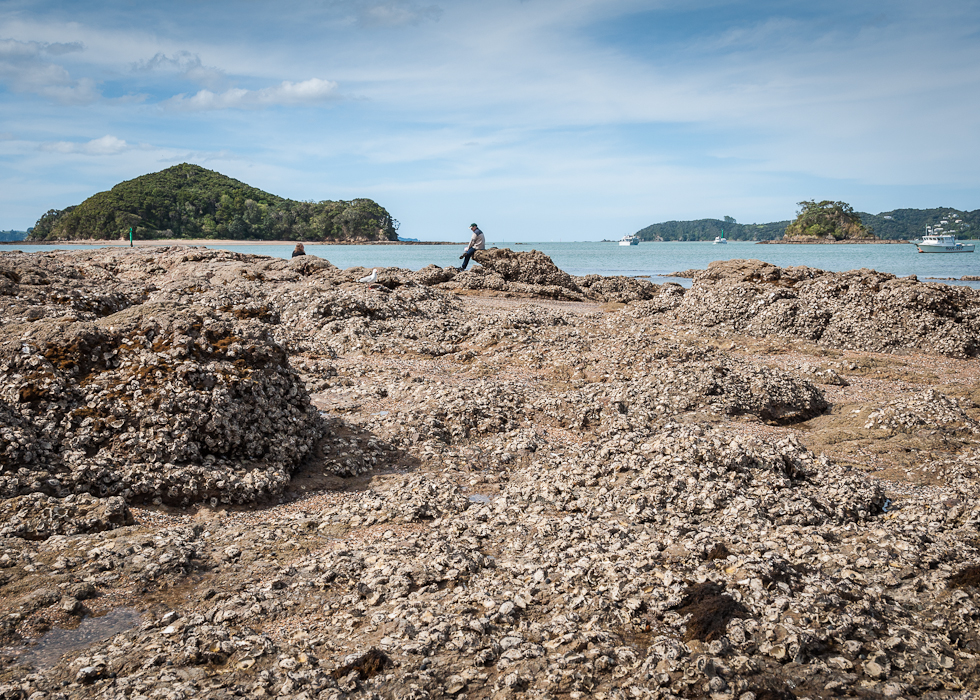
When I visited Paihia I was most impressed by the spectacle of oyster encrusted rocks along the shore.  The native rock oyster (Saccostrea commercialis) is found in the northern North Island, certainly not as far south as Wellington.  But most of these shells are those of the Pacific oyster (Crassostrea gigas) which displaced the much smaller local oyster in commercial farming and dominate here, with their larger and sharper shells.  These stick to the rocks tenaciously so even when the oyster is long gone, there is a decorative and painfully memorable (for bare feet and unprotected legs) display.

Oyster encrusted rocks on the shore at Paihia Beach, looking out to Motumaire and Taylor Islands on a sunny late afternoon.  The oysters are protected from harvesting, but seagulls heed no rules!

This is a red-billed seagull, Chroicocephalus scopulinus, a smaller gull which is a New Zealand native, tarapunga or akiaki in Maori.  There is an Australian gull of very similar appearance but apparently they are not closely related.  Like all gulls, it is a scavenger and - new word to me - a kleptoparasite - stealers of food from other gulls or from other species - including unwary eaters of fish and chips on the waterfront.  Anyway, this one was having a more gourmet snack. 

I noticed some brown algae - seaweeds - growing on and around the oyster zone, and was taken by the idea of luxury suggested by the following combination...

One of the common names given to the brown alga Hormosira banksii is "Neptune's pearls."  It is also called Neptune's necklace and sea grapes.  It does look like strings of beads to me, the hollow beads varying in colour depending on the conditions, but generally being olive brown and never opalescent.  Nevertheless, I see oysters and pearls! (and when I can pick the brains of a friendly phycologist, I will be able to write about another brown alga which also made lovely patterns on the shore.)

Summer - flowers and flies!

December is here, so it is summer time even though the weather doesn't seem to know.  It is a green time still - there has been enough rain to compensate for the wind, although the forecast is for a dry summer.  So there has been plenty of growth and flowering going on, and with all this luscious plant-life the beasties are much more in evidence...

The greenish yellow iridescent sheen of a blowfly's thorax harmonises well with the bright yellowish green of a parsley plant with its umbels of little green buds and foaming of tiny white and yellow flowers. 

Parsley is such a useful herb and very easy to grow.  It is slow to germinate, and it can be a bit difficult to keep producing a supply of the tasty and decorative leaves because it is a biennial (at least in temperate zones). In the first year it forms a dense clump of leaves - curly or flat depending on the type - which are such a good source of vitamins and minerals as well as being a familiar garnish.  The parsley plant forms a deep taproot and, in the second year, the tall stalks which bear the umbels of flowers.  The leaves are sparse at this stage and after the profuse seed is set, the plants die. 

In my wilderness that I call a garden I am very happy to let parsley go to seed and then establish itself where it will, although it can be a bit of a thug if it gets too close to other wanted plants.  But in leaf, then flower and seed, it is a lovely sight.  As for flies, they do fill an important function in the cycle of life and decay, even if most of them are not remotely as decorative as this particular one. 

The parsley flowers when opening - a delicate almost lacy pattern. 

Parhelion ("sundog") at Paihia

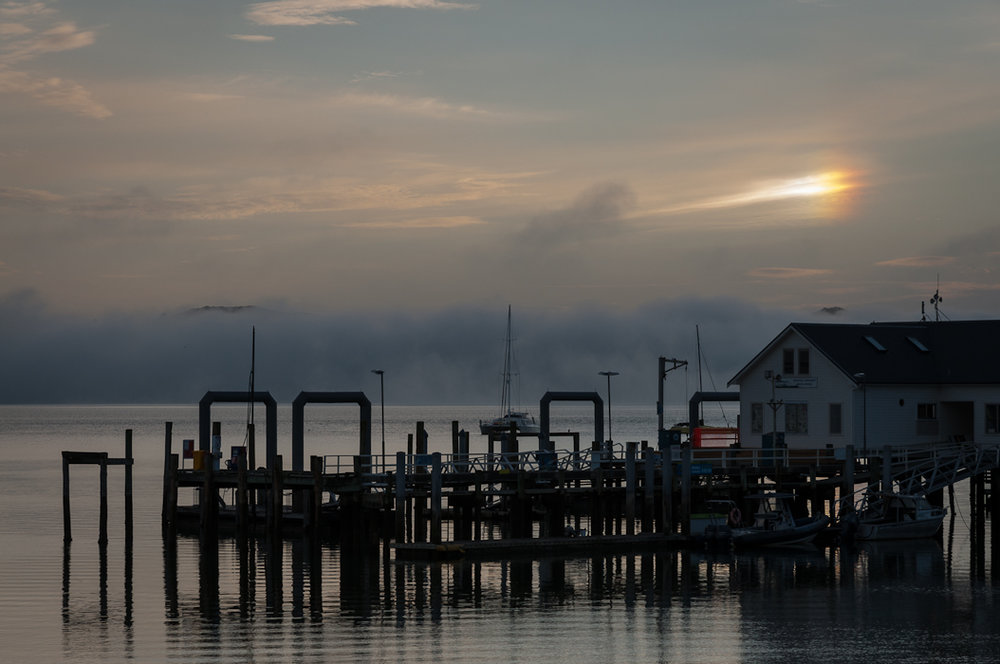
On a peaceful misty morning in Paihia, a sight sent me to my copy of "The Cloud Collector's Handbook" by Gavin Pretor-Pinney.  Despite its name, this little book isn't about a delusional acquisition problem - he writes, "You don't have to own something to collect it.  You don't even have to hold it.  You just have to notice it and record it."  His book is one of the official publications of The Cloud Appreciation Society - www.cloudappreciationsociety.org.  Rather than ticking boxes, it helps me with the act of appreciation - learning and better understanding about the weather and the clouds which make such wonderful patterns in the sky.  But this was not a cloud...

That bright spot of light is a sundog, or parhelion - from the Greek, meaning "beside the sun."  These are a "halo" phenomenon caused by refraction of sunlight through ice crystals in the thin layers of high clouds.  Sundogs appear on one or both sides of the sun and are level with it, and are brightest when the sun is low in the sky.  They are reddish coloured on the side facing the sun.  When I saw this one it was early morning and all was still - the mist was low, the water was calm, and the colours were soft and muted.  So the sundog was a striking sight.

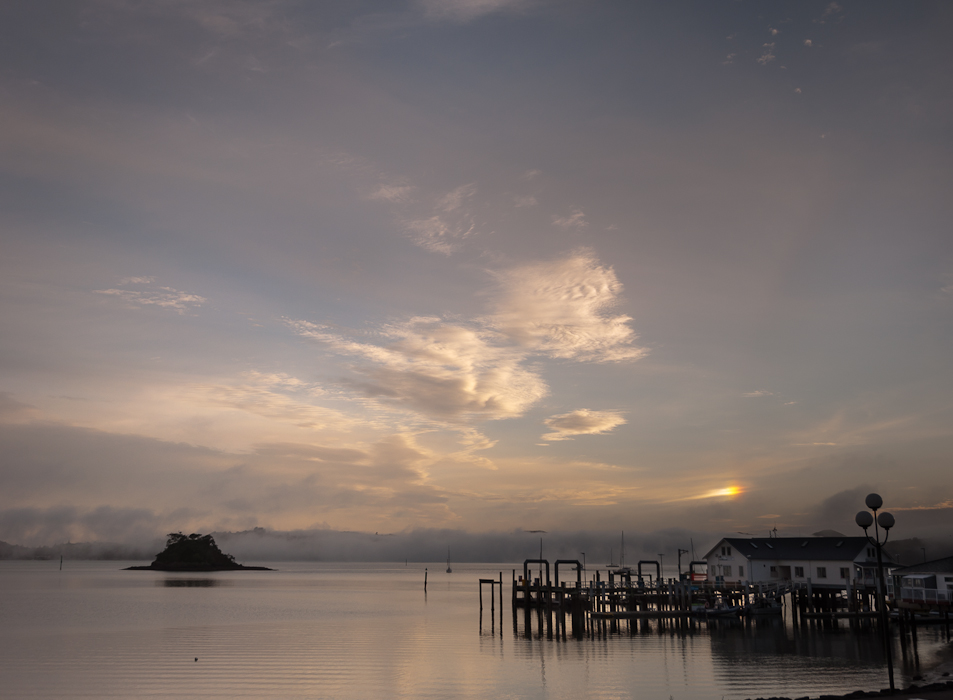
The wider view - a sundog and associated high cloud over Paihia looking towards Russell, the very small and picturesque Taylor Island, and the usually-busy wharf.