Kayakers at Onetahuti

Abel Tasman in summer provides a great deal of pleasure and adventure for lots and lots of people - from New Zealand and from all around the world.  But we are very small in the scale of things...

At Onetahuti Beach in Abel Tasman National Park - kayaks lined up and people preparing, donning lifejackets and doing warm-ups in anticipation of some happy paddling and exploring around the coast.  

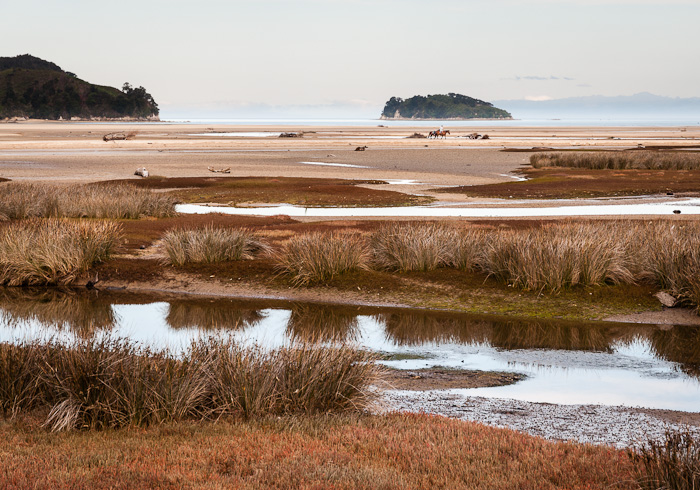
Summer evening glow at Marahau

A very peaceful evening at Marahau, tide out, the extensive estuary revealed, the light a soft pink adding to the warm colours of the sand and grasses - wiwi and glasswort in particular.

Two horseriders, dwarfed by the sweep of sand, rode quietly by. 

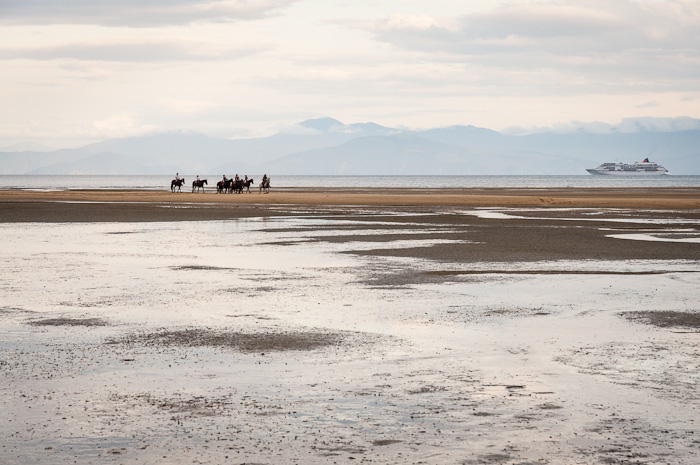
Another night, a paler light...

This time looking out from Marahau to Tasman Bay.  Open sand, more horseriders, and a huge cruise liner looking like a toy in the distance.  And still very peaceful.

Getting around Abel Tasman - tractors?!

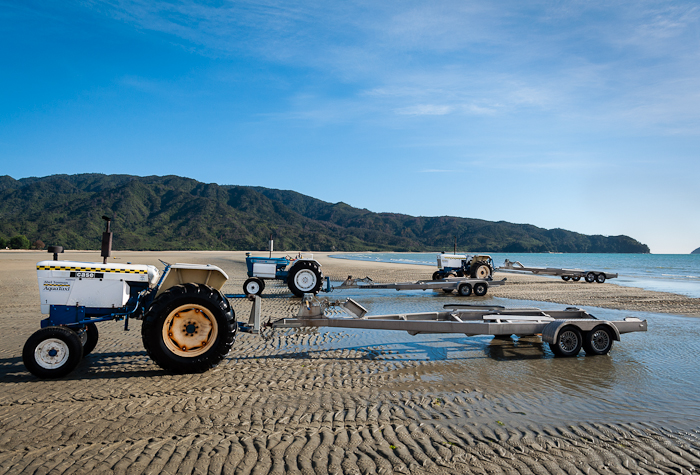
Marahau is at the southern end of the Coast Track through the Abel Tasman National Park.  The beginning of the park is seen here in the distance.  It's a bright sunny morning at Marahau, the tide is mostly out and the exposed sandy flats a pretty rippled pattern - but what on earth are these tractors doing there?  Would it help if I added that I took this photo while sitting in a fully occupied water taxi?

An ingenious solution to the problem of low tide and launching the boats that take people +/- kayaks along the coast of the Abel Tasman - these tractors have delivered their loads and are ready to collect incoming water taxis.  The tractors start the journey at the water taxi headquarters.  They pull the fully loaded boats on the trailers down the road, onto the sand, and across to the water.  In they go...easy!

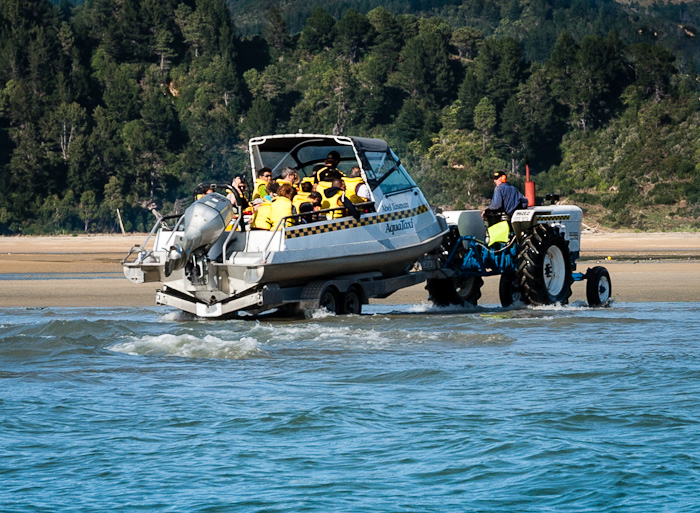
Launching a taxi.  Backing into the water quite a way - the trailer has to be under water, then off goes the boat.  It was difficult to get a decent photo, with the bouncing of the boat I was on - first on land, travelling on the trailer, and then on the water.  The other passengers - tourists and holidaymakers exploring the coast of the Abel Tasman - seemed to find the experience lots of fun.  I certainly did.  An unexpected bonus to add to all the other pleasures of being there.

Monarch butterfly sighting

I tend to think of butterflies as delicate, no doubt because they are small and can fly with such lightness and grace.  The Monarch is quite a big and dramatic butterfly, and an amazing traveller.  Native to North America, Monarchs got to New Zealand and established themselves here in the 1800's.  It's a long way!

They are apparently the most recognised butterfly in New Zealand.  There is even a Monarch Butterfly New Zealand Trust which researches and educates about all butterflies here, not just the Monarch.  Like most butterflies, Monarchs don't like the cold.  In North America they migrate, flying up to thousands of kilometres to get to southern California and Mexico to overwinter together in huge groups.  When the weather gets cooler here they fly up north (it's the southern hemisphere) to the warmth (at least 10 degrees C) and swarm in sheltered sites, often in coastal areas.  Generally they are inactive but they can become active on warm days in the winter, feeding on nectar, sunning themselves and flying around.  What a pleasant way to spend winter!  I know that many people grow swan plants in order to watch the voracious stripey caterpillars, the rather gorgeous gold studded green chrysalides, and the emerging butterflies. 

I was passing a garden when I saw this Monarch by chance - feeding on the blue echium flowers (Echium candicans) with their bright pink stamens.  Having my camera close to hand most of the time means I can "capture" such happy chance sightings - I hope that you enjoy them too.

Golden summer, golden autumn?

No rain yet, and hardly a puff of wind til today.  Last night the evening stillness probably contributed to the soft misty look of the sea and the coast.  The colours were pastel - the sea a baby blue and the sky a delicate pink.  Then just before sunset the sunlight seemed to become focused, and golden sunbeams bathed the rocky outcrops and grasses of Princess Bay on Wellington's south coast.

The misty conditions will have added to the spectacle - a haze of gold.  It lasted barely a minute, and then the sun went behind the hills, and the colours faded.  I have visited and photographed Princess Bay more times than I can count and there is always something new to be seen and appreciated.  

Jewel-like colours of Abel Tasman National Park

Our summer is officially over now that it is early March - and instead of relentless sunny days the sky has been grey today - but still no rain!  While waiting for the further sunny days that are forecast, I decided to delight the eyes with the almost unnaturally bright colours of sunny days at Abel Tasman - as the park is generally referred to.  (He was a Dutch explorer who was in charge of the first European expedition to sight New Zealand - in 1642 - and it was from the Dutch Zeeland that we got our name.) 

To start - a corner of the beach at Anchorage on a bright summer day with the typical golden sand, dense native bush (forest) and the somewhat emerald hue of the water when it is shallow.

Next, the greens of backlit ferns, framed by silhouetted tree ferns - seen on a bush walk between Anchorage and Torrent Bay.  The native bush in this area is quite lovely, with lots of ferns, kiekie, rata, kanuka, akeake, mahoe and some black beech.  I love the patterns and textures of fern fronds, and was taken by the bright light making such a strong contrast - to my eyes almost like a stained glass window.

Last, a view of the tidal flats by Marahau, at the southern end and beginning of the Coastal Track.  The sandy flats are great for horseriding. 

The rich blue of the sea and the reflections of the sky in the shallow water on the sand contrasts with the golden sand and the dark green of the bush on the headland and islands.

The colours of Marahau in the bright light of early evening.

Canada geese - the downside of success

A gentle summer's evening and the tide was out - a long way.  There are extensive tidal flats along the coastline of the Abel Tasman National Park at the top of the South Island.  These intertidal areas are sandy, not muddy, so are great for walking and for bird watching.  The park is famous for the Coast Track which passes through original and regenerating forest along a beautiful coastline with interesting rock formations, golden sand and very clear water - and the tidal flats.  On the sand close to the southern park entrance, a group of Canada geese appeared to be doing a sedate dance...

These rather handsome birds were unflapped by the arrival of humans, no hiss honk or hassle - which is what I generally expect from geese.  As their name suggests, Canada geese (Branta canadensis) originated in North America.  They got to Europe without assistance but were deliberately introduced to New Zealand as game birds.  It's the usual story - there was population decline in their native range because of overhunting, habitat destruction and so on.  This was successfully countered with breeding programmes and conservation measures.  But Canada geese have been too successful in establishing in some new territories.  They are plant eaters and their impact on crops and pastures - damage, droppings, and the bacteria in their droppings - has made them a problem in some parts of New Zealand to the extent that in 2011 the government changed their status from protected.  They are "fair game".  They also tend to form large noisy groups with pestiferous confrontational behaviour.  But these ones maintained a dignified imperturbability.   

In the subdued light the golden colour of the sand is not very evident, but it can be seen in the shoreline rocks which will gradually erode to form the sand.  The black patterns on some of the rocks are clusters of little developing mussels. 

The rocks are of "Separation Point" granite - it tends to erode readily, creating the many interesting rock formations along the coast as well as the lovely sand.

Waikoropupu springs and protecting the pristine

Golden Bay, named for the golden sand of the beaches along its coast, is on the northwest edge of New Zealand's South Island.  There is just one road in, over the Takaka Hill - a range of hills, actually, about 800m at the highest point.  It is a dramatic place - weathered marble, sinkholes and caves - some very deep, strange rock formations, and underground rivers.  Unsurprisingly, it was apparently used as a location for some filming for the "Lord of the Rings". 

Just west from the Takaka Hill are the Waikoropupu Springs - the largest freshwater springs in New Zealand and the largest cold water springs in the Southern Hemisphere.  The clarity of the water is remarkable - the underwater visibility has been measured as 63 metres.  The only place with clearer water is under the Weddell Sea in Antartica.  The clarity of this water results from a prolonged period of filtration as it travels in underground channels through the limestone rock of the Takaka Valley.  At the springs the water wells up with considerable force, and in some areas you can see the sand and stones of the lake floor dancing with the water movement.  The plants growing underwater are so easily seen they look much closer than they are, like a colourful garden. 

The beauty of the springs did not trump gold fever.  In the late 1850's prospectors burned and cleared the surrounding plant cover - which would have been mature lowland forest - and constructed water races to channel water from the springs to sluice for gold.  Numerous water races and sluice channels remind us of the damaging (and futile in this case) gold fever of the past, and they are only partially obscured by renewed plant growth.  Almost none of the original forest remains in this area - damage to the bush continued into the 1970's.  The reserve around the springs reveals different stages of forest development as regrowth occurs, with signage that explains this fragile process. 

Sigh.  How thoughtless and foolish we can be if our preoccupation is just what we can take from the land!  How we treat the land is greatly affected by our beliefs and priorities...  The Maori perspective protected the water from contamination because it was seen as sacred.  But they were not in control, and people were allowed to dive in the water of the springs until the threat of contamination was extremely tangible and disturbing in the form of an alien invasion - Didymo (Didymosphenia geminata) a freshwater diatom. 

Charmingly called "rock snot" this revolting pest (and I am delighted by most plants!) began to invade the rivers in the South Island from 2004.  It is extremely difficult to stop the spread, and a great deal of effort is being expended to control it.  Under the Biosecurity Act 1993, the entire South Island is a Controlled Area, which means people are legally obliged to prevent the spreading of didymo and face penalties to the tune of $100,000 in fines or 5 years in jail if they knowingly infringe. 

And it seems that this was the trigger - at last, the protection of the springs was taken really seriously.  This is now the official rule - "The waters of Te Waikoropupu Springs, including Fish Creek and Springs River, are closed to all forms of contact (including fishing, swimming, diving, wading, boating and drinking the water) to safeguard water quality and to respect cultural values."  Serious protection of what I too see as a treasure.

Dawn redwood - a visitor from the past

I have been thinking about the impact of introduced plants, and this was brought into focus again by the role of gorse in the fire at Owhiro Bay.  Then today I heard an interesting interview with ornithologist and author Glen Chilton about the impact of "alien invaders" - plants and animals introduced for various reasons into a variety of countries.  Amongst other things I learned that a number of African grasses were introduced to Australia (in the 1930's) and that they have intensified the nature, intensity and impact of fires there - which are on a huge and terrible scale compared to the little local fire which set off my musings.  I had no idea!  What a cocktail - flammable native plants plus exotic grasses which greatly add to the risk, intensity and damage caused by fires, and now changing climate and record high temperatures...

Fortunately there are many exotic plants which have not caused problems (so far) and it has been a great joy for me to experience some of them.  One is the dawn redwood - Metasequoia glyptostroboides.  It is often called a "living fossil" because it is a survivor from the Mesozoic era - dinosaur time!  Fossil records show that it was widespread in the Northern Hemisphere then.  It is not clear why a small forest survived - in China, in Lichuan county in southwestern Hubei province.  But it did, and we can experience a connection with that time in the form of this beautiful deciduous conifer.

It was in the 1940's that there was a curious flurry of recognition and discovery for the dawn redwood - Shigeru Miki of Japan reclassified fossils as coming from a separate species which he named Metasequoia, and Chinese foresters discovered unfamiliar trees subsequently identified as of this species, until then considered to be extinct.  In the late 1940's and early 1950's seeds were distributed to arboreta and botanical gardens.  It has proven to be a fast-growing and beautiful tree.  This one in Queen's Park in Nelson is seen in the golden light of a summer's evening.  This emphasises the lovely sculptured trunk, the reddish bark and the very attractive fresh green leaves with the lighter coloured drooping clusters of pollen cones.

It is quite extraordinary to think that this lovely tree links us with the very distant past, when our ancestor mammals were tiny mouse-like creatures - maybe they scurried up trees like this to avoid being squashed by enormous dinosaur feet?

A sunny dry summer...and fire

Well, when I said I would be posting again on February 21st I had no idea that circumstances would be rather dramatic.  In the low light just before sunrise the flames seemed particularly threatening. 

A fire began during the night in the scrub on a hillside by Owhiro Bay - on the opposite side of the valley to the houses in this image.  They were not threatened but houses closer to the fire were, and people had to be evacuated. Nobody was hurt and there was no damage to any houses.  The firefighters - people and helicopters - had a lot of work to do, evident in the bright daylight.

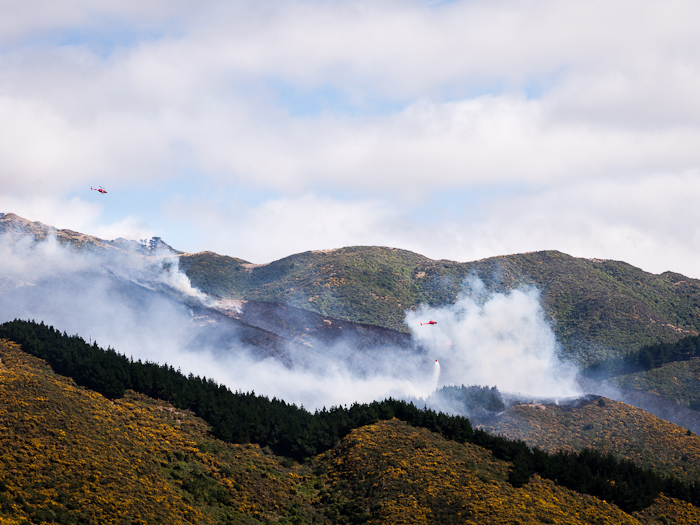
The fire-blackened vegetation on several ridges can be seen behind the smoke.  There were three red helicopters in action (how small they look!) and one is emptying its water bucket by a stand of pine trees which seem to have been spared.  Then it is off to refill...

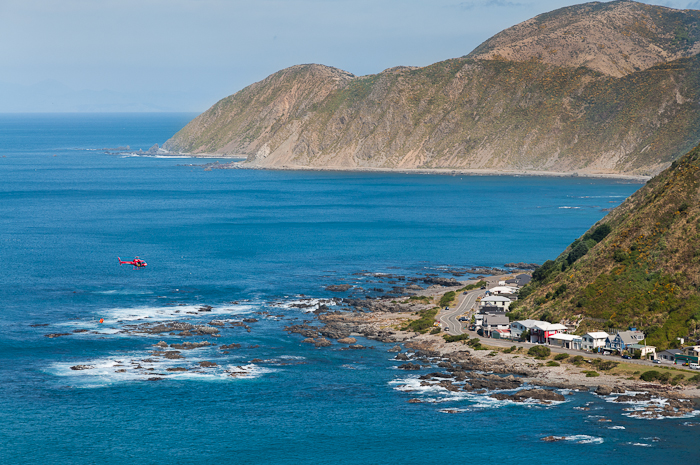
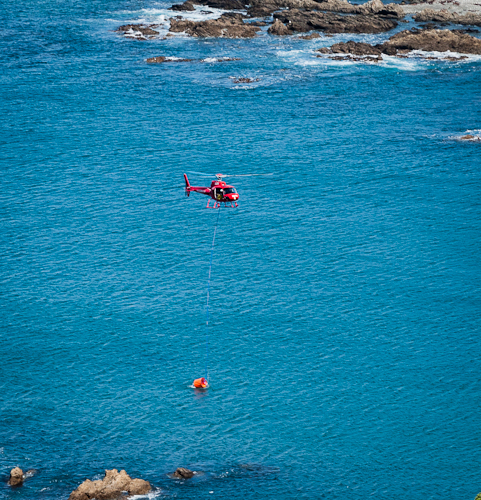
A helicopter approaches Owhiro Bay to refill its bucket, flying low and scooping the seawater.

The fire was fuelled by the dry scrub, especially the very flammable yellow-flowered gorse, of which there is a great deal over the steep hills. Oils in the gorse plant apparently make it difficult to put out the fire. Gorse was brought to New Zealand by British settlers who used it as a hedging plant, and seemed to have some fondness for it - this is puzzling as it is a thorny and threatening thing close up!  But it has been wildly successful - in other words it is a weed, a plant thug.  However, in the harsh environment of the south coast it does provide some shelter for native plants to grow and emerge.   

We have had an unusually sunny and dry summer - very pleasant for people unless they are farmers or growers of fruit and vegetables.  But thank goodness, some rain is forecast tonight.