Working on the website

A spider's web on the zigzag branchlets of a Muehlenbeckia astonii shrub - a New Zealand native plant I have previously featured.  The image is heavily vignetted - I hope it helps to make the fine strands of the web more visible against the busy clutter of the many tiny leaves and flowers and reddish divaricating stems. Glistening raindrops outline some of the strands.  It has been raining but the sun is coming out.

I am wanting to work on the structure of the website, but lacking the web building skill of a spider I will be taking a bit of time, so there won't be any new posts till 21 February. 

While you won't see any major changes at first, I am wanting to add to what I am offering. In the meantime, there are quite a few old posts that may be of interest again. 

I really really welcome any feedback - what brought you here? what interests you?  is there anything you would like more of? 

Most of all, thanks for visiting and welcome back on 21st Feb!

Summer fog

We have had a prolonged period of beautiful bright sunny weather with almost no wind.  This is very special for Wellingtonians and we tend to flock outside, and especially to the beach, given such a chance - our summers are not always all that warm.  But very little wind can mean odd things happening - on a bright still day a very localised fog suddenly appeared, coming in from the south...

Looking up Island Bay suburb - normally we can see steep hills and houses, but there was just a white blanket. The bay, island, and headland opposite were also completely obscured by dense whiteness - not a very interesting image to post.  This reminded me of another fog exactly three years ago.

That time the fog rolled in on top of the hills.  It was a sunny evening rather than mid-day, but again something from the south was interacting with the warm conditions - it is never particularly humid here, so I am not sure where the moisture was coming from and why it was condensing in this pattern.

It continued in, to cover the hills just like this year's fog.  In the news a person from the meteorological service explained that sea fog is caused when warm air flowing over the cold ocean is cooled, and the moisture (carried in the warm air? or via evaporation from the water caused by the warmth?) condenses.  I can see that the patterns of air movement are important in shaping the fog, but I am puzzled by why it is so localised.  It still seems like another of nature's mysteries for me to learn about!

Te Raekaihau Point sunset finale - fireworks

As with so many things, patience is rewarded.  It is worth waiting after the first blaze of colour and watching the process that unfolds - after the sun goes below the horizon, the sunset reddens...

As with so many things, patience is rewarded.  It is worth waiting after the first blaze of colour and watching the process that unfolds - after the sun goes below the horizon, the sunset reddens...The sun has set over the South Island, in silhouette in the distance.  Taputeranga, the island of Island Bay, is in darker silhouette closer to a rocky outcrop at Te Raekaihau, the vantage point for this image. 

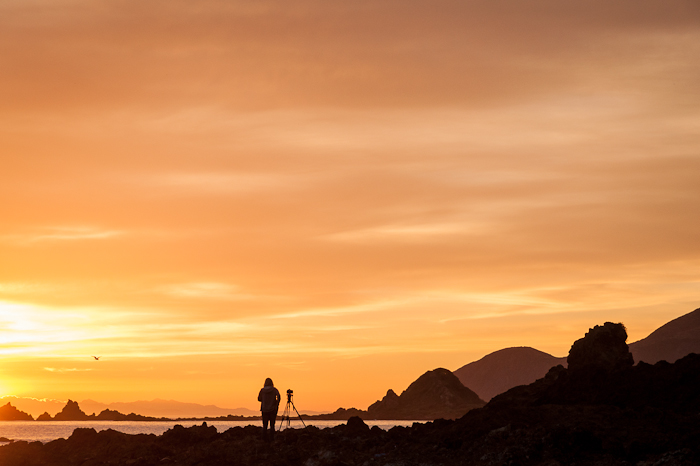
More sunset sightings - photographers at Te Raekaihau Point

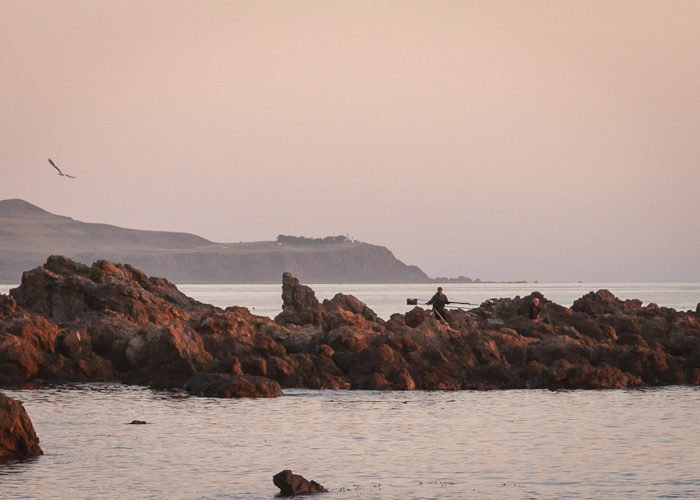
Enjoying the evening at Te Raekaihau Point we watched the unfolding of a vividly colourful sunset.  I also enjoy the more subtle colours in the sky facing the sunset, and was admiring the golden light on a rocky outcrop and the pink sky above Baring Head.  This is a crop of a much larger image - although I saw some movement I couldn't see the photographers until I looked at my photograph at high magnification.  This is a bit like a sighting of a rare beast which blends into the scenery!  I have captured a photographer with what looks like a view or field camera on a long-legged tripod - but I'm not completely sure about this.  The stance of the other photographer is more effective for camouflage.

Such film cameras are rarely seen, especially in this digital era.  The large size of the film used in field cameras can give exquisitely detailed images.  But the cameras are cumbersome and the process of using them is different, a measured, thoughtful and almost meditative process requiring more deliberate learning and skills, than what is required to use the remarkably easy and able digital cameras we are now blessed with.  There is plenty of room for both approaches to photography - the thoughtfulness and observation involved in carefully choosing how the image is going to be made, as well as the happy ease of being able to click away and get pleasing images regardless of knowledge and skill levels.  Using a tripod is just that little bit more hassle, although you can get carbon fibre ones that are very stable and very light (and very expensive!), but using one means that you are slowing down a bit, maybe thinking a bit more, and can maximise the possible quality of the image.  On this occasion I was in casual mode - it was a lovely evening, I didn't have my tripod and relied on the fact that digital sensors are so much more light sensitive than the films I used to use - even in my middle-aged digital camera - and I wasn't trying to get a perfect shot.  There were plenty of people who were using cellphones and other small cameras, and other photographers who appeared to be waiting with more serious purpose...

The sun is just about to set, and the colours are bright and intensifying.  Most of the humans on the Point seemed to be paying attention.  No surprise that phenomena involving the sun seem to have a special pull for us - after all, this is the star we all depend on!

Wiwi at Te Raekaihau Point

Wiwi, or knobby clubrush, side-lit by the soft light at sunset, looking golden and rather prettier than its name might suggest. The seedheads are close to the end of the stems, and they are thought to be club-like in appearance - I can't see it myself.

It is a sedge (not a grass or rush), quite adaptable it seems, native to Australia and New Zealand.

Here it is growing in the tough conditions of the south coast at Te Raekaihau Point - a translation of this name is "the headland that eats the wind" and this gives a sense of what it is like!  Another little reminder of Wellington's qualities is the fact that a major earthquake in 1855 lifted this area up 1.5m, creating the point as it is today. 

As part of the rehabilitation of this area, which had been degraded by different (ab)uses, there was a survey of the plants, and wiwi was recorded as growing here.  It is thriving now, as work has been done to protect and enhance the environment - better for all.

There were a lot of people there enjoying the beauty of the location, and the sunset.

Big herbivore, small carnivore

A katydid dines on the bruised pink petals of rose Mrs Doreen Pike.  The long antennae assist navigation at night.  Because they are often nocturnal and usually well hidden, I don't often see katydids.  This one was easily seen perched on its pink meal but the bright green colour and vaguely leaf-like appearance made it pretty difficult to spot when it moved back under the rose leaves. 

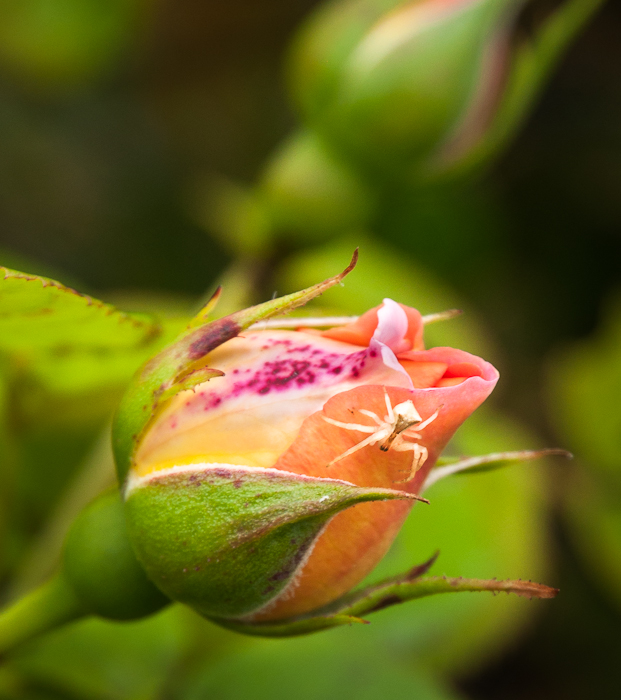
Another beastie spied on a rose was less camouflaged, but much smaller and harder to spot for that reason...

It seems to me similar in shape to so-called square ended crab spiders.  This tiny white spider perches on a rosebud -  probably waiting for tiny prey.   The rose is safe - no veggies for this meat-eater!

Sunbeams at sunrise - it's a new day

A beautiful beginning to the day...

Looking across Island Bay to the Orongorongos - one end of Taputeranga can be seen on the right side of the image.  The golden orange colour is intensified by particles in the atmosphere carried here on the wind from the bushfires in Australia.

Weather! - wet and/or windy

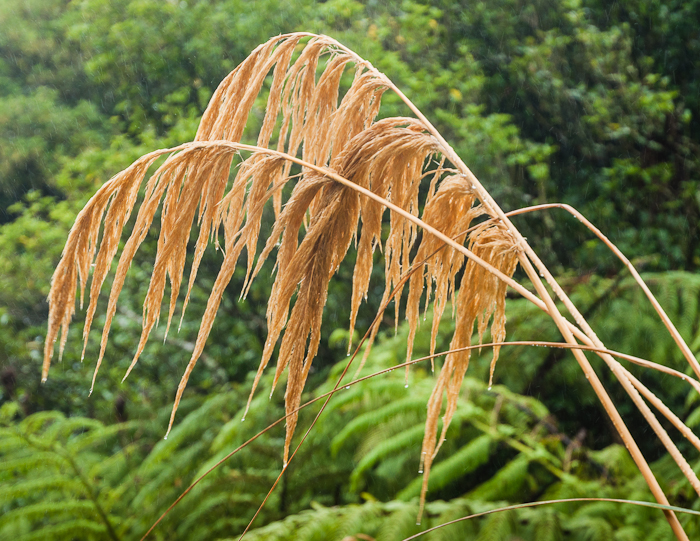
Never boring, although a bit repetitive - the weather keeps changing.  Really wet days help to keep things green, although these flower plumes of toetoe (Austroderia sp), a tall native New Zealand grass, are sodden and darkened with the rain and no longer their usual fluffy cream-coloured selves.  Normally they have an elegant droop, but when this wet they are clumped and heavy.  The streaks of rain are just visible against the backdrop of shrubs and treeferns at the edge of the stream where the toetoe grow. 

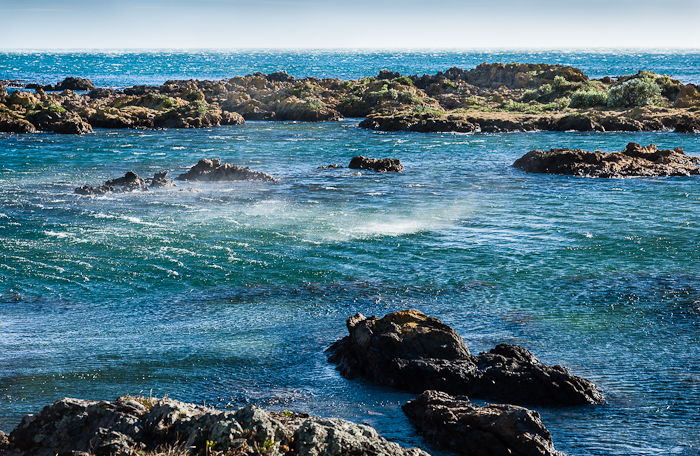
It stops raining and starts blowing - drat, says the gardener - the wind hampers growth as plants hunker down, closing their leaf stomata to protect against the drying out that wind causes - reducing photosynthesis and thus growth as well.  So much for the benefits of that rain.  But the wind is quite something.  Really windy days stir up the water along the rocky shore...

Flurries of seaspray, the surface of the water rippled and churned and the mist and whitecaps in the distance obscuring the line between sea and sky - this is turbulence caused by northerly gales.  It is very difficult to convey how strong the wind is in photographs!  The foreground is the intertidal zone on Wellington's south coast at high tide.  Imagine being a little seaweed, churned by the water, then exposed at low tide - not an easy life.

Tiny mushrooms

Appearing on the surface of some used potting soil, a mix of homemade compost and commercial potting mix - tiny (about 3 cm tall) transient fungal fruiting bodies, exquisitely delicate and lasting only a few hours from opening to collapse.  Careful study of various fungus identification sites told me that this is a mushroom in form being soft and fleshy with gills under the cap, but yielded no clear idea of its name.  Anonymous but beautiful, and reminding me of a world about which I know little...  

I do know that fungi are very important to our survival - they are involved in recycling organic matter and assisting plants to get the nutrients they need from the soil, are the source of medicines like penicillin, and are used for biological pest control.  They also provide us with tasty nutritious meals, but not without some risk - there are very poisonous ones, so there is an element of adventure for those bold enough to gather them for consumption - how good is my identification?  Given what little I know, I'm sticking with eating the cultivated ones!