It's an ill wind...

It's a new day, sunny but still ferociously windy.  And as the saying goes, it's an ill wind that brings no good.  The strong northerlies sculpt some interesting cloud shapes and we have enjoyed the phenomenon of lenticular clouds...
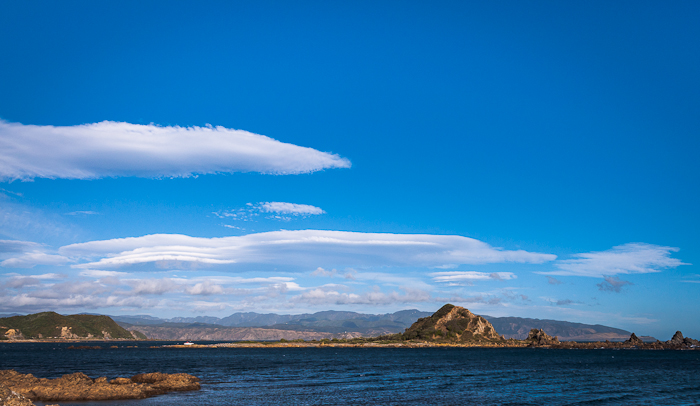
Lenticular (lens or lentil shaped) clouds can be really weird looking - sometimes very like "flying saucers", or thought to be UFOs.  These ones, seen when looking across Island Bay, are stretched out and layered.  It is late afternoon, the light is bright and there is a very strong northerly wind - you can't tell, but it was hard for me to stand steady when I was photographing this sight.  Lenticular clouds are stationary although the winds around them tend to be strong, a feature appreciated by glider pilots.  These clouds appear to hover over the water, echoing the distant Orongorongo ranges and drawing the eye to Taputeranga.   

Bright relief - Coleus colours

Let there be brightness!  On a grey windy day it is a great relief to retreat to the warmth of the Begonia House in the Wellington Botanic Garden.  Ahhh - to have a moment in the soft moist warmth of the tropics.  Coleus is a tropical plant from Southeast Asia often grown for its brilliant - some would say strident - display of multicoloured leaves.  This one is Solenostemon scutellarioides - there are other plants also called coleus.  The leaves can be very decorative in shape - these have scalloped edges to a varying degree - I think they would be described as having crenate margins in botanical terms.  

It may sound fanciful, but to my eyes we have:

the golden yellow and lime green of sunshine, 

burnt sienna, pink and lime green of a warm day

and a sunset of brilliant pink, lilac and purples.

And another day is around the corner...

Wind - give us a break!

Living here means accepting that we will experience frequent harsh winds, but after a gentle spell of sun and calm the gales we are getting again are particularly unwelcome, to me at least.  The lily flowers are bruised and battered, sigh, but the buds will provide another beautiful display when the gales have passed.  Doing their remarkably effective wind-baffling in the meantime are two NZ native plants...

Muehlenbeckia astonii and Brachyglottis greyi, together making an informal hedge and windbreak. 

The divaricating form of the Muehlenbeckia with its dense tangle of zig-zagging wiry red branchlets protects the tiny bright green heart-shaped leaves and little white flowers, and it disrupts and slows the wind flow.

In bright contrast is the Brachyglottis with its profusion of daisy-like yellow flowers.  It has more substantial branches and makes a dense and wind resistant bush.  The bright silvery hairs on the branches and leaves protect them from dessication, and have a lively brilliance no matter how dull the sky.

The sunny silver and gold and the tangle of red and green - together a formidable team.  Not by blocking  the wind - dense barriers actually make things worse by increasing turbulence downstream - but by diffusing it, slowing it down, and still letting the light get through. 

Glorious lilies

We are having a patch of lovely warm days - sunny without much wind.  Glorious!  And my lilies have begun to bloom.  They are a form of Lilium longiflorum - called Easter Lily in the northern hemisphere as it can be induced to flower at the right time for Easter celebrations there.  From islands off Japan and Taiwan, its Japanese name is teppouyuri, I understand. It is a coastal plant, growing on woodland edges.  This may explain my success - I find it remarkably easy to grow in my windy coastal location.  But I do take care to grow it in a very big pot well sheltered from the wind.  It multiplies happily, new plants arising from the numerous bulblets separating from the bulb. 

The beautiful lily flower has been used to convey a variety of ideas and spiritual messages, and for some people it is also associated with grief and death.  I appreciate these associations which come to mind when I enjoy the lilies - life, death, love, simplicity, peace, the gift of life and nature, beauty and abundance, appreciation of what is.  

What a gift!

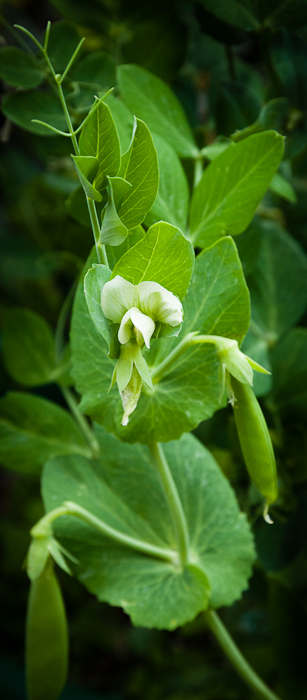
Pretty special peas

Even if you don't have a garden it is possible to enjoy eating vegetables that you have grown in containers - some are just extra tasty when fresh. 

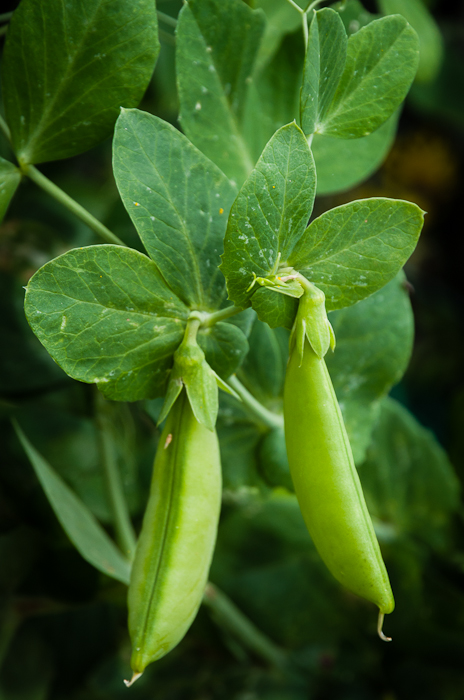
Sugar snap peas are edible podded, or mangetout, peas - meaning you can eat the peas in their pod rather than shelling them out.  I think of them as a crisp sweet treat picked fresh from the plant, and if you have good self-control they are great added raw to salads or cooked in stir fries (but why cook them, I wonder, when they are so nice fresh?).


Instructions for growing peas are readily available, but my approach to growing them is determined by two features of where I live - WIND and precious little  topsoil.  Pea plants are climbing plants - described as having a "vining habit," their tendrils are amazing in their capacity to cling on to anything that helps them reach up to the sun.  However, there is a bush form of the sugar snap pea, and that is what I use - I don't want them growing too high because the wind will just wreck them, and they are ok with being grown in pots. 

Pea plants don't like really hot weather and so are best planted early in the season, with the aim of having lots of production before high summer.  But I plant them when I remember, confident that we will not get too hot in the summer - there is an upside to our less than perfect weather! 

You have to be careful not to disturb their roots when transplanting but I prefer to plant the seeds in starter pots to protect the little plants from snails and wind till they are reasonably robust.  Then I transplant them in groups of 3 or 4 into reasonable sized pots - at least 30cm diameter and around that in depth to give a decent root zone, in a mixture of home-made compost with some commercial potting mixture and a bit of fine pumice added to help with drainage.  While they are more tightly packed together than recommended, they protect and support each other this way.

I can move the pots to keep them in enough sunshine and enough shelter - it's a pay off. 

They will often have less than the recommended minimum six or so hours of sunshine, but still they thrive.  I do have to remember to keep them from drying out - pots and raised beds are much more vulnerable to this.

I think that these pea plants are very attractive with the fresh green leaves and pods and the creamy coloured flowers. The peas are produced in reasonable abundance - you just have to remember to keep watering the plants and picking and enjoying the peas.   Growing for substantial food production is a really different business from my casual approach - but what I do is realistic for me.  While I have managed to improve the soil in some parts of our section, the wind exposure limits what I can plant in those areas, and I am learning to be realistic about what I can hope for, and to enjoy what I can grow. 

And to me these peas are, indeed, pretty special - I recommend them!

New Year's light show

Northerly gales (again!) so no big New Year's Eve fireworks display, for safety reasons.  Still - nature's light show, while not as bright or quite as loud, was impressive.  The late afternoon light at Island Bay was moody and dramatic with the clouds whipped into interesting contrasts and textures.  No sign of the South Island, hiding behind the clouds in the distance, but Taputeranga keeps watch over the bay...

Further along the south coast towards Owhiro Bay, and later at sunset - another light show...

The soft colours of sunset in the golden glow of evening, with contrasting clouds and seagulls seeming to scud along in constant motion - yes, those little dots that look like sensor dust on my coastal photos are the ubiquitous seagulls - a happy constant, the gulls and the beauty of the everchanging vista.

Christmas crimson - pohutukawa flowers

What a sight!  Looking up at the profuse display on a tree that was in full tilt bloom on Christmas Day, the bright side lighting emphasising the texture of the thousands and thousands of red stamens with their little golden tips of pollen.  Every which way you look right now there seems to be another display of rich reds, scarlets or crimsons, catching the light and lighting up the rather greyer days that have followed the record setting sunshine of Christmas Day. 

What a difference a day makes!

Christmas Day - Wellington's hottest one since the 1930's - around 28 degrees C.  And while it is the same part of the coast as yesterday's image, the view is rather different...

In the mid afternoon the light is bright and contrasty, and people are enjoying Princess Bay - some brave souls are swimming (the water is not tropical!), others are paddling and playing at the water's edge, and a kilted and Santa-hatted man is joining them - it appears that his job is done, no parcels to be seen.  Others are enjoying barbecues, snorkelling around the rocks or just sitting and admiring the view.

Light puffy cumulus clouds over the South Island.  The bright blues of a sunny day, evident in the calm sea and the shadows in the distance.  No shrouding of clouds today, quite open and expansive.  Gorgeous.  Appreciation for it all, whatever the weather!

Rolling back

Christmas Eve - the airport has been able to function, but still the fog has lingered over the south coast -  past Island Bay it looks almost overwhelmed by a really thick blanket of dense fog covering the hills.

But we can see Island Bay, and a wider view from Princess Bay shows that the clouds are in retreat, the light is breaking through, and the gloom should be gone for Christmas!

Looking dramatic, but there is light - the south coast, with Taputeranga and the Island Bay hills cleared of the fog and visible in the distance.  Blue skies are appearing - the sombre mood is breaking.

Where's the sun?

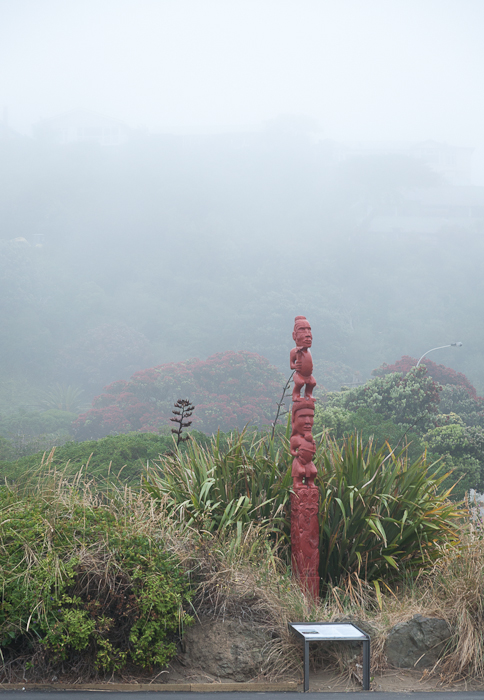
Nothing stays the same, certainly not the weather in Wellington.  Remnants of tropical cyclone Evan, which caused death and devastation in Samoa and damage in Fiji, delivered warm moist air over the North Island.  Connecting with cooler southerly air this resulted in a dense mist around the coast - fog actually, since it reduced visibility to less than a kilometre - closing the airport and frustrating the travel plans of people wanting to get away for Christmas.  The bright reds of the pouwhenua (carved marker post) and pohutukawa flowers at Shorland Park in Island Bay were muted by the mist and the hills and houses behind were barely visible shadows.

Shorland Park is across the road from Island Bay beach.  With a children's playground, band rotunda, barbecue and picnic facilities, it is a popular place for people of all ages, and a very good place to enjoy your hot fish and chips from the local shop while admiring the views.  But not with this fog - even the island was hidden from view!

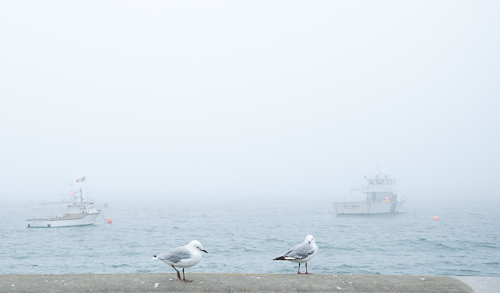
No island, no bay, no distant headlands to be seen.  Nor was there much on offer from humans for the scavenger seagulls on the wall by the beach - no people out and about, only those fishing boats closest in able to be seen, and no fish to be had from them. 

Sigh!