WOMAD - it's a wonderful world

WOMAD (World of Music Arts and Dance) is a celebration of being human, enabling participants to connect with people and their cultures from all around the world through their music.  The video clip on http://womad.org/about/ gives a sense of what it is like - a glorious diversity of musical talent and styles, and an introduction to or reminder of the lives and issues for people in other countries.  WOMAD New Zealand is hosted by New Plymouth every March and the welcome by the local Taranaki Maori people is often cited as a highlight by the performers from around the world.  This wonderful festival is made even more special by being in a lovely location - the Bowl of Brooklands, with the backdrop of Pukekura Park.

The main stage faces a steep grass rise and is backed by trees with a reflective pond in front - the image above shows a corner of this.  More stages and areas for workshops, cooking demonstrations by the musicians, food and arts and crafts markets and so on are all in the park up beyond the hillside of the Bowl.  With all the dancing and walking WOMAD exercises the body as well as the senses.

This image shows about half of the Bowl of Brooklands - it extends steeply beyond the viewpoint, creating a kind of grassy amphitheatre.  Despite the number of people the mood of the crowd feels happy and easy going, so there isn't the feeling of pressure that such a crowd can cause, but so many people does make for messy photo edges!  The Soweto Gospel Choir are performing, and the large screen behind them gives a close-up view.  I really appreciated the extra sense of engagement from seeing the musicians so clearly.

Seen from near the side of the stage, the colourful crowd is packed up to the edge of the pond.  The steep path up to the rest of the venue can be seen in the background, and this view still does not cover all of the Bowl of Brooklands, nor give an idea of all the colourful flags and artworks displayed through the site.  This was on Saturday, which as you can see was sunny.  Not so the Sunday...

Can you see the rain?  It provided a welcome but too brief interlude to the drought, and stopped falling the next day.  The band played on - in this case it was The Melbourne Ska Orchestra - and the audience donned colourful rainwear and umbrellas and danced on - a bit uncomfortable, but too many mustn't-miss events.  The music continued regardless and it was great. 

On Sunday evening the Children's Parade is held.  The many children who attend WOMAD have the option of involvement in art workshops over the three days, making costumes and creations for this colourful event.  The theme this year was about rubbish, recycling, and the natural environment.

The Melbourne Ska Orchestra led the parade, which went down the hill, around past the stage and then back up the hill again.  (On the stage in the background you can see the Aotearoa National Maori Choir and the Yoots getting ready for their performance which followed the parade - a joyous sing along). 

It was happily chaotic by the time they got to the top of the hill.  There was much beating of drums and tooting of horns and taking of photographs.

Then the Ghostnet Taniwha appeared, woven from discarded fishnets and other debris which can be so damaging to marine life. 

Supported by a large number of young people, the long tail undulates behind it, reminding me of the dragons in Chinese New Year parades. 

And looming behind it were the Alien Junk Monsters. 


As their name suggests they are made of rubbish - unwanted materials which have been repurposed in a most creative way.

Three Alien Junk Monsters, cartoony but serious, as they remind us of all the useful materials that can end up on the scrapheap and be wasted, beating their drums. 

Following on their heels - reminders of the natural world that we want to protect.

Fish hats, sinuous eels and birds held aloft - a big one with a soft rainbow of feathers is cresting the hill.

The limitations of my photography of people in action and of my camera's performance in low light mean that this is only a ragged glimpse of it all.  But what an added pleasure to the feast of WOMAD!  Recycling on the site is a prominent aspect of WOMAD's organisation.  But seeing the children's creative exploration of how we care for the environment was a really delightful way of reminding us about how precious is our world and how important it is that we treat it with awareness and respect - and enjoy it.

Brown hills and blue sea - ongoing drought

The dry continues in the North Island.  The rain that fell almost two weeks ago did not make much of a difference for the poor dry soil.  The Orongorongos always look dry as the summer progresses, but it is now early autumn, and usually they are greening again.  But not this year...

From Karaka Bay, looking across the Wellington Harbour channel, to the Orongorongos.  Close to the shore the submerged seaweeds are thriving and a pied shag sits on a rock, presumably scanning for food.  The turquoise blue of the sea water is in rich contrast with the dusty golden (I think there is some gorse in flower there) brown hills.

The seaweeds growing in the shallows by the shore seem lush in comparison - they have more than enough water. 

The sparkling sea is a very refreshing sight.  Rain would be too!

A reassuring resilience - glasswort

Sometimes I feel very sad and overwhelmed about what we are doing to our planet.  Our government, like so many other "leaders" around the world, seem to have little care about the natural environment or the future of planet earth.  But I have learned that getting upset is not helpful if that is where I get stuck, and that my energy needs to be focused on what I can do to reflect how I connect with and value the natural world.  This blog is a small celebration, my awareness of what is around me, and my invitation to you to enjoy and connect and learn and value the natural world around you.  And I am working on bigger projects, which I hope to share later. 

In the meantime, I find solace in an amazing plant, a survivor which is not deterred by the very adverse salt desert conditions in which it grows and thrives - salt marshes, estuaries and beaches at high tide where it is intermittently exposed and dry, then bathed in salt water...

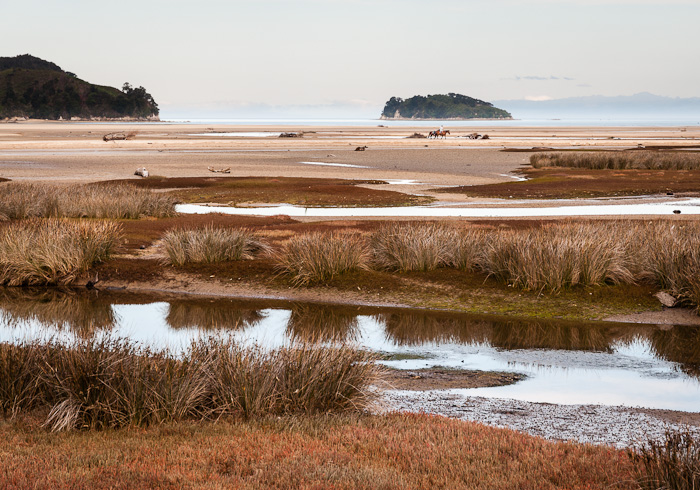
It is glasswort (Salicornia australis or Sarcocornia quinqueflora, Maori name ureure) a small succulent halophyte (salt tolerant plant) which is oddly attractive and actually edible (just don't add salt!).  Here it carpets the upper reaches of the estuary at Marahau, along with the bleached brown tufts of rushes. 

Salicornia species are widespread.  The European version is also known as marsh samphire or sea asparagus, although to my eyes the jointed stems are very unlike asparagus, especially with their varied colouration, here orange, emphasised by the backlighting of the late afternoon sun low in the sky.  It was called glasswort because ashes of the plant were used for making soda based glass.  Versatile, robust, resilient, undaunted - I will take my cue from it.

The subtle beauty of a dense carpet of glasswort at Marahau estuary in the late evening on a summer's day.

Pukekura Park - lit-up summer nights

Summer is celebrated in New Plymouth's Pukekura Park with the Festival of Lights.  Colourful lights are distributed to illuminate the plants, lakes and fountains, and the daytime natural beauty becomes a vibrant and somewhat alien vision at night.  Looking across the main lake towards Poets Bridge and Mt Taranaki, the lights are reflected in the still water and the ducks are quietly getting on with life... 

The view from the bridge in the other direction is even more surreal...

Crowds visit to enjoy the spectacle and associated events and performances.  I find it quite spell-binding and bizarrely enjoyable, but am pleased too to return to the quieter beauty of nature au naturel. 

Rain at last!

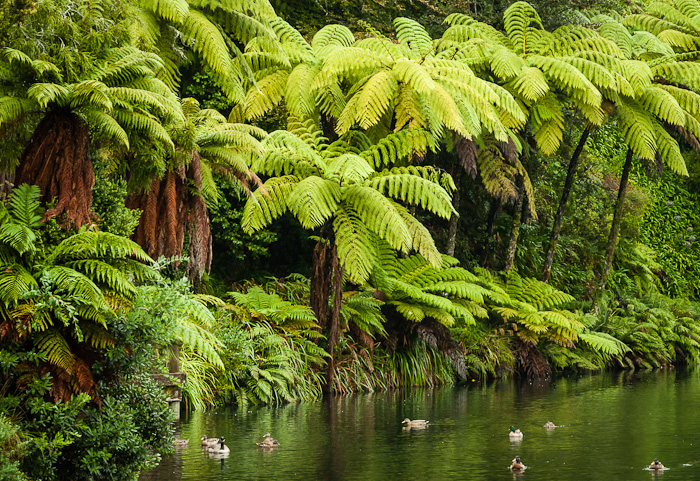
Well, it may have been a damp start to summer here in Wellington but it turned into a very dry season, not just here but all over the country.  For a lot of the North Island drought has been declared.  So the arrival of rain this weekend was a great relief.  I was in New Plymouth and the walk to the lovely site where wonderful WOMAD was taking place took me through Pukekura Park, where the treeferns by the Main Lake looked lush and the resident ducks in their element...

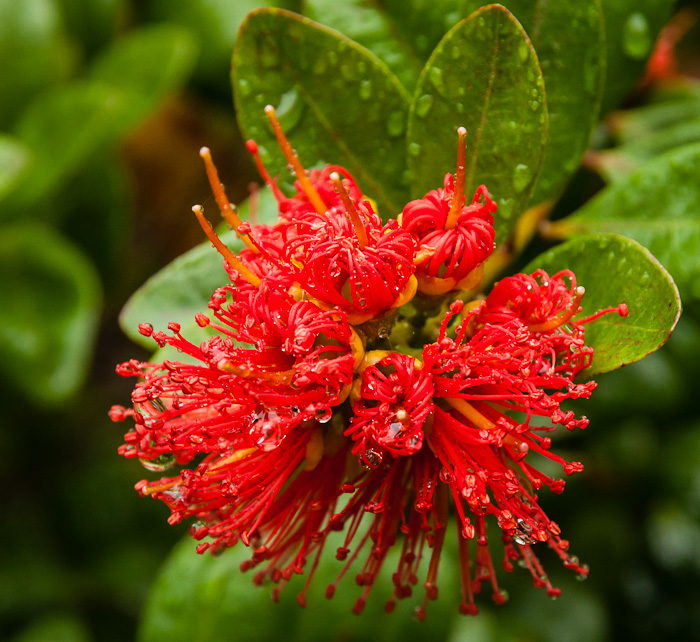
And the scarlet rata was bedecked by gleaming raindrops...

Scarlet rata, Metrosideros fulgens, is a New Zealand native climbing plant or liane which flowers in autumn and winter - the bright flowers stand out in our predominantly green on green bush.  It is found in lowland and coastal forest in the North Island and on the west coast of the South Island, growing up trees - in this case a treefern.  It thrives in warm moist conditions.  So it was good weather for ducks and scarlet rata - not to mention lots of other living things.