Fire damage - before the rain

I wrote about the fire at Owhiro Bay back in February.  Two months later, there had been almost no rain, and the blackened scrub was stark against the dry soil. 

Looking across to the hills, the distant green of native shrubs and gorse plants contrasted with the blackened areas consumed by the fire.  A stand of pine trees showed almost no damage but in the foreground there was a large macrocarpa which had been badly injured and a blackened stump had fallen beside it.  There was a contrasting pattern made by the fire-delivered plant death - skeletal black branches and soft bleached shrubby mounds.  These photos were taken on an atmospheric grey day with clouds which did not deliver, and seagulls circling in the sky providing a rather sinister presence.

Closer up a lone tree on a ridge, probably a native Pseudopanax, provided a glimpse of green among the charred branches.  Gorse seemed to have been thoroughly consumed by the fire, and I wondered whether it fuelled the fire more than the native plants did, but what I saw did not enlighten me. 

Since I took these photos a month ago there has been rain, decent rain.  I intended to go back today but didn't have the opportunity - so tomorrow I hope to see what difference this rainy month has made.

Beached - but still holding fast

A southerly storm and its wild waves subsided two days ago.  But evidence of the disturbance was still to be seen today on the beach at Lyall Bay, including many seaweeds looking curiously like a horde of beached creatures.  The small (compared to the piles of kelp) seaweeds were still holding fast to the rocks that had secured them in the deep until the turbulence had wrenched them and washed them up.

Many of them were a gorgeous red.  Closer up, you can see the soft corrugations of the red blades,

or the texure of papillae on some contrasting with the texture of the sand.

Green and brown seaweeds had also suffered this upheaval.

This brown seaweed has beautifully ridged blades, and you can see its branched holdfast holding on tight to the stone which was its secure anchor until the storm.  On the stone there is a pinkness which could be a crusting red alga.  I await correction! 

A holdfast, as the name suggests, is a structure which holds on tight - but although it looks a bit like the roots of a plant it does not take up nutrients, just sticks incredibly tightly to the surface on which it anchors.  Impressive - the holding fast and the power of the waves.

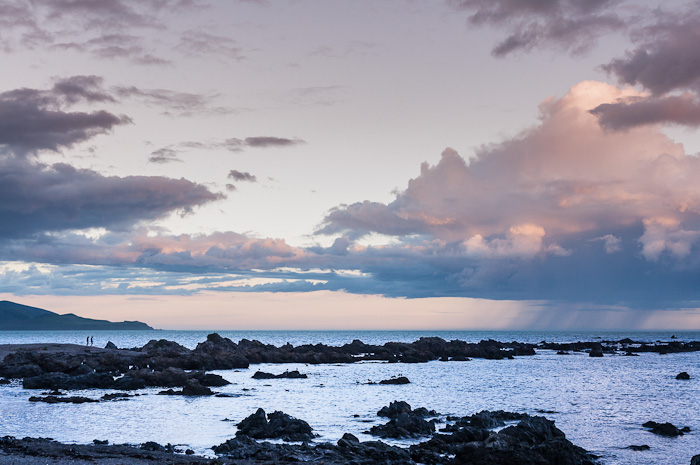
Soft sunset calm - before the storm - at Te Raekaihau Point

It is autumn, but southerly storms bring "instant winter" to Wellington at any time of year and with them there is a big drop in temperature.  But the compensation for the cold is the drama of the clouds and waves, and the contrast of storm times with the in-between times.  At Te Raekaihau Point, at sunset at the end of an unseasonably warm and gentle day, a southerly front was approaching - the clouds a soft pink, the sea still calm and baby blue...

Two people walking on the rocky outcrops were dwarfed by the scale of sea and sky.  The calm mood of the pretty scene was somewhat disturbed by the sight of rain falling from the approaching clouds, the beginning of a southerly storm front. 

Awareness of weather is very much part of living on the south coast for me.  The fluctuations we experience are a profound reminder of how vulnerable we living things are to changes in the movement of wind and water, and that reminds me of climate change and the challenges we all face on this precious earth. 

Dreamy autumnal maple

With stormy weather raging outside I have been enjoying an image from yesterday - a Japanese maple in the Wellington Botanic garden which is usually covered with crimson leaves at this time of year.  Maybe it is the warmer temperatures we have had, maybe the effect of the drought - but only some of the leaves have changed.  With the wind here we never have a "perfect" autumn display anyway - the leaves are usually quite tatty and weathered, ready to fall, which they no doubt will be doing now.

I love the pretty contrast of soft greens and rich crimson, with dappled backlighting angling through the branches - a dreamy look emphasised by a soft focus effect. 

Today is so very different, any softness in the light being due to the dense rain and/or sea spray, depending on proximity to the coast.  In the north there has been torrential rain, in the south there was snow, and here in the middle we have had dense rainstorms, thunder and lightning, gale force southerlies, flooding in the city - generally miserable.  And stormy seas never look as impressive as you might expect in still images, and when I tried to capture an image or two my lens was spattered with salty spray in seconds.  So I turned to the calming beauty of yesterday, anticipating the settling of the storm as its energy dissipates.

Avian invaders

Sighted in their "natural" habitat - outdoor seating for the rose garden cafe, shaded by a grape-vine covered pergola.  There they are, hungry and ready for action... 

Sparrows!  Actually house sparrows - there are hedge sparrows too.  

Likened to the Norwegian rat and the house mouse - hitching a ride with human migration - they seem to be everywhere.  One local cafe, asking people not to feed them, calls sparrows "rats with wings!" 

But despite their pestiferous qualities they are also cute and engaging and, like ducks, are fed quite a bit of bread by children playing here in the rose gardens in the Wellington Botanic Garden. 

Bright eyed and quick moving, these little dinosaur descendants are also ready to take any unguarded food.

Incoming sparrow, wings aloft!

Butter - a fast way to get that winter weight on.  

I have only recently learned the history of the house sparrow in New Zealand - there are differing accounts, but the gist is that a small number were deliberately introduced to help control agricultural pests.  It's the usual story - a small number arrived, they were wildly successful - but not as agents to control pests, more a pest themselves, eating fewer of the insects and caterpillars and more of the grains that were being grown.  Within 20 years futile sparrow-elimination efforts were underway.  Sigh.

And these young sparrows just wanted you to know that they are actually as clean as can be - fluffed up and grooming while perching on the cafe chairs, a brief interlude in the constant search for food.

A coastal rock garden

On Wellington's south coast there are some sandy beaches, but otherwise it is a quite dramatic and really rocky shore.  Despite the harshness of the environment some very determined plants make these rocks home, surviving the lack of soil and exposure to drying salty winds and fierce gales.

A tiny tree - karo, or Pittosporum crassifolium, growing from a split in a rocky outcrop at one end of Houghton Bay, looking towards the rock formations by Princess Bay. 

Even smaller...

A tiny shrublet of taupata, Coprosma repens.  This is a plant which can happily grow into a tall shrub or small tree if conditions are better (see earlier posts). 

In both cases, a seed dropped by a bird has somehow germinated and thrived in a small fault in the rock which is able to collect water and accumulate some organic matter, in effect creating a tiny flower pot.  Of course, the very qualities which mean that a plant can actually develop and thrive in such conditions suggest that it could be overly successful, and that is the case for karo which is seen as a potentially invasive weed in some situations.  And speaking of weeds, there are other plants that grow and flourish on the rocky shore, but these ones are not a problem...

Seaweeds exposed at low tide, growing on the rocks and in the water at the end of Houghton Bay leading to Princess Bay.  At a distance, the plants seem muted, overwhelmed by the overall rather austere appearance of the rocks - the green of little coprosmas on the formations in the distance is barely visible, and the seaweeds seem to be a rather dark and dull presence.  But closer up, they are more vibrant and colourful...

Brown, green and red (I think) algae - the different colours and forms of the seaweeds, including the long sculptural blades of kelp and the bright green of sea lettuce.

Even brighter!  Contrasting colours and forms. 

Time for me to learn to identify the wonderful range of seaweeds here.  And yes, there are seaweed weeds too - invasive aliens coming from ballast water and similar sources, behaving like thugs, elbowing out the locals - its just like the problems that can arise with introduced terrestrial plants, and even some native ones like karo.

Reflections on a Town Belt sunset

Sometimes I find that if I just look up and see the vast expanse of the sky I can feel calmer and get a sense of perspective on the foibles of humankind.  We're just a small part of this very big world.  And right in the middle of Wellington is this well-tree'd hillside, part of the quite extensive Town Belt.  I find it provides a refreshing  backdrop to the central city and Parliament Buildings - this is the capital of New Zealand.  Storms in recent years and maybe the drought we have just experienced have killed a number of the trees.  The rather ghostly presence of their silver skeletons contrasts with the deep green of the live pines and other evergreen trees.

So life, death and regeneration are there for us all to see, in the trees of the Town Belt.  And transience and change is even more evident in the rapidly changing cloud patterns and colours of the sky at sunset - it was golden, then pastel blue and pink, then soft grey all within a minute.

No matter how much human effort is put into being certain and in control, we are subject to the same forces as the sky and the trees.  Maybe if we paid more attention to being in tune with the natural world, we would be more accepting of things that are out of our control, less fearful, stressed and striving, less prone to look for what's wrong and who to blame.  It's a different energy.

A fiery sight

Every autumn this sight grabs my attention.  It looks as if flames are licking along the upright branches of an evergreen tree in the Wellington Botanic Garden.  On closer inspection it is clear that all is well, but there is no lessening in the visual drama.  The fiery colours are the leaves of Parthenocissus tricuspidata (Boston ivy or Japanese creeper) in their full autumn regalia.

When it comes to enjoying autumn leaf colour Wellington suffers a double disadvantage - our maritime climate does not deliver the temperature variations which favour the development of intense colours, and we have winds which quickly blow away any leaves that do put on a display. 

Parthenocissus vines are reliable in colouring up regardless (Parthenocissus quinquefolia, or Virginia creeper, is also a very decorative plant.)  They can be used to beautify walls or unsightly areas or even to provide insulation by shading the walls of a building in summer.  But they are vigorous climbers and have to be kept in check if they are not to smother other plants.

Their display is most welcome right now, as the days get colder and wetter and more grey, and before there is much colour from any other deciduous plants.  This year it looks as though some plants have responded to the drought with early loss of leaves, helping them to manage with so little water - so even less colour from them.  But the glossy leaves and colourful display of these Parthenocissus suggests that they are coping well despite the long dry late summer. 

A close up of Parthenocissus tricuspidata leaves growing along a wall, and many that have already fallen on the grass, showing a glorious mix of reds, golds, greens and pinks.  This image was captured in a spell between the periods of quite heavy rain - which is most welcome, but rather dull!

Rain, rain, beautiful rain - and a tiny snail

At last there has been some decent rain over most of the North Island, and we have had some of it.  There is a lot of catching up before the soil moisture is back to normal but already plants look fresher, more perky.  And the raindrops are a very pretty embellishment.  But wait, there's more...

I was admiring the glistening drops on the rather tired fennel heads, flowering mostly over, seed not yet set, when I saw a tiny snail.  Generally I don't regard snails with fondness - they have big appetites - but this diminutive version was very appealing.  It was so young it had a white foot and its pale translucent body, when extended - presumably in search of food - revealed some of the little snail's anatomy. 

With its body stretching upwards we see the eyespots at the end of its two long tentacles and the smaller tentacles above the mouth are also extended.  The dark nervous tissue coming down from the eyes forms clumps, or ganglia, and the pale brown streak is its gut, I think.  The white foot is holding on to the stalk of a fennel flower.  At the junction of the shell with the body and foot there is a little dark spot with some glistening around it which I think is moisture beside the breathing hole.  It was on the move...

Food!  In the act of feeding on a fennel flower, its little white foot holding on tight.  As it ventured further up it was lit by the bright overcast sky.

With this backlighting the dark ganglia are even more evident as is the delicacy of the shell, showing shadows of the organs it is protecting.  But the little snail is now quite exposed...watch out for the birds!

And oh for a macro lens - these are tight crops, so I regret that they can't be enlarged further.  But I still had fun finding out more about snails than I knew before, and enjoying some small-animal cuteness.

Friend or foe? - Muehlenbeckia complexa

On a farm fence line, wiry brown stems intertwining to make a tangled mass - a New Zealand coastal plant - Muehlenbeckia complexa.

Pohuehue is the Maori name but it is also called wire vine, for obvious reasons. A vigorous vine, with support it can climb to 4 or 5 metres, or it will clump along the ground to form a dense groundcover - great as a shelter and nesting site for birds and a habitat for insects, lizards and other small beasties, and useful for dune reclamation or smothering introduced weeds. 

But these qualities also mean that it can become a weed in its own right - it has become established and problematic in Australia and in California.

Here it is beginning to form a hedge at the edge of a paddock. 

Although it looks rather dull from a distance, it has very pretty little cream coloured starry flowers and it produces black seeds held in little fleshy white cup-like berries - food for the creatures that shelter in its dense cover. 

So - in the right place a really useful plant supporting the ecosystem,  but an invasive pest requiring a sustained eradication/control programme in San Francisco.  Success in the plant world is not always welcome in the human scheme of things.