Calm waters for paddle boarding

Not much wind, high cloud, the water is calm and flat and the light is too - softened by the cloud cover, rather muted.  Altogether a gentle kind of day.  And in the early evening, coming along the coast road I spied some stand up paddle boarders, taking courage presumably from the calm waters and making their way quite a daunting distance around to Island Bay.

Accompanied by a swirl of seagulls, and dwarfed by the setting, two people paddle their boards towards Island Bay.   As they approach Taputeranga a fishing boat is heading out from the shelter of the bay.  Island Bay is part of a marine reserve and the situation is unusual in that it also provides mooring for a number of fishing boats - which needless to say, have to leave the reserve area in order to do the fishing.

Fishing boat passing and paddle boarders approaching Taputeranga.  They are almost invisible, swamped by the vastness of the soft blues of water and sky and the rugged rocky outcrops of the coast.  (And one paddler was indeed swamped by the wake of the boat - but he got up quickly again, and all was well - they made it to shore.)

For the birds - Taupata (Coprosma repens) in fruit

The rich glossy green leaves of the "mirror plant" taupata (Coprosma repens) have persisted despite the drought (still no decent rain here!) and these remarkably resilient coastal plants have been fruitful as well.  Their bright orange berries, technically drupes because the juicy flesh encloses the seeds, are very attractive to birds. They feast on them, liberating and spreading the seeds.  Thus taupata plants pop up in all manner of locations - on rocky outrops on the coast, low growing as if they are crouching in response to the wind and the ocean spray, and at the other extreme as small trees with more abundant leaves and upright spreading form where there is good soil and a better life to be had. 

A self-sown small tree has grown by a wall at our gate and arches over it, shaped by the wind.  Every time I open the door to walk out it seems I catch the sight of a bird, often a blackbird at present, quickly pecking at another berry before making a tut-tut noise and flying to a higher spot.  And when I walk under the arching branches of the little tree I can look up to see the bright green of backlit leaves and the luminous orange of the ripe fruit, glistening in tight little bunches.

From summer through autumn the bright orange drupes of taupata provide a colourful display, a feast for the eyes and the birds.

A beastly sighting - a bag moth caterpillar

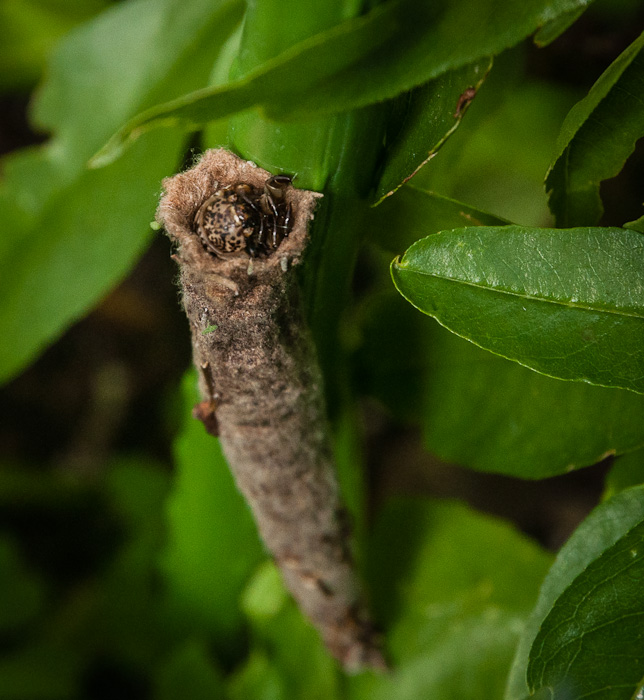
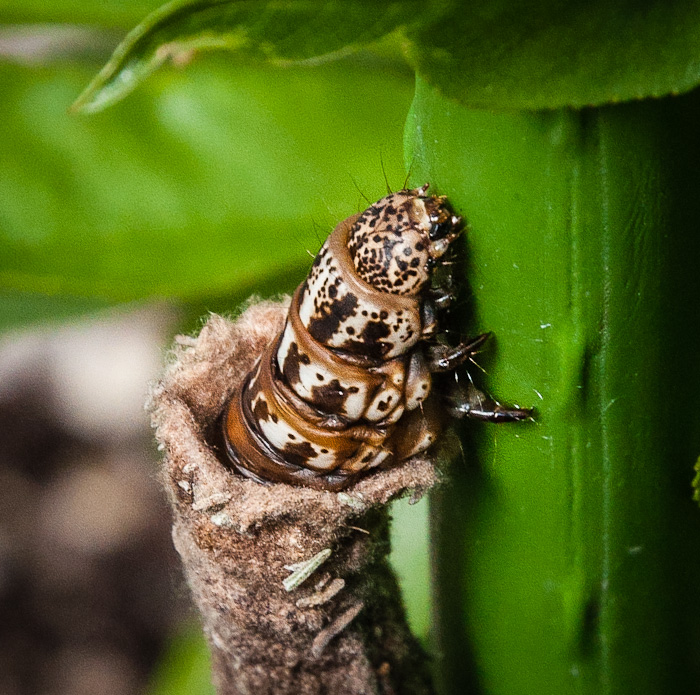
There is always something new to learn.  Today I saw something unexpected and unfamiliar - and, I confess, I found it quite unattractive and a bit disturbing at first - maybe because I didn't know how to regard it.  Was it a benign beast or was it more sinister?  Maybe its distinctive colouring was suggesting "don't mess with me!"  (Often brightly coloured caterpillars are advertising to predators that they are poisonous or unpleasant to eat - they don't need to try and hide to survive.)  Or maybe it was just that it took me by surprise and I was sure it was up to no good on my dwarf almond tree - although it was actually just hanging onto a green garden stake, and moving up it ever so slowly.

But soon enough it emerged again, just the first few segments stretching out then pulling the long brown bag up a small distance, then stretching out again. 

Thus it gradually climbed the stake.

When I went to check it later, it had disappeared.  By then I had figured out it was a bag moth caterpillar.  There are many different bag moths and many styles of bag decoration/camouflage, and while the male bag moth has wings the females are wingless and often don't leave the larval case.  They tend to have tough eggs, usually left in the protection of these tough bags.  While this sounds like a smart strategy, they are often subject to parasitic attack.  Nothing's perfect.  In this case the bag had an almost felted appearance, with little decorative bits of plant and twig.  It reminded me of homespun fibres.  Which it was, and it was a spun home too.

Honeybee on helenium flowers

Autumn flowers are like autumn leaves - often brightly coloured in golds and reds - but for different reasons.  The colourful leaves of deciduous plants are letting go, having fulfilled their function.  Autumn flowers are active, producing pollen, attracting bees, setting seeds.

A honeybee at work on helenium flowers.  Heleniums are often part of colourful autumn displays.  Originally from North America, they were called swamp sunflower or sneezewort (quite a few flowers have this connection, but this time it is not because of the effect of their pollen but because the leaves were used to make snuff, apparently).  There are a good number of garden cultivars in gold and red colours.  I haven't grown heleniums, but they are said to be easy to grow and disease resistant, preferring rich moist soil.  But despite the dry conditions they were putting on a great display in the Wellington Botanical Gardens.  And the bee was busy appreciating them too.   

Red sky in the morning - will the drought break?

Not yet, alas.  This was the display yesterday morning, looking over Island Bay, past Taputeranga, to Baring Head.  Like fireworks, but according to the sayings this brilliant colour is associated with rain.

There are clouds, there was a little drizzle and rain, but it is fine again - real rain is yet to come.  How dependent we are on nature.  How beautiful it is regardless.  How small we are in the scheme of things, really.