Apple blossom - on my brave little Autento

I have learned not to get too upset by Wellington's ferocious equinoxial winds - what's the point, the wind isn't going to respond!  And I live in a very exposed spot.  We get gales (defined as an average wind speed of 62-74km/h) regularly both from the north and the south.  But this is where I am and I want to be able to grow happy plants - what to do?  The first step is to notice what actually grows in your location.  Here in Island Bay I saw apple trees that seemed to be doing quite well.  So apples were worth a try - on dwarfing stock so the plants don't get too tall and thus more exposed to wind. 

I have two modern apples - Autento (Delcoros) and Tentation (Delblush) from Delbard, a French nursery that was already of interest to me because of beautiful roses they have bred.  Like roses, modern apples are bred with disease resistance in mind - the use of pesticides and fungicides is being limited as we become more aware of the problems they cause.  And plants in my garden have to manage without being sprayed - I prefer organic practices if at all possible, and it is just being realistic about my way of doing things - I am not particularly interventionist.  Using older varieties which have proven their disease resistance over time is another way of ensuring we can have safe gardening practices, and there are really great people who have collected heritage varieties so that they are not lost to us. 

Autento has been a great success despite inauspicious beginnings - scaffolding fell on the plant breaking off branches on one side.  And the wind hasn't let up just because it had a hard start.
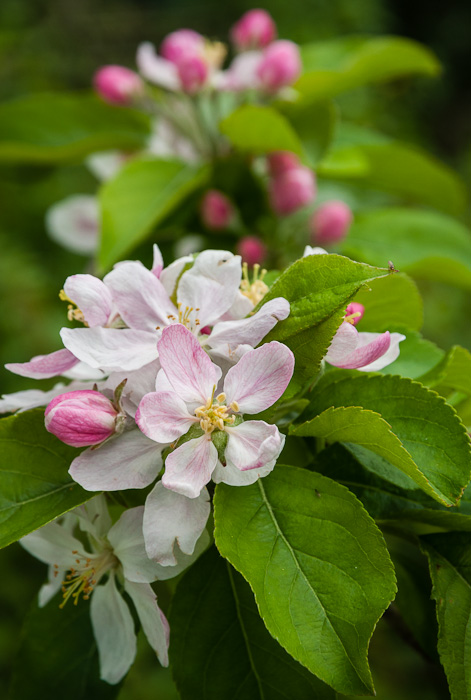
But spring brings blossom -

the pretty pink buds and blush flowers of Autento blossom framed by the soft fresh green new leaves -

with the promise of delicious apples - crisp and tangy, a good strong apple flavour, and they store well.

It is still a small crop from this tree, but there are many layers of pleasure from growing it.  A suprise is that it reminds me of how lucky we are to get such generous supplies of tasty apples from local growers.  I enjoy the particular flavour and quality of the Autento apples.  And  I am able to enjoy many different aspects of the life of this plant including its beauty and resilience - not least the amazing capacity of trees to heal themselves when branches are lost. 

I love my brave little tree!
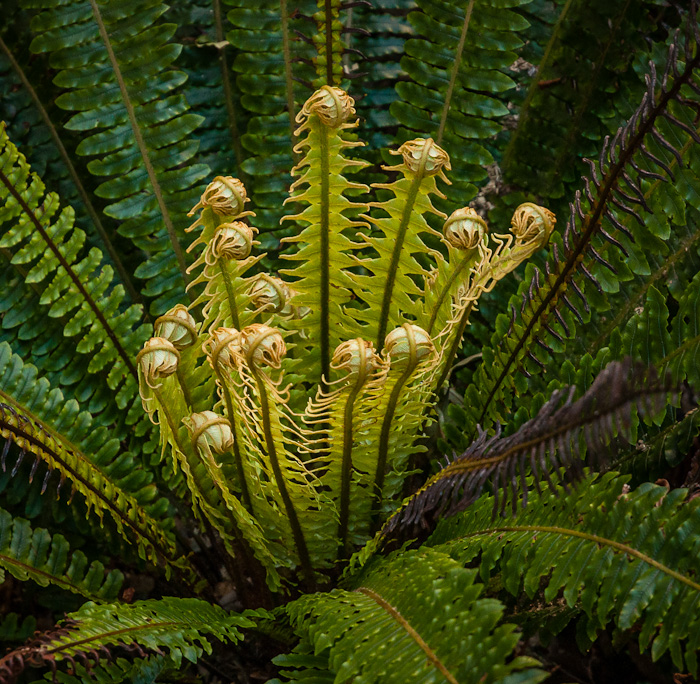
A fresh crown - unfurling fronds of Blechnum discolor

Who cares about the weather if you are sheltered on the forest floor?  Blechnum discolor is a native fern found there in a number of different plant communities and locations within New Zealand.

Different Maori names are cited by different sources - kiokio, piupiu or petipeti, and it is also called the crown fern.  The pale fronds that are unfolding, fresh spring growth, are sterile.  Spore bearing fertile fronds are very dark and look spindly and shrivelled. The old ones here are not easy to see. 

This fern can be the dominant plant on the forest floor, making a rather enchanting covering of crown-shaped clumps.  At Otari Native Botanic garden where I took this photo there are several areas where they are growing in this way.  As they mature the plants can develop woody trunks up to 30 cm tall, like little tree ferns.  It may sound strange, but to me they have a perky quality, little characters holding their own amidst the big trees.

And then shine -

Relief - after the rain there is light...

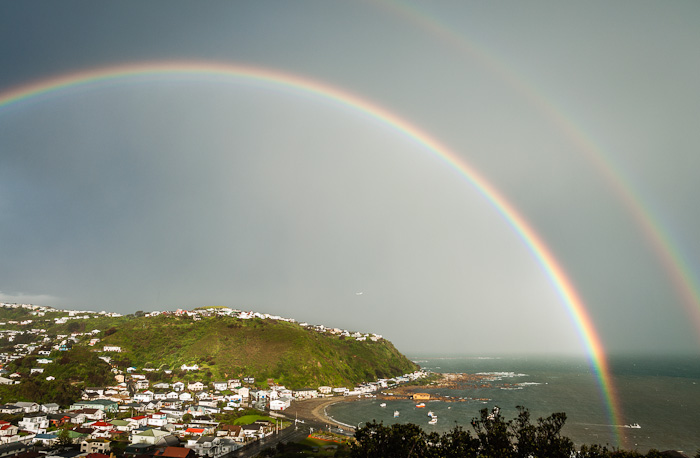
A dramatic glow over Island Bay -  bright light breaking through the mist and creating a double rainbow.  The rainclouds were still so dense you couldn't see the Orongorongos across the water from Island Bay.  A tiny white dot in the sky is an airplane taking off contrasting with the dark of the clouds.  

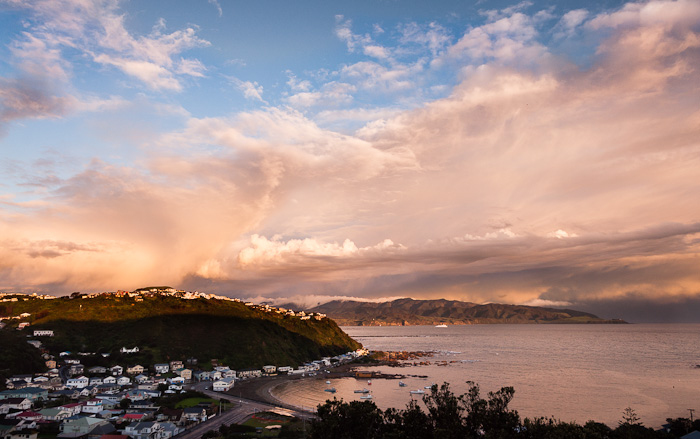
Less than an hour later, as evening falls, a different light.

The pink of sunset colours the sea and the soft cumulus clouds.  The dark rainclouds and mist recede over the Orongorongos, now visible.  Shadows are muting the beach and hillside, but a ferry leaving Wellington is brightly lit in the much more focused and fading light.

Rain!

It's been raining...

The sparkle of raindrops on rose leaves,

and on the delicate leaves of fennel - drooping gracefully under the weight of tiny droplets lined along each leaflet.

Storm stripped Phormium leaves - muka revealed - and when is a flax a flax

Equinoxial winds continue to blow.  People can feel besieged by the weather, irritable, restless.  Tender spring growth suffers, plants are bruised and battered.  But some of the damage is curiously attractive.  The long strappy leaves of Phormium (harakeke, New Zealand flax) growing along the waterfront near Te Papa have been stripped by the pummelling of severe gales.  Long pale strands of fibre hang from the leaves like a cascade of silver.  This fibre, revealed when the fleshy part of the leaves is scraped away, is called muka in Maori.

The muka is strong and flexible.  It is the reason for Phormium being called New Zealand flax, even though the plant Linum usitatissimum which is traditionally called flax and used to make linen is very very different - it is an annual with slender stems, pretty blue flowers and little grey-green leaves, and grows about a metre high.  The strong fibres come from the stems and it is also the source of linseed oil. 

Just to complicate things, we have a native Linum too, Linum monogynum.  I have never seen Linum usitatissimum in the flesh, but the similarity is clear from the descriptions.  Our Linum is a little delicate looking thing compared to Phormium.  As far as I am aware it has not been used as a source of fibre, but confusingly, I have seen it called flax too. 

Described as a subshrub or a short-lived herbaceous perennial it grows about half a metre high.  The white flowers continue from spring to summer and it seeds a lot - I always have little seedlings popping up to replace the ageing plants.  Despite its rather fragile appearance it grows well in poor coastal conditions and can be used in sand dune restoration. 

And despite all the battering, this year along the south coast there are so many flowering spikes on the Phormium plants they are looking like a little forest.  Impressive!