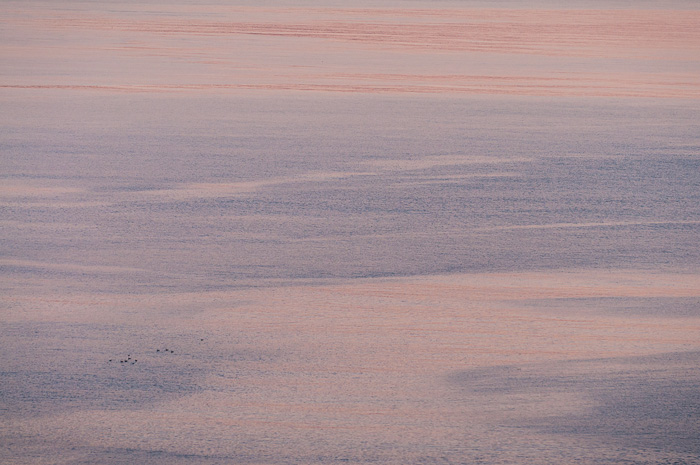
Peaceful waters

Island Bay has many moods.  At sunset on this early autumn evening the water is calm, with subtle texures reflecting the gentle water movement. 

The colours of the sunset are reflected in the water - pinks, lilacs and grey-blue.  A small group of seagulls float on the water, giving scale to an otherwise quite abstract sight.

The Golden Bearing - a sculpture by Reuben Paterson in Pukekura Park

Pukekura Park in New Plymouth is a lovely green and well-tree'd hilly space, the slopes surrounding peaceful waterways.  Located in a valley described as originally swampy and tree-less, since 1876 it has been shaped (creating an open central lake meandering into a sleepy sheltered upper lake, a number of smaller ponds, a fountain and water cascade that play on request) and planted with exotic and native trees and plants to make that curious mix that is a garden - nature groomed for our pleasure.  The upper lake area is still, reflective, the exotic and native plants a lush and dense presence on odd little islets and on the water's edge.  Such a space creates an atmosphere that is evocative -

we are inclined to project our feelings and ideas onto it - it can be experienced as mysterious, peaceful, magical, foreboding, comforting, and so much more.  If we linger we can breathe in the scents of plants and water and soil, and hear the quiet sounds of the life around us.

And then - this bright apparition.

A sculpture,  The Golden Bearing by Reuben Paterson, on the Boatshed lawn, an opening amidst the trees.  Descriptions of the sculpture, a golden glittering 'archetypal tree form' installed in a park - 'an unnatural environment of natural beauty' - suggest that the work questions ideas of artificiality, reality and 'natural' environments, and that it references many ideas including the concept of the golden mean, classical composition and the framing of images, of focal point and navigation by the glittering stars (nga whetu), and so on.  

At 4.5 metres tall it was imposing and arresting.  It clearly delighted people who came upon it while I was there.  Some seemed to want to climb it, others asked "is it real?"  I am not sure how much thinking really happened - a lot of snaps were taken, including mine.  And I was left wondering about thinking and feeling, our senses and emotions, and how we connect and relate to nature.  And while I appreciated the stimulus to think about things, I was pleased to resume walking amongst the trees, soaking up the quiet and green and turning off the thoughts for a bit.

The daddy longlegs spider and the blowfly - a domestic drama

"Daddy longlegs" is a name used for more than one species, as is the case with many common names or nicknames for plants and beasts.  Needless to say, this can cause confusion.  In the northern hemisphere "daddy longlegs" seems to be used most often for "harvestmen" - creatures which are arachnids, but not spiders.  It is also used for "craneflies" which are flying insects.  But the creature that I know by this name is a spider, Pholcus phalangioides, also known as the cellar spider - thus named because it tends to hang out in shadowy places, often in cellars or in warm quiet corners in houses, where it makes its rather raggedy tangled webs and can do good pest control service. 

In a shady corner I saw this daddy longlegs at work.

Dangling above a hapless blowfly, it was wrapping it up in silk - first trapping its wings, then banding its legs in a tangle of white threads.

Apparently daddy longlegs can cast their silk at their prey, a bit like casting a fishing line.  Once the prey is caught, they wrap it up ever tighter and then can deliver their venomous bite.

Despite their delicate appearance - their bodies are 6-9 mm long and their long legs are thin and translucent - they can catch prey much larger than themselves.  In addition to flies, woodlice and so on, they are known to catch and eat nasties like the very venomous Australian Redback spider. 

This may have led to the myth that their venom would be deadly to humans if only their mouthparts could puncture our skin.  Wrong on both counts!  Their venom is apparently not that bad on the scale of spider venom toxicity, and they are capable of making tiny little punctures in our skin.  They just don't seem to do it that often, even though on the whole they prefer to live in our houses and are often there in great numbers.  And watching this one, I'm happy not to be the object of its intentions.

The spider, having completely swaddled the fly, appears to be envenomating it - biting and poisoning it.  And while I know that a spider has got to eat, it did feel like watching a horror movie, a chilling domestic drama.  Sometimes it is hard not to anthropomorphise.

I didn't just witness a skilful killer at work, while doing my researches I also found a new word.  Daddy longleg spiders are synanthropes (from the Greek for "together with" - syn, plus "human" - anthro).  A synanthrope is a member of a species of wild animal that lives near and benefits from associating with humans and the environments we have shaped around us.  It appears that we benefit from the hunger of the daddy longlegs too - they like to eat the bugs we don't like to have around the house.

South coast summer fog - and a fogbow!

Our best summer weather (warmest, and most sunny and settled) seems to occur most often in February - late summer.  Warm humid air comes from the north.  When it encounters the cold water of Cook Strait the moist air is cooled and water condenses forming mists, which build up into fog if there isn't any wind to dissipate it.  (In case you wondered, the difference between fog and mist is that fog is denser and reduces visibility to less than 1 km whereas mist reduces visibility to 1-2 km.) 

Sure enough, with our hottest weather this summer came a spell of dense fog, disruptions of air traffic, and interesting light effects.  This was the view at Lyall Bay yesterday.

Wellington's south coast, beside Cook Strait, is where the warm hits the cold.  So it is a particularly good place to experience the fog.  Our airport is on the south coast too and normally from Lyall Bay you can watch the planes taking off on the nearby runways.  But with yesterday's fog even the practice launching of a Lyall Bay Surf Lifesaving Club rescue boat was barely visible.   Nevertheless, it was a hot summer day and people were not deterred from their beach pleasures.

The fog softens and obscures almost everything - a swimmer who is not far away looks like a white smudge.  Boys play, walkers walk and optimistic surfers are looking for the waves. 

The moist air swirled and shifted, so the brightness and visibility kept changing.  I noticed that there was an arc of lighter fog, looking just like a rainbow but with only a hint of colour at the edges.This is a view from Waitaha Cove, looking back over Lyall Bay.  Above, the bright blue sky of a hot summer day, below the dense shifting fog.  Believe it or not, there is a boat - I think a Coast Guard one - about a third of the way along from the left hand edge of the bow. 

I thought of this as a "fog-bow" or "mist-bow" and when I checked The Cloud Collector's Handbook, http://cloudappreciationsociety.org/collectors-handbook/ , I discovered that this phenomenon really is called a fogbow.  As with a rainbow, a fogbow is formed by sunlight shining on water droplets.  The water droplets of fog are much smaller than the raindrops which cause rainbows.  The small size of fog's water droplets limits refraction of light within them, but it does occur in the larger raindrops.  This means that the reflected light from fog does not have the distinctive colour separation seen in a rainbow, and there is very little colour in a fogbow.  In fact they are sometimes called white or albino rainbows. 

So, I have learned something new, and have another tick in my cloud "collection" (fog is described as a low-level Stratus cloud.)  And the winds picked up - it is Wellington after all - and the fog has been rolled, as it were. 

Stripes in the swan plant - a most welcome Monarch caterpillar

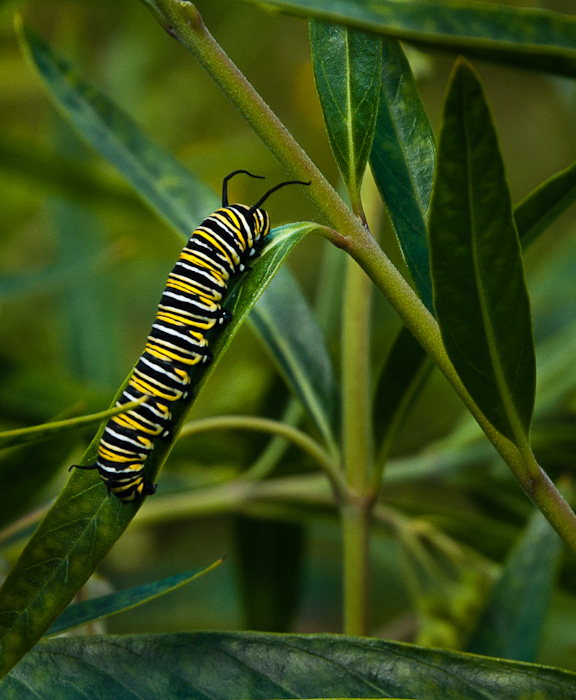
Almost hidden - white, yellow and black stripes - I had begun to wonder if I would see any this season...

A Monarch butterfly (Danaus plexippus) caterpillar surrounded by its food, the leaves of a swan plant.  Swan plants belong to the milkweed family, so called because of the milky sap, and they are often planted here specifically to provide for the very fussy Monarch caterpillars.  They feed almost exclusively on milkweed plants in order to get cardenolides, a type of cardiac glycoside, which they accumulate in their bodies.  Apparently this is required for successful pupation and transformation into the beautiful butterflies.  It is also a toxic substance - these plants are not for human consumption! 

In the small beastie world dramatic and eye-catching appearance often signals a kind of "eat me if you dare" message and generally means that being noxious to eat is their survival strategy.  Unfortunately for the Monarch cat (as enthusisasts call them), accumulating a toxic substance in your body doesn't stop some wasps, soldier bugs and the odd praying mantis from eating you.

Monarch butterflies are self-introduced to New Zealand - they appear to have island-hopped on the way and were first recorded here in 1873.  Their feats of flight are amazing.  And their severe decline in their native North America and Mexico is alarming.  So - having inspected a few swan plants and failed to see any sign of Monarch caterpillars this summer, it was a real treat for me to catch a glimpse of this one and a few siblings, all looking quite plump and close to pupating.

Milkweed or the Asclepiadoideae is a large family of plants with only a handful available in NZ. It is the host plant for the Monarch butterfly, which lays its eggs on the plant, and then the caterpillars begin to eat the leaves.

It is named for its milky juice, which contains alkaloids, latex, and several other complex compounds including cardenolides. Some species are known to be toxic. However, do not get the plant family confused with plants such as dandelion, sow thistles, portulaca and Euphorbia species etc. – all of which also have a milky sap.

- See more at: http://www.monarch.org.nz/monarch/species/monarchs/monarch-host-plants/milkweed/#sthash.198sgwKl.dpuf
Red algae (seaweeds) - not always red and not weedy

Names can be a problem.  Seaweeds are really important to our survival - producing half the oxygen we breathe, for a start.  But although "weed" is a term used for aquatic plants with no negatives implied, the word is more often used to describe problem plants - unwanted, bothersome ones that turn up where we don't want them and compete with the ones we do want.  And weedy can mean a bit pathetic, feeble. 

But put on a lightbox, the beauty of these overlooked plants is evident.

Plocamium microcladioides, I think, with characteristic side branchlets in alternating series of three.  Yes, it is this red naturally.

Polysiphonia strictissima with its lovely feathery looking branches and soft fine tips.  And yes, it is a red alga too - but the colour can vary from reddish brown to rich crimson, fading to yellow-brown.

A small sample indeed - there are about 900 seaweeds in New Zealand, many as yet not even named.  There is so much to explore and learn about the world around us!

A busy buff-tailed bumblebee on purple heliotrope flowers

I do enjoy bumblebees - their big hairy bodies and apparently slower flight give the impression that they are much calmer than the zippy focused honey bee.  And their movements can appear rather comical and awkward - they do seem to bumble along.  This one has been busy - it has collected a large clump of orange pollen on its hind leg, in what is often called the "pollen basket."

In addition to the pleasure I get from noticing and photographing, I enjoy learning new things. 

I didn't know that bumblebees belong to the genus Bombus (I love how that name fits them) and they come from the Northern Hemisphere and South America.  They were introduced here - four species of bumblebee were brought to New Zealand in 1885 and 1906 specifically to pollinate red clover, the first time any country imported an insect for this purpose.  The large earth bumblebee, Bombus terrestris, is the most widespread species here.  It is also called the buff-tailed bumblebee.  So that is what this one is, and why the stripe on the end of its hairy abdomen looks paler than I expected! 

Another pleasure - the wonderful vanilla-spice scent of the purple heliotrope (Heliotropium arborescens), which comes from Peru and is also called cherry pie plant.  I have never had a cherry pie, so don't know what it would smell like.  But these flowers smell lovely to me. 

The bee also seemed to find these flowers very attractive - I had a happy time watching its bumbling busy-ness, a feeling that is very familiar to me at present.

Weird clouds at sunset - pink and lenticular

Dramatic and a bit spooky - at sunset last night.

Lenticular clouds (altocumulus lenticularis) catching the pink from the sunset and looming over Island Bay.  Their distinctive shapes are often likened to alien spacecraft - the more circular ones look like the classic "flying saucer."

These dramatic clouds usually arise from the impact of mountains or hills on the flow of a relatively moist air-stream - they behave a bit like speed bumps in the road, causing a kind of bouncing up and down movement of the air flow which is sometimes called a "gravity wave."  The clouds form on the upside of this wave flow as the rising air cools.  Other phenomena such as tall thunderclouds or winds created by a front can also act as barriers which set off this wave-like air movement, but are a much less common cause of lenticular cloud formation.

Spectacular lenticular formations are often photographed on tall mountains like Mt Shasta in the USA.  Here on Wellington's south coast we don't have any tall mountains but we do have a great combination of frequent strong winds and nearby low mountain ranges - a good nursery for these interesting clouds.  A compensation for the recent turbulent weather.

An elegant thug - Lonicera japonica

Seen in the early morning, glowing in the shadows of a dense hedge - elegant white flowers and buds.  Alas, they belong to an introduced plant which is so successful at spreading and taking over that it has achieved a position on the New Zealand Pest Plant Accord as an unwanted species.

A very vigorous vine - Lonicera japonica, or Japanese honeysuckle. 

The paired flowers turn a creamy yellow as they age and are followed by little black berries.  Birds enjoy the berries then spread the seeds far and wide.  But that's not all - it is a climbing plant but also an effective groundcover, and the shoots root and take over more and more ground.  The flowers have a lovely fragrance and can look quite beautiful when seen close up.  But if you step back, you can see the thuggish nature of this honeysuckle.  Despite being in dense shade in a thick hedge this plant was looking well on its way to taking over. 

Fortunately there are many climbers with scented flowers that are better behaved.  So we are not left bereft if we get rid of plants with such aggressive tendencies.  And there is a helpful booklet that lists some of our native plant options, with regional variations - Plant Me Instead .  A great resource!

Colouring up - sunset and streaky clouds (cirrus radiatus)

The high streaky clouds - cirrus radiatus - tonight caught the light of the sunset (the sun was setting to the right and behind the viewer) and made a lovely pink sunburst pattern over the Orongorongos. 

Looking across Island Bay - you can see the beach and the fishing boats and the closest arm of the island, Taputeranga - towards Baring Head.  Everything is in the pink! 

Looking right, closer to the brilliance of the setting sun, the colour in the clouds is more intense.

Cirrostratus clouds - a bright abstract of pinks, golds, oranges and soft blue.  A summer sunset and promise of another lovely day.