World Oceans Day and Matariki

I have just found out about World Oceans Day - June 8 - a day to honour and protect the oceans.  Despite the great vastness and apparently endless abundance of the oceans on this watery planet, we humans have managed to cause lots of problems, so indeed the oceans do need our attention and care.  There is a website about it - http://worldoceansday.org. 

Saturday June 8 was also the day that Te Matau a Maui was formally welcomed as part of Matariki celebrations in Wellington.  It got there in plenty of time.  On the Thursday evening changes to the rigging suggested preparation for departure from Island Bay.

On Friday morning, from a hill above Island Bay, I was surprised to see a glowing red on the sea...

Te Matau a Maui was sailing - leaving the shelter of the bay and heading for the harbour entrance.  The low angle of the sun on a winter's morning brightened the red sails, reflected in the calm water.

In this image you can see how Taputeranga shelters the bay from the southerly storms to some degree, and it shows the rocky shoreline which can be a problem and hazard at the entrance to the harbour.  Beyond Taputeranga a ferry is heading to the South Island, and the morning mists are still evident on the Orongorongos.   What a wonderful corner of the beautiful ocean this is.

Matariki is the Maori name (thought to mean "the eyes of God" - mata ariki, or "little eyes" - mata riki) for the group of seven stars also known as the Pleiades or Seven Sisters.  The group appears low on the northeastern horizon, in the tail of the Milky Way, around the end of May.  It was traditionally a time to remember the dead and celebrate new life, differences in the appearance of the cluster of the stars were used to help with timing of crop planting, and it was also harvest time so it is seen as a thanksgiving celebration as well.  And these stars were important in navigation - Te Matau a Maui is a waka that is sailed using traditional methods of navigation.

Shelter from the storm - Te Matau a Maui at Island Bay

Te Matau a Maui is a waka hourua, an ocean-going voyaging canoe.  It is a 22 metre double-hulled vessel, launched several years ago by Ngati Kahungunu (iwi, or tribal group) to sail in a fleet of 7 canoes travelling the Pacific.  This week it sailed from Napier to join celebrations of Matariki (Maori New Year) in Wellington, due to start on Saturday.  But it was not able to enter the harbour safely because of a nasty southerly storm.  It diverted to shelter in Island Bay and on the grey and very windy and cold Wednesday morning, there it was among the usual fishing boats moored in the bay...

Lots of people were there, News crews were filming, everyone was bundled up against the cold.  But all on board the waka were fine - they had managed bigger waves in their travels.

Another view, the waka riding the waves close to the beach, behind it the iconic terracotta coloured bait shed, now a marine education centre, and the Orongorongos in the distance marking the route in to the harbour.  The crew in bright protective gear stayed with the waka.  They were able to secure it to a mooring offered by a local fisherman, and lines to his boat helped ensure that the waka did not beach.  The weather was very unpleasant through the following night too, but on Thursday it began to ease.

One of the local red billed seagulls that claim the seawall as their territory, feathers ruffled by the strong wind, surveys the boats as the sun breaks through.

Seaweeds upon seaweeds

The beaches along Wellington's south coast are often strewn with seaweed, often literally stacks of seaweed, washed up after a southerly storm.  A few days ago I came across this pretty sight on the sand at Lyall Bay, the colourful cluster of a small seaweed on the holdfast of a bigger brown one.

What were they?  I had to consult an expert for their names - thanks Wendy! and any mistakes are mine.  The leathery brown seaweed is Carpophyllum maschalocarpum.  Also known as the flapjack it is a common seaweed here, living on rocks in the low tide zone and coping with moderately exposed conditions.  Covering its holdfast are the glossy little beads of a green alga, Caulerpa geminata.  Unsurprisingly the pinky red ball structure is not a seaweed, and could be a sponge or a compound ascidian - closer inspection would be required.  Surprisingly, the pinkish tinge on many of the pretty green beads is caused by another kind of seaweed - an epiphytic nongeniculate coralline alga making a very fine pink coating on the beads. 

Closer up, another pink nongeniculate coralline alga is in view - this one a thick crust.  "Nongeniculate" means the algae are not articulated or branched, but are flat growths ranging from a few micrometres to several centimetres thick.  Crusty patches of such coralline algae on rocks in the intertidal zone can look just like patches of pink paint rather than living things.  Look for the blotches of pink paint next time you are exploring the rocky shore - when I started to look, there they were! 

Blades, beads, crusts, coatings - seaweeds come in a great range of sizes and forms.  And much of this we often don't notice or give our attention.  I was asked what I was photographing several times while getting these pictures and got a puzzled reponse when I answered "these interesting seaweeds."

And they can be edible too!  I haven't tried them but apparently the little green beads taste quite a lot like cucumber with a slightly peppery quality, and close relatives of this species are sold in markets across Asia and Pacific as a sea vegetable - either eaten fresh or in coconut milk.  Yum.

Burying little treasures

An autumnal activity at the Wellington Botanic Garden involving lots of gardeners:  prepare the soil of a number of beds,  measure up the planting areas,  define them with markers and strings,  arrange the bulbs in dense array in these areas,  start planting,  and keep on planting til all the little treasures are buried (at an appropriate depth.)

Then wait til spring.

A big bed, an abundance of tulip bulbs and a hard-working posse of gardeners (what is the word for a group of gardeners, I wonder?)

Another bed, more gardeners, and evidence of careful progress - bare soil behind the kneeling gardeners covering some already planted bulbs. 

A feature at the Botanic Garden in spring is the annual tulip festival, and this is where it all begins.  It is a fascinating sight - tulip bulbs in their thousands, like little parcels hiding the life and beauty that will appear, have to be planted.  The planting takes ages, even when so many hands are at work.  And it will be months before the brilliant display is seen - usually late September.

We have to get through winter before we get to enjoy the tulips - but it's a happy anticipation.

Beauty every which way

Winter is here, with a polar blast hitting the country - not too much of an exaggeration as the wind has an unobstructed path to us from Antarctica.  After the wind and cold there is sunshine, a crisp clear day.

The big waves have settled, but the water is still very active.  Looking across Island Bay, past the island Taputeranga, are the snowy hillsides of the Orongorongos.  When I stopped briefly to get this photo I was warmed by the delight of some young tourists who had also stopped their car to enjoy the sight.  One was wielding an iPad to capture some images.  "This way," pointed one of the friends.  "Hey this way too," said another looking in the other direction to the South Island with its snowy mountains.

And that, I think, aptly conveys the possible delights of life here on earth - even if there are no snowy vistas there can be beauty wherever we look, if we bother to stop and see.

Autumn colours and textures

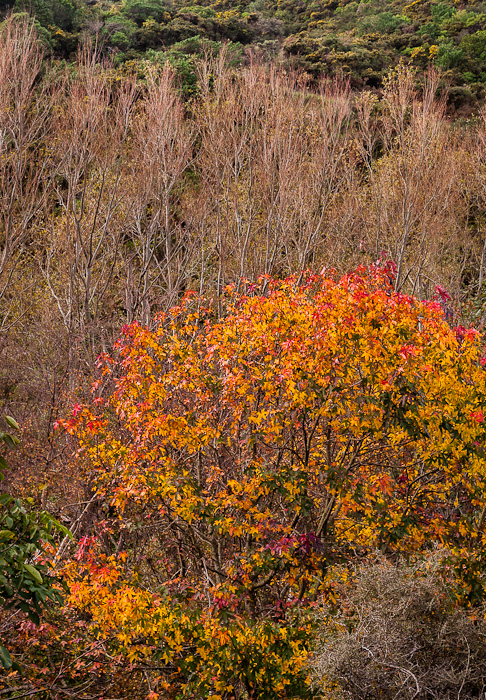
A flash of colour in the relative shelter of Happy Valley, by Owhiro Bay -     a liquidambar tree flaming in bright contrast with the trees and shrubs nearby.

Behind it are the upright bare branches of a line of poplar trees and behind them, down beside the stream are some willows - you can just see the soft gold of the willow leaves which have not yet fallen. 

Up the hillside beyond is the bright green of various shrubs with a golden gorse flower embellishment. 

At the front right there is a small coprosma with the typical divaricating tangle found in many New Zealand native shrubs.

The lovely warmth of the colours and textures stopped me in my tracks, to bask a bit in the pleasure of it, knowing that soon it will be winter and warmth will be more likely found indoors.

Batty or catty? The flowers of Tacca chantrieri

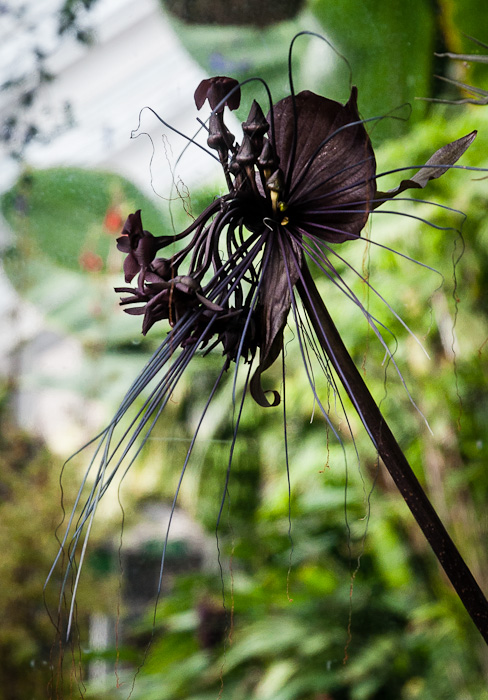
A striking sight in the Begonia House at Wellington Botanic Garden.  Not a begonia! 

The black bat plant, also known as cat's whiskers or devil flower.   

Black (or dark purple) is an unusual colour for flowers, and the flowers of this plant have a most unusual appearance. 

The bat-like wings are bracts and the long whiskery growths are filiform bracteoles - modified leaves.  They frame an umbel (cluster) of flowers - the lower ones have opened and are fading, the middle ones are wide open and above them is an array of buds that are yet to open.

The long leaves are a lush glossy deep green, but are not visible in the image. 

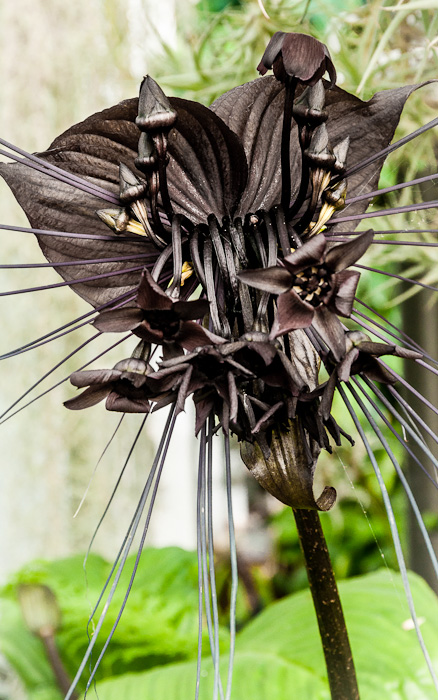
A closer view of the flowers and bracts, demonstrating the difficulty of photographing very black flowers...

This is a large perennial plant from South east Asia and it is found in the understorey of tropical rainforests.   It is quite popular as an ornamental plant but in the wild it is endangered because of habitat destruction.

The plant produces taccalonolides and these are being investigated because they show promising anti-cancer properties - microtubule activity which kills certain cancer cells but not healthy ones - similar to Taxol, a very important anti-cancer treatment  found in the yew tree.

So - losing this plant could have meant losing a promising cancer treatment.  How careless we can be with the treasures around us!

Cloudy stripes - indoors version? Zygopetalum flowers

To my eyes their patterns echo the rather clumpy stripes of the altocumulus undulatus clouds.  Otherwise they are a sight as different as can be - flowers of an orchid, Zygopetalum "Titanic" - or that was the cultivar name my plant was given when I got it fifteen years ago - but the accuracy of horticultural naming can be very erratic. 

The flowering spikes, longer than the leaves, have about six flowers cascading down. The colours of the flowers - dark maroon blotches on the green sepals and the big white lip with purple stripes and speckles - make them an arresting sight.  They have a lovely scent and last well. 

My plant seems to flower mostly in late autumn - apparently they are meant to flower in winter or spring.  But given that Zygopetalum come from humid forests in South America, and mine has lived in a rather cool and dry room, albeit with good morning light, it isn't too surprising that it doesn't necessarily conform to expectations.  Bold and nonconformist, it is delightfully reliable and uncomplaining and a source of great pleasure!

Stripes - altocumulus undulatus for the cloud-savvy

Hope I've got the cloud-naming correct - with the help of the Cloud Collector's Handbook (see parhelion post) and the good old internets.  A striking sight yesterday in the late afternoon...

They seem to arise in unsettled weather - harbingers of further rain - and appeared after a day of showers and sun, but rather muted autumnal sunlight.  "Altocumulus" refers to their altitude (mid-level) and that they are layers or patches of cloudlets, and "undulatus" describes the wave-shaped pattern.

Closer up, the stripey shadows on the hills of the Orongorongos.  The hills are still quite brown after the long dry, but there is some green appearing and the clouds suggest that there will be more rain to assist the grass.

After the rain - the greening begins

I had hoped that the Owhiro Bay hillside with the worst fire damage would be recovering with the rain over the last month.  But no such luck.  And there was also evidence of some erosion - since there isn't much topsoil above the sandstone base that is a great pity.  However near the macrocarpa tree which was by another badly burned area, there were signs of new life...

Closer up, the devastation's mostly monochromatic textures, jazzed up by the green of some grasses and a few recovering shrubs. 

I was being pretty unrealistic and impatient in my hope that real recovery would have appeared already.  It does look as though the gorse burned up most completely and it will be interesting to see which plants come through as the winter progresses. But I am pretty confident that spring will bring an amazing sight, a silver lining as it were - but it won't be silver.  (There is a daisy which I have mentioned on the blog previously - watch this space!)