Cyclamen persicum (species) in flower - subtle and fragrant

Cyclamen persicum, the species from which the big and bright florist's cyclamen cultivars have been developed, has a subtle and delicate flower.  Both the species and its cultivars are good house plants as long as you don't over-water them - Cyclamen persicum comes from places that tend to be hot and dry (Greece, Turkey, Syria, Israel, Jordan, Lebanon, Algeria, Tunisia) and it also doesn't like frost, athough The Cyclamen Society 1990 expedition to Israel found it growing in snow on the Golan Heights.

I got my first plant from the wonderful Joy Plants more than twenty years ago.  The tuber is now the size of a bread and butter plate and has scores of flowers in late winter.  I have also grown on some more plants from seeds that I have collected from the original.  There is subtle genetic variation reflected in slight flower and leaf differences in my cluster of plants.  In late winter they flower.

The upswept petals are like little propellers, the flock of flowers hovering over the leaves, filling the room with sweet perfume. 

Bright winter light on shrubs and grasses at Otari-Wilton's Bush

It has been a most welcome clear sunny day.  The lower angle of the bright still-winter light had the effect of emphasising the textures and shapes of a group of drought tolerant New Zealand native plants at Otari-Wilton's Bush.  As most of our plants are not deciduous there are leaves and colour (and not too limited a palette) throughout the year.

These mounding shrubs and tussock grasses are typical of those found in the "rain shadow" to the east of the Southern Alps in the South Island.  The effect of the mountains is to increase precipitation of rain on the west side, so the east gets much less rain and is much drier.  This means the plant landscapes on either side of the Alps are very different. The plants that thrive in the dry east tend to also do well here in Wellington with our drying winds.

I think they look great.  And although it's still cold, hints of spring are beginning to appear.

All good.

Cistus Snowmound - some early flowers and a happy honeybee

It isn't yet spring, but the days are getting longer, the light seems stronger (when the clouds aren't dulling everything down) and our plant of Cistus Snowmound already has a scattering of opened flowers.  This cultivar is a dwarf form of Cistus, but over the years the plant has spread into a big mound, several metres wide and densely covered with white flowers at its peak - hence the name. You can see how many buds (with pink sepals) are waiting to open. 

There were enough flowers already out to attract some honeybees.  This one really immersed itself in its food!  It was having a pretty good time as evidenced by the well-stocked orange pollen basket and the pollen coated hairs on its little body. 

I love seeing honeybees - they help fortify my hope for the future of the planet.

A tiny "bennie" - a Tasmanian lacewing - Micromus tasmaniae

Another storm and gales were beginning to batter the plants out in the garden.  A pot of yellow hyacinths was in flower, so I brought it inside to enjoy the bright colour and the rich fragrance.

Putting my nose up close in order to get a good long sniff, I noticed a tiny insect on the flowers.

I had no idea what it was.  Thanks to the internets, and a closer view...

Cute, delicate (7-5-10mm long), and named...the Tasmanian lacewing (Micromus tasmaniae).  It is a plant-grower's friend, feeding at night on the various aphids found on vegetable crops, field crops and pastureland.  It also feeds on psyllids living on crop plants and native plants.  Aphids and psyllids, although also very small in size, are sap suckers which attack in large numbers.  They can do terrible damage to plants. 

The Tasmanian lacewing, as the name suggests, came from Australia and is now widespread in New Zealand. It is welcomed by us humans as a useful biological control agent of aphids, a beneficial insect or "bennie."  I daresay that aphids, if they could speak, would not concur.

Everything is relative.

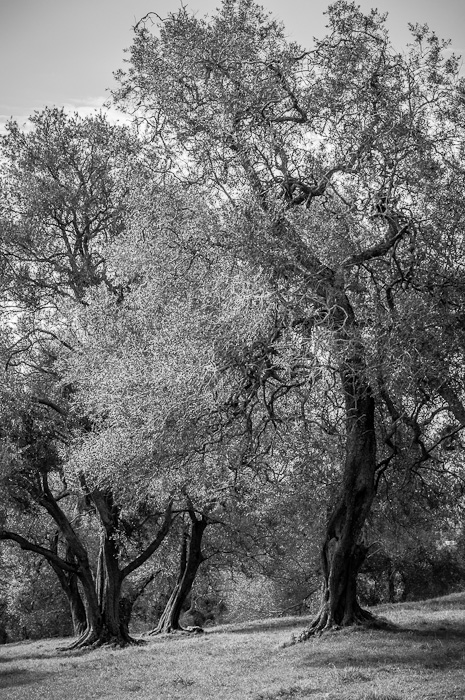
The folly of war - the peace of the old olive grove in Cornwall Park

August 4th, 2014 - one hundred years since Britain's declaration of war against Germany meant that New Zealand was caught up in the "war to end all wars."  And what was it good for?  Suffering.  Setting things up for more conflict in the world, and delivering overwhelming grief and loss - the deaths of so many, and the terrible impact of physical and mental injury on so many people - those who served and those who awaited their return. 

One of my grandfathers died of complications of his wartime injuries long before I was born.  My other grandfather (see "About"), who survived (Gallipoli, the Somme, Ypres/Paschendaele) was profoundly anti-war when I was growing up and the Vietnam war was in the news.

How foolish we humans are.  All this pomp and ceremony from our politicians and armed forces - I'm not sure what they are celebrating.  And still people are dying all around the world in so many areas of conflict.  Terror, death, injury, suffering.  It is so easy to harm, so difficult to heal.

This is a time when I find some peace in contemplating nature.

The gravity and peace of an olive grove - trees planted by Sir John Logan Campbell in Auckland's Cornwall Park, in the 1880's.  Black and white treatment for mourning.  Olives for peace.

Blessed are the peacemakers.