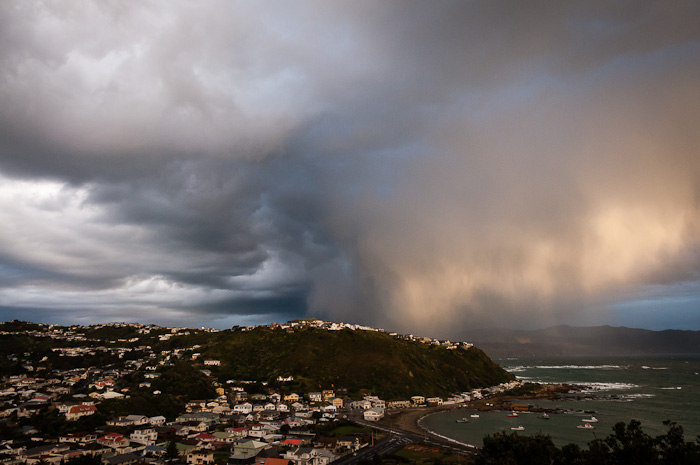
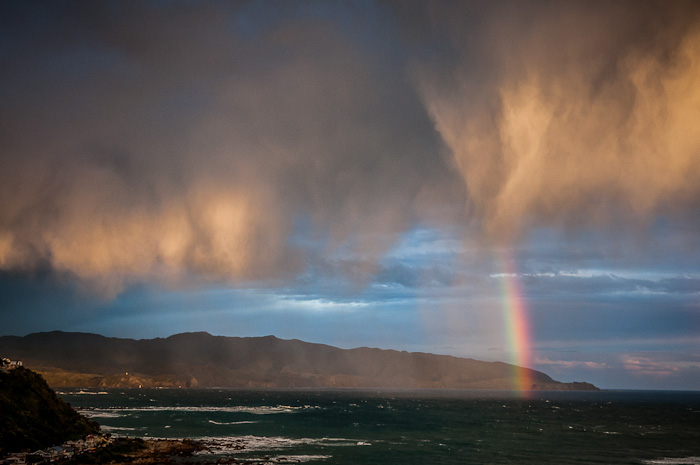
Buff-tailed bumblebees in pink and blue.

Spring weather is always a feast of changes and today we have been blessed by sunshine and stillness, with barely any wind.  Favourable conditions for plants and animals alike.  More and more flowers are opening, colouring the garden.  The tall Echium spikes are still blue with their little flowers, there is an abundance of pink flowers on my rose-scented pelargoniums, and buff-tailed bumblebees came out in force.
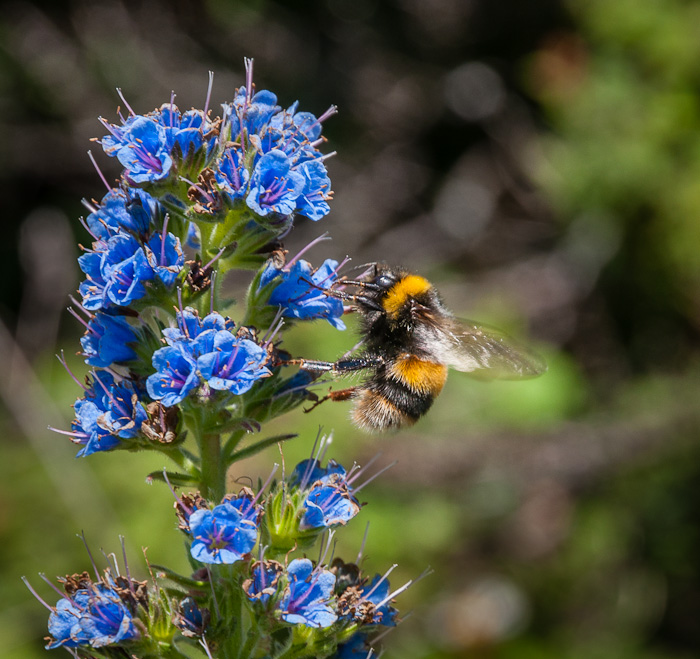
No doubt appreciating the kinder weather and the plentiful supply of food, they buzzed from flower to flower, sometimes dipping their heads in so far that all you could see was their little buff bottoms.
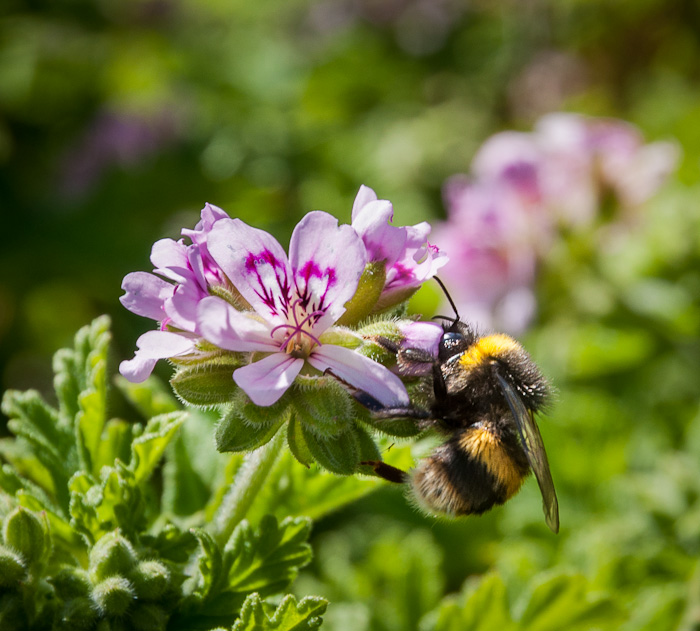
We are encouraged to plant food for bees whose job as pollinators is so important for our food supply.  Fashions in gardening come and go, but failing to include flowering plants is a loss for all of us.
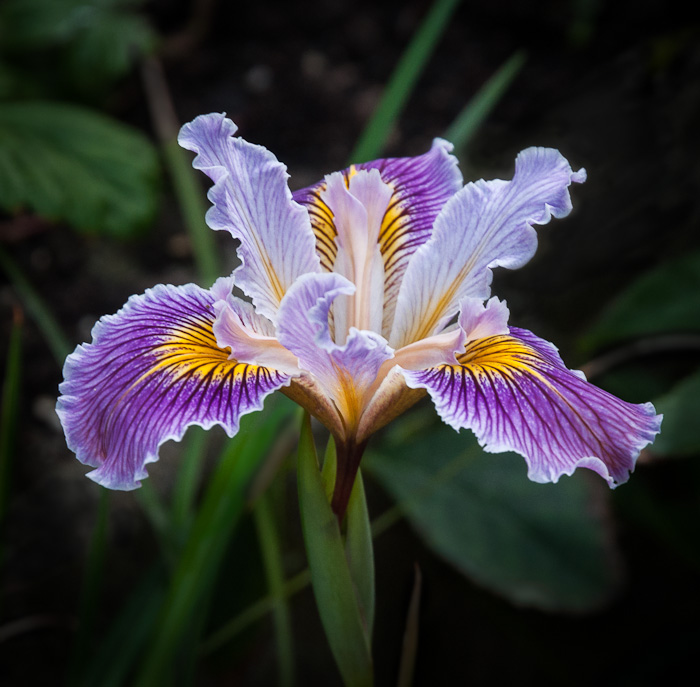
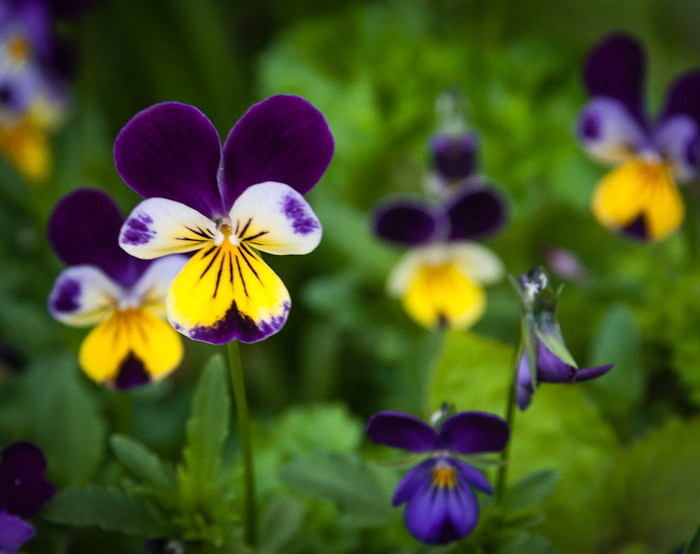
Little purple treasures in the spring garden - heartsease and Iris innominata

The burgeoning of new growth can make springtime a bit overwhelming - all these visual delights!  It is also a time of reckoning - have my little treasures survived the rigours of life in the windy coastal site where I live? 

So far, so good.  A particular delight right now are some lovely purple Iris innominata flowers - my plant came from Hokonui Alpines, a special nursery in the South Island.

A much less sumptuous purple flower, and much more abundant, is heartsease - Viola tricolor - from which the much larger garden pansy was bred.  This is a herb which has been used for a variety of medicinal purposes and the flower is edible too - a charming garnish.  It might be small but it is very persistent.  I bought a plant from a herb nursery about thirty years ago.  A constant companion since then, it travels with me, seeding enough to mean it pops up wherever I and my plants have gone, but never to the point of being a pest. 

The self-fertile flowers can be purple, blue, yellow or white and from that one plant I have quite a mix.  I think of it as having a very cheerful perky presence.  It has lots of other names which suggest it has that impact on other people too - they include: heart's delight, tickle-my-fancy, Jack-jump-up-and-kiss-me, come-and-cuddle-me, three faces in a hood, love-in-idleness, call-me-to-you, johnny jump up.  A little wild pansy with quite an impact!

One Wellington day - spring winds, god beams and rainbows

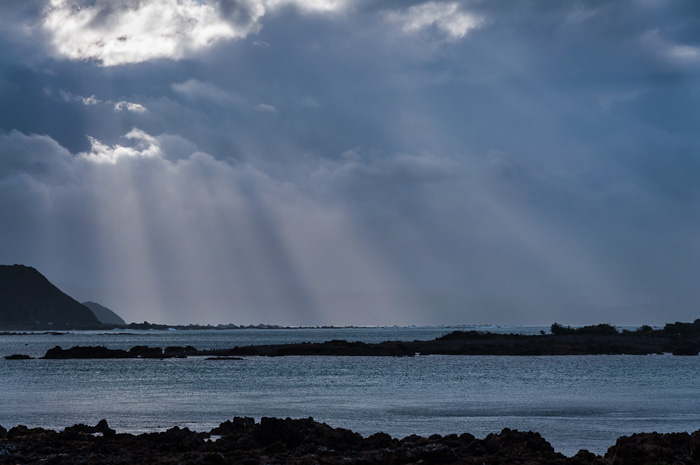
It started with a ferocious northerly, beginning to fade in the morning after a very stormy night.  As the clouds began to break, rays of light shone through in "god beams" over Island Bay. 

Then the clouds and mist cleared quite quickly, and the sky became a bright forget-me-not blue.  Looking towards the South Island a rainbow made a brief appearance.  A really lovely day - for a few hours. 

Then...

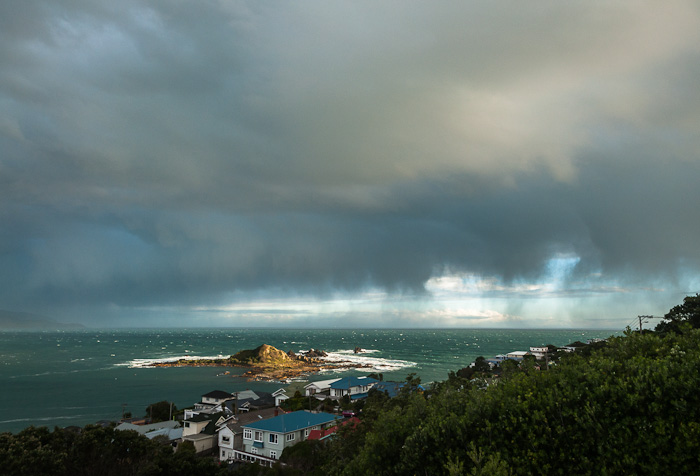
ominous clouds from the south, heavy and dark, with raggedy rain-bearing edges.

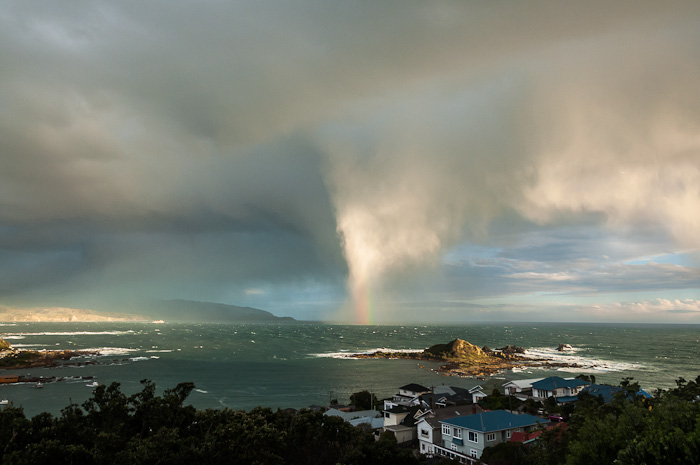
The wind picked up, the clouds advanced quickly and kept shifting and changing, creating an almost spout-like formation.

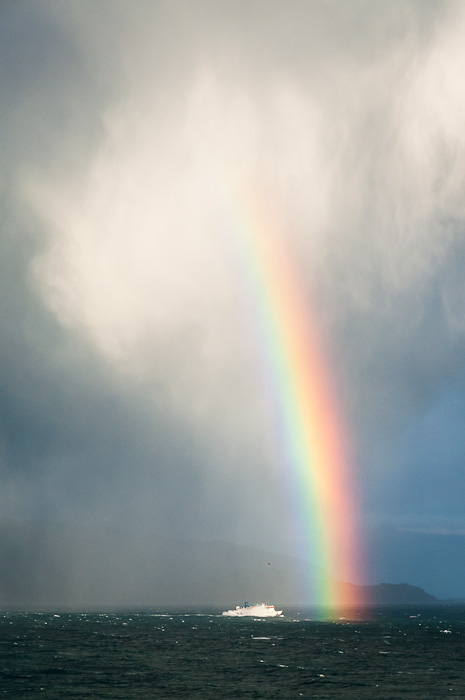
It was as if the spout-like formation was extruding a rainbow to snare the Interislander ferry passing by.

The ferries are used to dealing with the stormy weather of the Cook Strait between the North and South Islands.  And spring weather in Wellington is indeed very dynamic.

Sure enough - there was more to come - a darkness appearing to subdue the bright mist and the rainbow.

The light faded as the sun began to set, a pinkness apparent in distant low cloud beyond Baring Head.  The rainbow reasserted itself - the rain had broken although the clouds still had a threatening aura.

The colours intensified the way they do when the sun is very low.  And then the light show faded away. 

The winds were settling.  Knowing Wellington weather we anticipated a lovely clear day after the storm.  And it was.

Red & green - Kaka beak (kowhai ngutukaka) and shotgun conservation

Red and green stand for "stop" and "go" - pretty much the state of affairs for the attractive NZ native shrub, Clianthus maximus or Clianthus puniceus, known as the kaka beak or kowhai ngutukaka because the shape of the flowers evokes the beak shape of the kaka, a New Zealand parrot.  Red light - even though it is enjoyed as a garden plant, the survival of the kaka beak in the wild is seriously threatened.  Green light - people are trying to save it.  The Forest Lifeforce Restoration Trust (click to find out more) have come up with some creative tactics - and the use of shotguns is not for killing anything, but to access otherwise inaccessible places, away from the pests who find this shrub so palatable.

At Otari Native Botanic Garden here in Wellington there are many kaka beak plants and they are out in full splendour.  In dappled shade, the low spreading branches of this plant are fresh with bright green leaves and heavy with dangling crimson flowers.

Out in a brightly-lit open space more red and green is to be seen - at the back on a trellis fence covered with kaka beak and in the foliage of small shrubs framing another kaka beak plant.  The spear-like silvery leaves of the Astelias provide a sharp contrast.

Some people think New Zealand native plants are dull - maybe they just aren't looking.

In the pink - fresh new growth on Euphorbia glauca

Euphorbia glauca - waiūatua or New Zealand sea spurge or shore spurge - is a coastal plant endemic to New Zealand (endemic means it is native or restricted to a certain place).Because of habitat destruction it is in serious decline, but at the same time it has become quite popular in municipal plantings along Wellington's south coast.  It has a distinctive colour scheme - the green of its foliage varies in hue from a soft sage green through to vibrant blue-grey, the stems are pinkish red, and structures around the flowers are a wonderful contrast of deep red and purple.

This young plant, nestled in a hollow at the base of a large rock on Te Raekaihau Point, is just getting started - no flowers for a while yet.  But the fresh pink growth is very decorative I think.

Allium triquetrum - an attractive weed - edible too, if you like onions

Plants that we call weeds are generally plants that are rather too successful for our liking - pushing out the plants that we do want to thrive, popping up in places that are not of our choosing. Their presence can range in significance from being a serious menace to ecosystems through to the rather trivial problem of being unpleasing to the eye.  Generally weeds are plants that have been introduced by people to an area where they were not previously growing.  One that is grabbing attention at this time of year is the onion weed, Allium triquetrum, with its profuse display of pretty white and green flowers. 

There are other plants called onion weed, but this is the only one in New Zealand, it seems.  It is a bulb from the Mediterranean, naturalised here in 1899 according to the New Zealand Plant Conservation Network.  It grows happily in sun or shade, colonises disturbed ground, and spreads readily by seed or vegetatively. 

All the parts are edible with a mild onion-y flavour and when you are weeding or walk on it you get the pleasant (to me but not to all people) aroma of garlic.

Food forager Johanna Knox discusses its uses with Richard Scott on This Way Up on Radio New Zealand.

Attractive and edible, but alas, rather too successful.  In Victoria Australia it is listed as an invasive noxious weed.  It doesn't seem to have achieved that status here - yet.

International Day of Peace, the People's Climate March and a red sunrise over Island Bay

Red sky in the morning over Island Bay, a portent for more of our unsettled stormy spring weather.

Today, September 21st, is both the International Day of Peace and the day that people around the world will be participating in the People's Climate March.

I have little doubt that world-wide most people wish for peace, but it seems so hard for us to actually make peace.  A red sky in the morning is seen as a bad weather warning, and to me illustrates the state we are all in - the unsettled and dangerous weather of human aggression and reaction.  As I see it, real and lasting peace is not achieved by pummelling the "other" into submission.  In order for it to be achieved there must be the possibility that all people can have security and their basic needs met.  And the climate change which is upon us threatens to disrupt the security and lives of humans and all living things. 

I think we all need to heed the calls to action of the Day of Peace and the People's Climate March.  Peaceful coexistence in a world that is really cared for - achieving that is very challenging.  But we have named ourselves "Homo sapiens" - so let's start using some of that wisdom we claim to have!

Beachcombing at Lyall Bay - evidence of a quiet tragedy

Southerly swells often wash a lot of seaweed up on to the beach at Lyall Bay - but alas, there is more.

A mound of stuff, gathered as I wandered a few days ago on Lyall Bay beach (in the dog exercise zone) while my dog did his sniffing and exploring. 

I have the habit of picking up rubbish while we are there because, although it seems I accomplish very little, still it might save a seabird or some fish from being starved by filling their stomachs with unbudging plastic, or being throttled by the fiendish little pieces floating in the water.  I realised this after seeing the heartbreaking introduction to Chris Jordan's film-in-making, Midway, and since then I have been more alert to the danger - as plastic weathers it may break into very small pieces, but it never goes - it is always a threat.  Above is what I collected in an hour of gentle wandering.  The beach looked clean - it was only on looking closely that the rubbish was evident.

A small selection of the 431 pieces of stuff, from tiny to large, that I collected.  They are spread out to be seen more clearly - despite damage and weathering many are still recognisable everyday objects.  

People sometimes notice what I am doing and comment about me being "good" - but it is no big deal, my dog is exploring and enjoying the beach and I am too.  Most of this rubbish has probably not been left deliberately, but blown from rubbish bins, been washed out to sea in storm water, and so on.  We aren't being "bad," we just have too many risky products that end up damaging the life that is around us.

There is a big clean up/rubbish collection scheduled for Wellington's south coast this weekend, and all around the world - on International Coastal Clean-up Day, the third saturday in September. 

We also need to clean up the way we use and deal with materials like plastic that persist and cause the quiet tragedy unfolding in our oceans. 

Feeling spiky - Aciphylla aurea - taramea or golden Spaniard

Impressive to look at but it makes a less favourable impression if you get too close - Aciphylla aurea is a NZ native plant known as taramea in Maori, and as golden Spaniard or golden speargrass in English.  The long leaves are needle sharp (hence the scientific name Aciphylla - from the Latin "acicula" for needle and the Greek "phyllum" for leaf).  Those rosettes of spiky leaves around the the flower heads are also formidable.  You can see why it is called golden, but why "Spaniard"? you might ask.

Garden writer Sandra Simpson researched the use of "Spaniard" in naming Aciphyllas.  (My favourite of these for oddness of name is the "horrid Spaniard," Aciphylla horrida.  Its spines are indeed horrid.)  She wrote, 'The only reference I can find suggests it is "jocular", although the Reverend William Colenso, writing in a newspaper in 1894, calls the name "objectionable", preferring the Maori name, taramea.' 

So - not a lot of help. I imagine a soldier bristling with staves and spikes - but I have no idea why it would be a Spaniard.  Anyway, with upcoming elections and no certainty that we will elect a party with environmental concerns that will be acted on, I am feeling quite bristly and spiky myself.  But I still hope that the future will be golden - for our planet and for all living things.

Wellington colours - kowhai flowers and bus

It is a curious human habit to appropriate things and call them our own.  Wellington has claimed black and yellow as "our" colours.  Kowhai is the Maori word for yellow - and it is in glorious evidence right now with the spring flowering of kowhai trees around the city.  The rest of the year our buses, sporting teams and so on keep the bright yellow on display.  I snapped one of our buses climbing the Brooklyn Hill in central Wellington, echoing the kowhai flowers. 

There are eight species of kowhai, belonging to the genus Sophora, endemic to New Zealand.  Most are small trees, two are low growing or bushy, and some have a divaricating pattern of juvenile growth.  Kowhai are a popular garden plant, easily grown - in nature they grow in a wide range of habitats including river terraces, lake margins, hill slopes, flood plains and dunes.  One bushy species, Sophora molloyi, is found in a very restricted range on islands in the Cook Strait and on headlands along the south Wellington coast.  The smaller growth habit is probably an adaptation to the difficult growing conditions in these locations. 

Sophora molloyi is listed as "naturally uncommon" on the threatened plants list.  We are being encouraged to plant locally sourced native plants in our gardens, and since I live and "garden" on Wellington's south coast, Sophora molloyi would be a perfect plant for me to grow.  I think I might get it.  But I can't really delude myself that this would have nothing to do with my human acquisitiveness!