Subtle grace - silver tussock and shore spurge

With a quiet beauty but resilient enough to cope with the tough coastal conditions - two NZ native plants in a roadside planting down by the beach at Island Bay.

Silver tussock is Poa cita or wi.  It belongs to a large family of grasses, many used as pasture - a famous relative is Kentucky bluegrass.  This New Zealander is a tussock with dense tufts of fine silvery-green foliage, upright but flowing in habit.  Poa cita thrives in dry and difficult terrain.  I don't think anything grazes it - studies of Poa cita grassland in the South Island seem to suggest that sheep graze on non-native plants/weeds and actually improve things for the native plants, which thrive better in the grazed areas.  It shows us how important it is to test our ideas - I would have thought protecting the Poa cita grasslands from sheep would serve them better.  And I am sure that this is a finding specific to these arid zones where the less palatable Poa cita is being encroached by tasty introduced weeds.  In most other settings, grazing by introduced animals is pretty disastrous. 

Shore (or sea) spurge, or sand milkweed, is Euphorbia glauca or waiuatua - plants are often blessed with many names!  I love its colours -  soft grey green to blue green with reddish stems and tiny flowers surrounded by curious dark red/maroon cup-like structures.  It has a much more limited distribution - coastal cliffs, banks, sand dunes and rocky lake shore scarps. It is in decline - coastal developments, competition from introduced weeds, being eaten and trampled by introduced animals like sheep and possums...no help from the grazers for it.  But it has finally been recognised as an attractive plant for gardens as well as for amenity use (when Euphorbias were fashionable I used to humph about how it had been overlooked.)  This bit of human disruption might be helpful.

So - stories of survival in a small amenity planting, enriching the pleasure of what we see.

Shorter days - sunset seen from my office

We humans are light responsive creatures.  Some of us are more sensitive to changes in sunlight hours and day length than others.  Although I am fortunate and not badly affected by seasonal change, I do find the shorter days less attractive - and there is still a month to go before it is the shortest day, not to mention that winter hasn't really begun yet.  But then, it isn't so bad being inside when the weather is stormy and getting colder, and the winds do shape dramatic displays of rapidly changing cloud patterns.  These clouds caught the sunset in a brief display which lit up the sky, and I was able to catch the picture from my office window.

The lights on the tower beside the concourse to the stadium were redundant.  Nature's light show energised me as I returned to my work.  I find that even short moments of connection with the wonders of the world around us can be very sustaining.

Weather-worn but still sunny in autumn - chrysanthemum flowers

Brightening a corner by the path, some pale yellow escapees from my office - bought in one of those pots of tightly packed little chrysanthemum plants that produce an abundant flowering but then are pretty spent, and are not intended for the garden.  But they can happily grow on, given the chance.

And although they are a bit battered and worn, there is a rather defiant brightness to these flowers which are thriving despite the cold and wind and rain.

Muehlenbeckia astonii - food and shelter for a New Zealand katydid

I have written before about Muehlenbeckia astonii - one of a number of our native plants which has a divaricating pattern of growth where the repeated branching of the stems at wide angles creates a zig-zag thicket.  It is a wonderfully weird looking tangle of a shrub with wiry coppery brown branchlets, tiny heart-shaped leaves and little starry white flowers.  It is deciduous, so perhaps it was an autumnal thinning of the little leaves that allowed me to recently see something I had not noticed before...

A katydid! 

At first it was barely visible, although it is clear enough in this relatively close shot.  In fact, I counted eight katydids dotted amidst the shrub.  But they were so well hidden that you couldn't see them readily in photographs which I took from the distance required to include them all. 

This was a surprise.  Katydids are very good at munching their way through various introduced plants - my roses have been a prime target.  I have regarded them as attractive but a pest.  I hadn't even thought that the katydids I see in the garden might be native insects.  But Caedicia simplex, to give the proper name, is a New Zealander belonging to the family Tettigoniidae which numbers more than 6,400 species and is found on all continents except Antarctica.  The Maori name, I have learned, is Kiki Pounamu. 

Excellent camouflage is a feature of many katydid species.  Somehow, despite its size, the angular legs of this katydid blended with the angles of the branches, and the bright green leaf-like body (very well hidden on rose plants) blended with the massed effect of tiny green leaves.  The shrub offered added protection - a protective zig-zag wall.  I couldn't reach any of them. 

If finding it on the Muehlenbeckia was a surprise, the behaviour of the katydid was not.

Eating!  Not a pleasing sight, even if it does look very pretty with the backlight emphasising the patterns on its wings and exoskeleton. 

A closer crop shows this more clearly.

One theory about divarication is that it was an adaptation to protect leaves from the moa, an extinct very large plant eating flightless bird.  However, it is thought more likely that divarication evolved in response to harsh weather conditions, protecting the plant against desiccation and wind damage - Muehlenbeckia astonii is a tough coastal plant.  But the divarication and tiny leaves are no protection against small plant eaters.  In my reading this plant was described as an important host for insects, which in turn become fodder for native birds and lizards.  And deep-rooted Muehlenbeckia astonii can outlive them all - up to 80 years.

Transient beauty - autumn leaves on a flowering cherry tree

Soft golden-pink autumn leaves dangling in the early autumn sunshine - a flowering cherry in the Botanic Gardens, again in fine display.   Cherry blossom is celebrated for its transient beauty.  The beauty of the autumn colour is also a fleeting pleasure, and a reminder of impermanence.

When the leaves are blown by gentle winds, the fluttering colour reminds me of images of prayer flags in the Himalayas.  Perhaps it is a rather fanciful notion, but I enjoy the idea of them blessing us and the ground they land on.

Red, ripe and ready to harvest - Autento apples

Our little Autento tree has provided a delightful autumn display despite the recent storms and gales - not with the leaf colour - the leaves are dull and battered, but with a fine crop of gorgeous rich red apples.

I have written about this tree in an earlier post.  Since the inauspicious beginning to its life in our organic garden it has quietly thrived, disease free and productive.  The apples are delicious - aromatic, crisp and excellent keepers.  Just as long as we get to the apples before the birds...

In fact, this was the only one that had been eaten, perhaps because of ease of access - it was in the most prominent position on the tree.  The peck-marks suggested avian hunger and approval to me so I decided to deprive the birds of further opportunity and filled several bowls with delicious fruit. 

What a wonderful little tree!

April 22 (why not every day?) - International Mother Earth Day

I learned yesterday by chance that today is Earth Day - an annual celebration established by the United Nations, its full name actually  International Mother Earth Day.  Here it has not been well publicised, alas.  But it is intended to be a day of appreciation, awareness, action - focused on caring for this wonderful planet, our home, the environment which supports and nurtures us. 

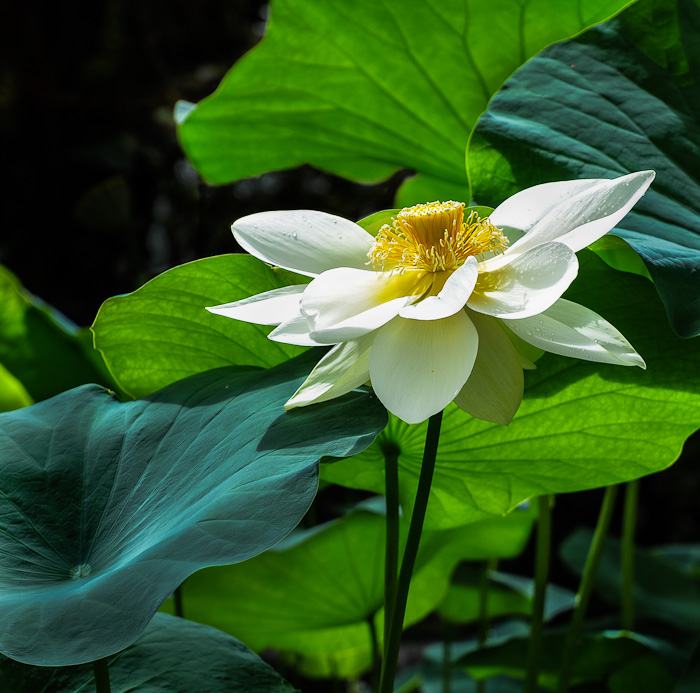
I have chosen to share an image of a lotus, this one growing in the Wellington Botanical Garden.

This remarkable aquatic plant (Nelumbo nucifera) is very beautiful and used by many peoples as a symbol to represent important aspects of life.  Growing in the muddy water of ponds and rivers, the roots flourish in the soil below, the tall strong stems reach up and out of the water into the air and light - lush leaves and bold sculptural flowers are held up to the sun.  In autumn the leaves die back and the seeds ripen and then are dispersed from the distinctive seedpods, and in winter the plant is dormant, hunkered down out of sight in the mud.

So the lotus can be seen to represent:  the elements on which we depend - soil, water, air, sun;  purification - the pristine flower arising from the mud;  the cycles of life, death and rebirth;  interdependence, our need to accept that the beautiful and the unattractive are part of the whole (there is no lotus without mud). 

And if we study further, it illustrates the complexity and wonder of the natural world that we so often fail to discover.  It has remarkable attributes:  thermoregulation - the temperature of the flowers is controlled - they are kept warm despite the air temperature, presumably to attract pollinating insects;  the lush textured leaves repel water and are self-cleaning - this capacity has been studied and used to inform technological advances;  the roots provide food for us;  the lotus shows remarkable longevity and resilience - a lotus plant can live for over a thousand years, lotus plants can revive after a prolonged period of stasis, and a seed from a lotus that was over a thousand years old was successfully germinated.

All of this is just a glimpse into the wonder that is this plant. 

When I think of Mother Earth I think of the wonder of each and every aspect of the life on this planet, and I wish that we would treasure and protect the life here that we humans are a part of.

There's thunder in them there clouds - cumulonimbus cloud drama

The remnants of tropical cyclone Ita brought "severe" weather - wind and rain - to New Zealand at Easter time.  Wellington is used to storms and we didn't fare too badly.  We even had some most welcome very settled periods.  It was early evening - not much wind, quite mild - and I was pottering in the garden, focused on the ease of working the moist soil.  Then I heard "look at those clouds!"

Rolling in and building up rapidly before our eyes - pretty fluffy cumulus clouds turning sinister as they gained height and blocked the fading sunlight.

I'm shaky on cloud identification but my research suggests that they were forming into cumulonimbus capillatus clouds - tall with a raggedy top, very threatening and in fact about to produce lightning, thunder and rain.  I retreated.

A royal visitor - a Monarch butterfly in our garden

It is autumn, a good time for planting shrubs - they have time to settle in with the rain and our relatively mild winters before the spring gales stress everything.  I had some swan plants ready as I want the garden to be more welcoming to Monarch butterflies next summer - none had visited our garden this year despite a butterfly-friendly abundance of flowers.  But I didn't have to wait till next summer - the swan plant foliage was being devoured already.  One hungry caterpillar was at work, its little black filaments waggling as it munched, the claws on the front legs seeming to direct the leaf to its mouth...

They might be fussy about what they eat (basically just milkweed plants thank you) but they are not what you would call fussy eaters - "eating machines" is one epithet.  The caterpillar (also known as a larva and called an instar if it is between moults) demolished much of the still modest sized swan plants, then disappeared.  Apparently they often go walkabout before the next stage.

Not too far away, the caterpillar had climbed into a plant of Ballotta pseudodictamnus, a pretty little shrub with grey-green leaves covered with soft white hairs.  Its rear prolegs were hooked into a dense white silk mat that it had woven on a leaf and the caterpillar, now called a pre-pupa, was dangling down, ready to go through its fifth moult to emerge as a green pupa.  You can see that change is afoot - the skin (exoskeleton) looks a bit more transparent, the pre-pupa is paler and lacking the healthy glow of the earlier instar.  Fortunately the autumn rains (hence raindrops) did not cause any problems. 

Next stage - pupa!

The soft stripey skin was shed to reveal the harder protective exoskeleton of the green chrysalis or pupa, blending well with the foliage - except for the bling.  Apparently the gold  and black band marks the end of the abdomen and the other gold spots occur over the thorax, the wing bases, and the eyes. When fully developed the butterfly emerges head first from the lower end of the chrysalis.  You can see the pattern of the wings through the transparent shell.

I had read that the pupation stage for a Monarch butterfly was about two weeks.  So when a month had passed, and the chrysalis looked black and lifeless, I had given up hope - it was too cold and wet I thought (the weather had suddenly changed.) 

And it turns out that the weather does indeed affect the pace of things.  The butterflies take longer to emerge (eclose) in autumn.  But if they survive the nastier autumn conditions they will then live much longer than their summer siblings.  They have a big task - keeping the population going by migrating and overwintering in warmer locations, ready to get started when winter is over. 

Not knowing this I had stopped checking, and I was very surprised one very wet morning, to see...

I am tempted to call this the "empty nest" - technically it is the "exuvium", the protective pupal exoskeleton no longer needed, metamorphosis complete.  So the butterfly had gone, just the imprint of its wings left behind.  But had it flown? How could it survive?  It was horrible weather - gales and rain and mist.  My heart sank.  I had read that cold and moisture can be deadly for them. 

But it is all relative.  I had forgotten that they are also tough little creatures.  They have been seen by glider pilots at 11,000 feet above ground.  And they are known (like glider pilots) to catch thermals which lift them up high to the strong winds - but only the wind heading in the right direction (how do they know?) for their migrations covering distances as great as the journey from southern Canada to central Mexico.  And then it didn't take long for me to catch a glimpse of orange through the tangle of grass being buffeted by the wind.

The imago - an adult Monarch butterfly.  Out only a few hours, apparently, with wings not quite completely expanded (butterflies emerge or "eclose" with rumpled little wings and haemolymph is pumped into the wing veins over several hours to expand and stiffen them) and sheltered near the empty chrysalis.  I was worried about how the wind was whipping the long brown leaves of the native grass (Carex buchananii) around and disturbing the butterfly's balance.  But somehow she held on, keeping down and away from the wind and rain.

She moved a little, occasionally fluttering her wings - but not very open.  This protected them from damage and anyway, butterflies need warmth to get moving, and there wasn't any!  But she seemed to be exploring - coiling and uncoiling her proboscis.  And those eyes - what does she see, I wonder.

You may ask - how do I know this is a female Monarch? 

I know because of her wing markings - the stripes on the wings of a female are thicker and don't have the spot on them which marks the males.  This moment was a rare one - a glimpse of her wings outstretched.  Mostly she barely moved and huddled, conserving energy and avoiding damage by sheltering down a bit and out of the wind, with raindrops on her antennae and her hairy thorax.  It didn't look promising for her.  But the next morning, she was gone. 

So - we were visited by a Monarch (butterfly) - and a monarch (human) of the future.  Her emergence coincided with a visit of William and Kate, royals from England (a hangover from our colonial past.)  The really wet weather has coincided with their visit - to the point that people from the drought beleaguered areas of Northland jokingly suggested that William and Kate go up there and take the rain with them.  If she has the chance, this lovely little lone butterfly may fly north too, and join the other overwintering Monarchs in a warmer part of New Zealand.

Fresh green fronds of wheki, the rough tree fern

Although the days are much shorter and the colours of autumn are beginning to appear, we are still enjoying warmth and sunshine.  The mostly evergreen New Zealand plants can look subdued when the sky is grey, but sunny days highlight the textures and brighten the different greens.  However, even in the shade of the bush there is fresh green to be seen.  Unfurling new fronds of wheki (Dicksonia squarrosa) glow against the deeper green of the mature fronds and the bristly brown hairs of the frond stalks.

Wheki is also known as the rough tree fern.  Presumably this is because the texture of the fronds is quite harsh to the touch, but the plant itself can also look a bit "rough" too - old and dead brown fronds hold on to the trunk, giving a raggedy look - not the thick skirt of dead fronds typically seen on the related wheki ponga (Dicksonia fibrosa).  Wheki is a medium sized tree fern found throughout New Zealand, often near streams and in damp places.  It is also quite resilient - bare trunks are used for fencing, and they can quite delightfully come back to life, sprouting from buds on the trunk. 

The trunks are slender and up to 7 metres tall.  The fronds of wheki, 1.5 to 3 metres long, are smaller than those of other tree ferns and they grow in almost horizontal array.  Wheki can cope with some sun and wind, but it shows - they tend to look more weathered and scruffy.

This one, in the fern glade at the Otari Native Botanic Garden here in Wellington, is in an ideal situation - a sheltered shady area that is not too dry.  Here the filtered light highlights the textures and shapes of the fronds, which seem to sparkle against the darkness of the shade cast by the big trees above them.