Spidery orchids

Although the conservatory at the Wellington Botanic Garden is called the Begonia House it shelters a wonderful range of tender and tropical plants.  The attraction of their exotic colours and shapes, not to mention the shelter and warmth provided for them, is particularly strong in winter.  When I visited it this week, the busy web of spidery white flowers in front of more familiar orchid shapes caught my eye.
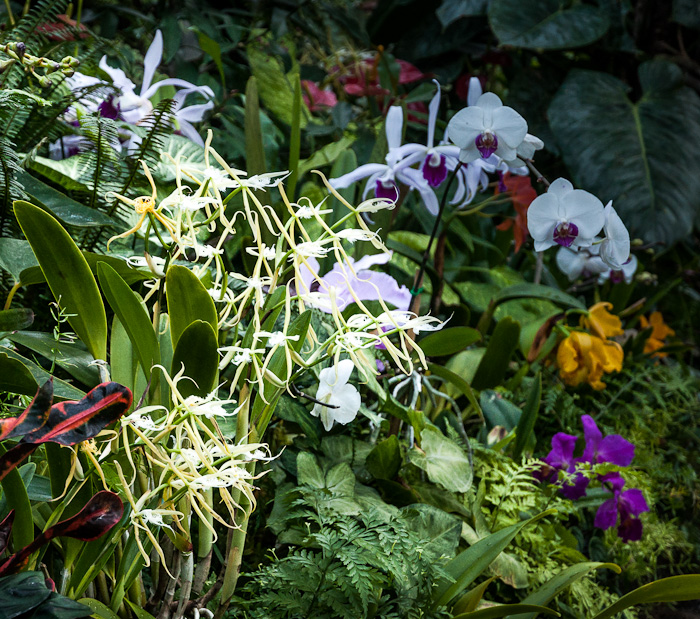
The label said Epidendrum ciliolaris, but I subsequently read that in 2004 it was renamed Coilostylis ciliaris.  It is also known as hairy-lip epidendrum (!) or fringed star orchid.  It is from Central America and South America to Brazil.  It grows in wet warm conditions, and flowers in winter and spring.

The white and whitish green flowers are fragrant at night - attracting moths which pollinate them.  But it was daytime and I could not detect a perfume.  They were in the warmest most moist area of the conservatory - I think of it as having a lush jungle-y feel. 

Tillandsias, the so-called air plants, grow without soil and perch on other plants but get no nourishment from them.  Their leaves are narrow and greyish in colour and in the conservatory they are displayed on a stylish metal frame, so the area has a very different feel - drier, more austere.  But lo, another spidery orchid was to be seen there...

Cirrhopetalum Elizabeth Ann 'Buckleberry'.

This is a hybrid which gained the highest award given by the American Orchid Society.It is apparently easily grown, and the photographs online, taken by enthusiastic orchid growers, show plants with many of these dangling groups of flowers.  But I have little other information about it part from the fact that it is also epiphytic and the name refers to the fringed petals - a naughty mix of Latin (cirrus - fringe) and Greek (petalon - petal).  The namer was not a purist.
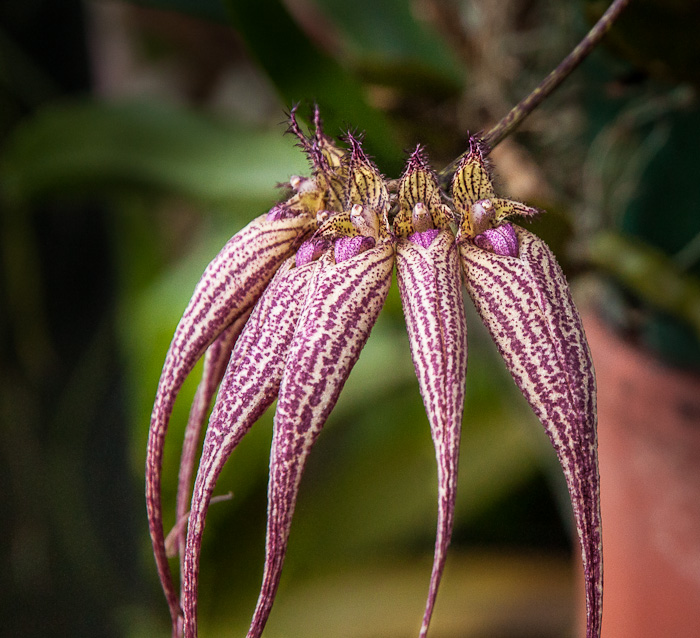
These flowers are like the Coilostylis in that they both feature fringing and what I think of as a spidery appearance - but how different they are.  I started wondering about my use of the word spidery.  I was not suggesting they they were infested with spiders - one meaning in the dictionary.  And they don't look like a fine spiderweb, as in spidery handwriting.  But yes, the long narrow shapes could be a bit like a spider's legs.  Just not too literally. 

And now, back to winter - another severe southerly storm is predicted.

A firm footing - macrocarpas on Maupuia

A lot of big trees fell or were badly damaged during the recent severe storm and most of them were exotic conifers.  Curiously the two most common exotic conifers in New Zealand are the Monterey pine (Pinus radiata) and the Monterey cypress (Cupressus macrocarpa).  Both have a very restricted natural range (in the case of the macrocarpa, to Monterey on the coast of California - more specifically Cypress Point at Pebble Beach and Point Lobo near Carmel) where the native populations, relics of much larger forests, are under threat.  However, in New Zealand, they have both thrived and sometimes seem to be rampant. 

Macrocarpas are tolerant of harsh coastal conditions.  They were introduced here in the 1860's and were often planted in windbreaks on coastal farms where their spreading branches and quite dense foliage also gave good shelter for stock.  There are a lot of large macrocarpas in Wellington's town belt, and a number of them growing on Mt Victoria have been seen world wide - they featured in the first "Lord of the Rings" movie.  On the coastal road along the Maupuia peninsula, between Scorching Bay and Mahanga Bay, two macrocarpas put on a different show...

They are growing in a rocky outcrop - straight from the rock - who needs soil?  Closer up, the disruption of the rock by the roots is evident.  Thus they create the conditions for the tree to survive...

The cracks in the rock, fractured by the strong roots, will catch water.  Some of the minerals in the crumbling rock are presumably available to be taken up.  And there is plenty of sunshine.  On the other hand, there is salty spray and harsh wind - burning of foliage is evident on even the most resilient plants along the coast since the big storm, some absolutely devastated as if by fire.  Neverthless, these trees are of decent size, and do not seem to have been daunted by the storm.  Impressive.

Rose "Summer Passion" - in midwinter!

In the rose garden at the Wellington Botanic Garden a few of the roses have a few blooms left - despite it being midwinter and the bushes being bare of leaves.  A pretty pink rose caught my eye.  I haven't noticed this one before.  I smiled - it was a surprising sight and a sweetly incongrous name...

Rose "Summer Passion," bred by New Zealander Gina Martin.  It is said to flower well all season - and beyond, if this is anything to go by. 

Roses tend to be much tougher and more resilient than people give them credit for and out of season flowers can be a real delight, although they are often smaller and different in appearance because of the harsh conditions.  "Summer Passion" is described as a floribunda in style, the flowers large and pink with apricot centres and some scent.  The registered name is MARquizzical.  I look forward to the first flowering of spring and will be sure to look for more "Summer Passion"!

Calm evening colours

n Wellington the wind direction has a major impact on how the day will be.  Southerlies - cold, fresh.  Northerlies - warmer, fractious.  In between winds - calm, the light often clear and sparkling.  Yesterday was a settled day and the evening was calm and soft.  A pink sunset coloured the water and the scattered clouds, making pink and purple stripes.

Looking across Island Bay to Baring Head, the light fading.  The stripe at the horizon is the last light of the setting sun - the west is to the right of the photo.   Out to sea, it is even more peaceful and soft.

A magical hazy shimmer, as the evening closes in.

Lyall Bay after the storm - sand loss, seaweeds (and a sheltie)

Lyall Bay beach is long, and one end is a walking area for dogs off leash - usually a sociable exercise area for humans and dogs alike.  But after the recent severe storm, big changes...  

Severely eroded sand dunes with pingao - golden sedge - dangling unsupported where it had been growing on the pre-storm dunes.  The usual steps down onto the beach, now piles of boards flat on the sand, showing how far the dunes used to extend.  The old weathered steps that we used to get onto the beach had been completely covered by the sand - I had no idea they were there.

But this was not the only change. 

Alfie the shetland sheepdog was curious - what's this?

Mounds and mounds of beached seaweeds (as well as some sponges - I even saw sea cucumbers and a sea horse.)  The turbulence of the water during the storm must have dislodged masses of seaweeds which were subsequently washed up on the beach - like a fallen forest.

Alfie found a great deal to explore and sniff.  He is a middle sized dog, so you get some idea of the size and extent of the dying seaweed.

Hundreds of plants that we usually don't see - a reminder of the abundance of life under the sea.

Colourful decay

Seen on a silver birch stump, in the bright light of a midwinter day, a lovely golden orange-brown clump.

Closer up I could see that the fungus, itself evidence of decay, was ageing and heading towards its own decay.  It was wrinkled and dry looking, with broken bits and spider web strands. 

Fungi are a very important part of the cycles of death and life - releasing the nutrients from dead plants so they are available for new life.  Many fungi can be eaten with great pleasure.  But also with care - many are very toxic to us humans.

This one could be an aged Flammulina velutipes, but I certainly wouldn't bet on it.  Cultivated forms of Flammulina velutipes are called enokitake in Japan, or "golden needle mushroom" in East Asian cookery. Grown in cold dark conditions, the resulting clusters of mushrooms are very pale and delicate looking with elongated stems and small caps.  So who would guess they were the same species as these clusters of rather squat weathered orange-brown mushrooms?  Wild Flammulina velutipes mushrooms apparently don't taste as good as the delicate cultivated ones.  Given how many poisonous fungi there are, I'll stick with the properly identified ones! 

Supermoon!

Things have been busy and so I didn't expect to have time to get a good image of the "supermoon," so called because the moon was both full and at perigee - its closest to earth, on 23/6/13.  But as luck would have it, I was passing Te Raekaihau Point and Princess Bay as the sun was setting.  It was very pretty and I was very tired, so I stopped to breathe and enjoy the scene looking south past Taputeranga - barely a cloud, the sky a soft pink, a hazy coolness from the sea spray - a lovely calm after the storm.

Seaweed, rocks, and other sea-borne debris littered the broken paths - evidence of the ferocity of the recent storm.  Turning around, I saw the rising moon.  It did look bigger than usual, and dwarfed the Pencarrow lighthouse, which is the white dot on the left hand side of the image.

The light was bright, and it cast a soft glow on the wave-like wind sculpted shrubs on Te Raekaihau Point. 

A telephoto lens on a tripod would have given one of those dramatic photos showing the moon as huge, and I could have organised a clever foreground to contrast with it - but too bad.  Not a very super image, but it was a super invigorating sight, and that is absolutely enough.

A stormy anniversary

Full circle - it is the shortest day of the year, and a year since I started this blog.  And here in Wellington we are recovering from a severe midwinter storm - the worst here in almost thirty years - wind gusts reaching 200 km per hour, waves of 15 metres.  Damage - roofs blown off, windows blown out, trees down, electricity supplies cut, landslides, seabirds battered and dumped by the wind and the waves, and so on, but still plenty to be grateful for - lots of risk and close calls, but no loss of human life. 

All that energy!  Without the sound effects it is hard to convey the fear-inducing power - apparently the isobars were lining up from the Antarctic ice to us in a most unusual (thank goodness) formation, that led to very heavy snowfall in the South Island, and dramatic weather in most parts of New Zealand.  Here on Wellington's south coast we get the full force of the southerly storms.  Along from Island Bay the coast road is very vulnerable, but even at our usually peaceful beach there was drama...

Storm swells battering the Island Bay beach.  The seawall was breached during the night and the orange arm of an excavator can be seen, moving the rubble and working to plug the extensive gap. 

In the curve of the beach there is an area of relative shelter from the island, Taputeranga.  Here fishing boats rode the turbulent waves.  Seaweed in large quantities washed up on the shore, but no boats. 

With extensive experience of trying to capture the drama of storm waves in photographs, I was realistic - you can be almost unable to stand in the wind, and the image will look quite peaceful!  But I tried.

With the glistening spray the waves can look playful (just watch that camera!) 

There is a grandeur to the scene with the dark brooding skies and the contrast between the white foaming water and the rugged rocks.

And there is drama, an ever changing scene, waves crashing against the rocks, curling and splashing.

All that energy, the huge forces that shape the environment around us, being made more intense in their effect on us by our effect on the environment. 

Chastening.

Winter colours - paperwhite and soft bud green

In several days it will be the shortest day of the year - although it takes a while for this to be noticeable, I am encouraged and look forward to longer days and more light.  Late this afternoon I enjoyed a quiet wander in the Bolton Street Memorial Park, which is the site of Wellington's first colonial cemetery.  It is a quiet wooded space sitting between the motorway and the city centre below, and the Botanic Garden above.  People in their office clothes walk up the steep hill on their way home from work, joggers trot past, dogs are walked, and amidst the old graves and memorials are heritage roses and other cottage style plants, many dating from the colonial era.  It is definitely winter now, but autumn lingered - gold and amber foliage on the rose Tuscany, bright red viburnum berries shining in the fading light.  But the chilly looking silvery bare branches and white bark of a silver birch were in keeping with the wintery cold.  And then - signs of life, reminders of spring...

In the increasing gloom the luminous white flowers of paperwhite narcissus - Narcissus papyraceus, growing by a path.  Originating in the Mediterranean, they are relatives of the daffodil but flower here in winter and early spring.  Their strong fragrance is not appreciated by all - but I love it!

They do tend to nod anyway, but heavy rain has added to their rather subdued pose.  I had to kneel down to see their faces.

And the soft green of these rhododendron buds, unbowed by the rain, a refreshing reminder of the new growth to come. 

But before spring, more winter.  A polar blast with wild winds and snow is forecast for the end of the week.  Snow might even fall in Wellington.  Brrr.

Follow that waka!

It remained sunny and calm when Te Matau a Maui completed the journey in to Wellington Harbour.  I was moved by the sight of the red sails contrasting with the familiar folded hills and jagged rocks of the landscape, the waka so small in comparison.  I reminded myself that this little vessel has safely travelled the not-always peaceful Pacific and I thought too of the journeys of the ocean going waka that brought the ancestors of the Maori people all the way to Aotearoa/New Zealand from afar, centuries ago. 

The image above is looking across Wahine Memorial Park.  The waka is approaching the notorious Barretts Reef (more correctly Barrett Reef) or Tangihanga a Kupe, at the entrance to the harbour.  An interisland ferry, the Wahine, was caught in an extremely severe storm.  Unable to enter the harbour, it was grounded and damaged on the reef and subsequently capsized.  Despite being so close to safety and the valiant efforts of many rescuers, 53 people died from drowning, exposure and injuries.  This tragedy was in 1968 but is still vividly remembered.

Safely past Barretts Reef, the Te Matau a Maui is approaching the rocky outcrops of Point Dorset - they give an indication what lies under water.  But after this, into the wide open spaces of the harbour.

The misty sunlight softens the hills - it isn't pollution - Wellington's winds keep the air very clear!  The waka has just passed Matiu/Somes island.  The mountains in the misty distance are the Tararua Ranges.

Into the bustle, a contrast of styles - passing an outgoing interislander ferry, and approaching the port...

From the shore near Oriental Bay the view is now looking away from the sun, so the bright blue sky is evident.  But the misty conditions still blur the hillside northern suburbs and Mt Kaukau, with the television transmitter on its summit.  From another angle, the destination can be seen...

An intrepid oystercatcher on the rocks by Oriental Bay, focused on food and not on incoming waka.

Coming in to dock at Chaffers marina, the crew are welcomed from the shore, prayers are said, and to the haunting sound of a conch shell, they arrive.

With the sun behind, lighting up the brilliant red sails, the design by artist Sandy Adsett can be clearly seen.  But very quickly, the waka is tied up, the sails are furled, and the crew are being interviewed by TV journalists, with people clustering around the dock to greet them and to admire the waka.

Close to Te Papa, where the festivities took place, and with the "Beehive" government building in the background, Te Matau a Maui is in effect in the middle of the city. 

Why have I focused so much on it?  I think because the traditional construction and scale of the waka, and the traditional navigation used to sail it, remind me of some important ingredients in the recipe for living well on this earth - awareness and observation of the environment and using this knowledge - being attuned and connected with nature, recognising that we are not always in control and responding with patience and respect to the forces of nature, being able to enjoy the environment without causing damage.  And, of course, the art and the craft evident in the making of Te Matau a Maui.